You've been diagnosed with sleep apnea. Now comes the question that trips up so many patients: which treatment should you choose?
For most people, the real decision comes down to two options, CPAP (continuous positive airway pressure) or an oral appliance. These are the two most widely used, most studied, and most accessible treatments for obstructive sleep apnea. Everything else is either more invasive (surgery), more restrictive in who qualifies (Inspire), or less proven.
CPAP and oral appliances both work. Both have decades of research behind them. Both are covered by most insurance plans. But they work in fundamentally different ways, succeed for different reasons, and fail for different reasons.
Choosing between them isn't about picking the "better" treatment, it's about picking the better treatment for you. This guide breaks down everything you need to know to make that decision.
How Each Treatment Works
Understanding the mechanism helps explain why each treatment has the strengths and limitations it does.
CPAP: Pressurized Air
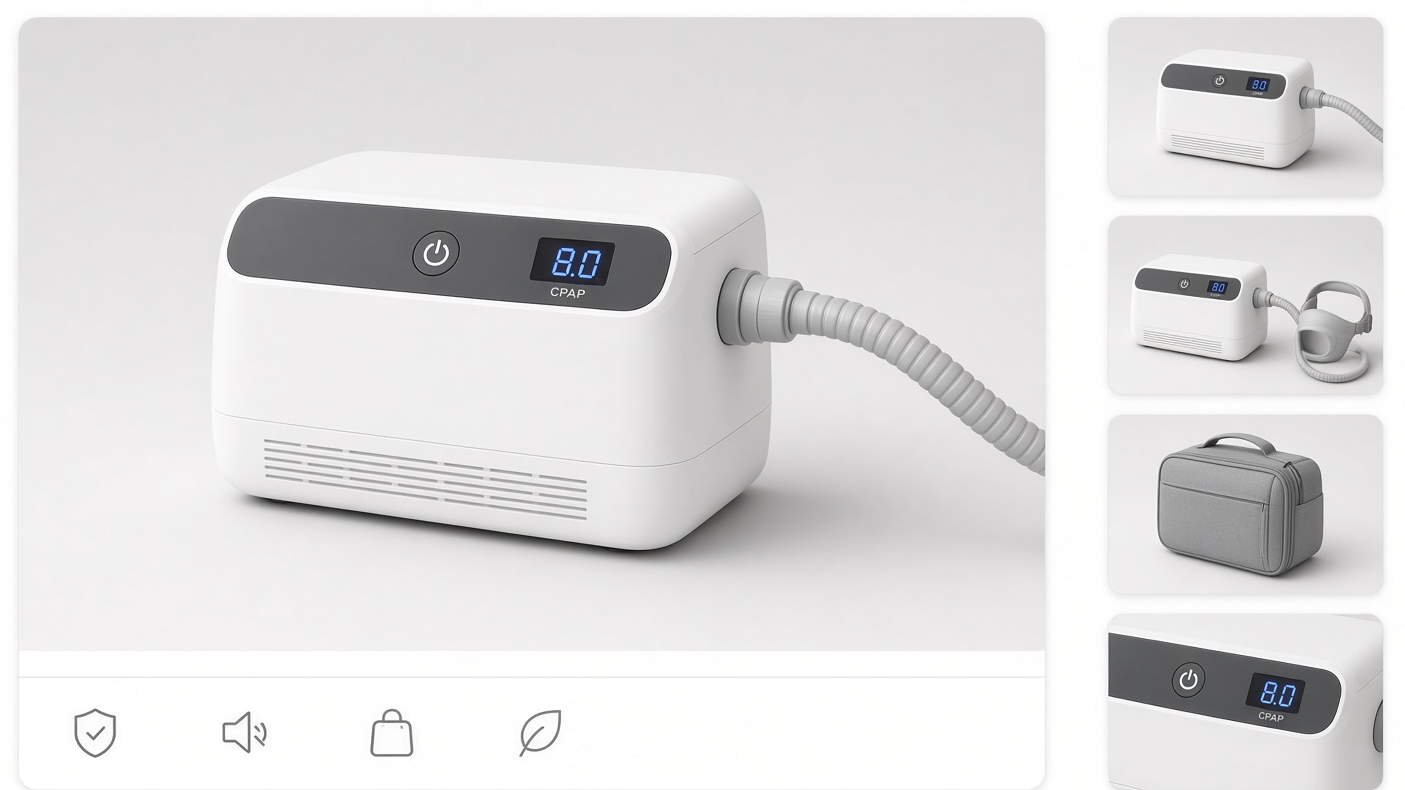
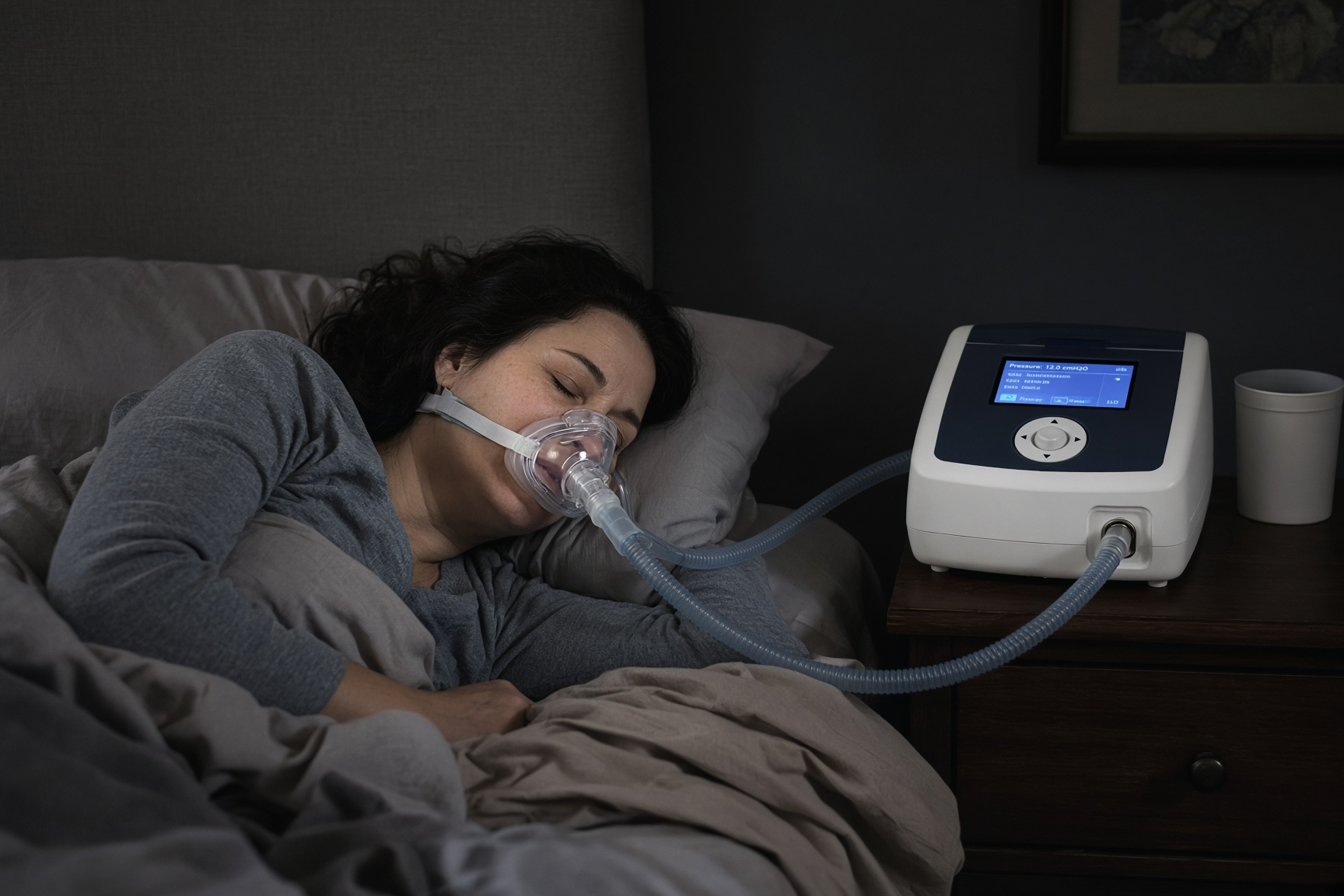
CPAP delivers a continuous stream of pressurized air through a mask you wear during sleep. This air pressure acts as a pneumatic splint, it physically holds your airway open by pushing against the soft tissues that would otherwise collapse.
The system includes:
- A machine that generates pressurized air
- A hose that carries the air
- A mask that delivers it to your airway (nasal, full-face, or nasal pillow designs)
- Usually a humidifier to prevent dryness
The pressure is calibrated during a sleep study or through auto-adjusting algorithms. When set correctly, CPAP eliminates apnea events almost completely, your AHI (apnea-hypopnea index) typically drops to under 5, often under 1.
CPAP doesn't care why your airway collapses. Tongue falling back? CPAP holds it open. Soft palate collapsing? CPAP holds it open. Throat walls narrowing? CPAP holds them open. This universality is its superpower.
Oral Appliances: Jaw Repositioning
Oral appliances (also called mandibular advancement devices or MADs) are custom-fitted dental devices that reposition your lower jaw forward during sleep.
Your tongue is anchored to your lower jaw. When the jaw moves forward, the tongue comes with it, pulling away from the back of your throat. This increases the airway space and reduces the likelihood of collapse. The device also slightly tenses the soft tissues of the throat, adding stability.
A properly made oral appliance:
- Is custom-fabricated from impressions or digital scans of your teeth
- Has upper and lower components that connect
- Is titratable, meaning it can be adjusted incrementally to find the optimal jaw position
- Is made by a dentist trained in dental sleep medicine
Unlike CPAP, oral appliances don't pressurize your entire airway. They work by changing your anatomy while you sleep, moving structures out of the way rather than forcing them open.
Effectiveness: The Numbers
Let's look at what the research actually shows.
CPAP Effectiveness
When used as prescribed, CPAP is extraordinarily effective:
- Reduces AHI to normal levels (under 5) in approximately 95% of patients
- Works for mild, moderate, and severe sleep apnea
- Works regardless of body weight or specific anatomy
- Improvements are immediate, the first night of proper use shows results
The catch is in that phrase "when used as prescribed." CPAP only works while you're wearing it. Take off the mask, and your apnea returns instantly.
Oral Appliance Effectiveness
Oral appliances are effective but less universally so:
- Reduce AHI by approximately 50% on average
- Achieve AHI under 5 in about 35-50% of patients
- Achieve AHI under 10 in about 50-70% of patients
- Work best for mild to moderate apnea; success rates drop for severe apnea
- Effectiveness varies significantly based on individual anatomy
A meta-analysis published in Sleep found that oral appliances reduced AHI from an average of 33 to 14, meaningful improvement, but not the near-elimination that CPAP achieves.
The Adherence Factor
Here's where the comparison gets complicated: CPAP's superior efficacy is offset by inferior adherence.
CPAP adherence rates:
- Only about 50% of patients meet the minimum adherence threshold (4+ hours/night on 70%+ of nights)
- Many patients use CPAP inconsistently, some nights on, some nights off
- A significant percentage abandon CPAP entirely within the first year
Oral appliance adherence rates:
- Approximately 75-90% of patients report regular use
- Adherence tends to be more consistent night-to-night
- Long-term retention is higher than CPAP
This matters enormously. A treatment that works 95% of the time but is used 50% of the time may produce worse real-world outcomes than a treatment that works 60% of the time but is used 90% of the time.
Health Outcomes: What Actually Matters
The ultimate question isn't which treatment produces better AHI numbers, it's which produces better health outcomes.
Several studies have compared cardiovascular outcomes, blood pressure reduction, and quality of life between CPAP and oral appliances. The surprising finding: when both treatments are used consistently, health outcomes are often similar.
A randomized trial published in JAMA found equivalent reductions in 24-hour blood pressure between CPAP and oral appliances over 4 weeks. A study in the American Journal of Respiratory and Critical Care Medicine found similar improvements in endothelial function (a marker of cardiovascular health).
The interpretation: for patients who will actually use an oral appliance consistently, it may be as good as CPAP for cardiovascular protection, even though it doesn't reduce AHI as dramatically.
Side Effects and Drawbacks
Every treatment has downsides. Understanding them helps you anticipate what to expect.
CPAP Side Effects
Common issues:
- Mask discomfort: Pressure points, skin irritation, marks on the face
- Mask leaks: Air escaping disrupts sleep and reduces effectiveness
- Dry mouth and nose: Even with humidification, dryness is common
- Nasal congestion: The pressurized air can irritate nasal passages
- Aerophagia: Swallowing air leads to bloating, gas, and belching
- Claustrophobia: Many people feel confined or anxious with a mask on their face
- Noise: Modern machines are quiet, but not silent
- Bed partner disturbance: The mask, hose, and noise can affect your partner
Less common issues:
- Skin breakdown or pressure sores from the mask
- Eye irritation from mask leaks
- Chest discomfort from air pressure
- Central apneas emerging (complex sleep apnea)
Practical drawbacks:
- Requires electricity (though battery options exist for travel)
- Requires distilled water for the humidifier
- Equipment needs regular cleaning
- Travel is more complicated
- The setup can feel medicalized and unsexy
Oral Appliance Side Effects
Common issues:
- Jaw discomfort: Especially in the first weeks as you adjust. Morning jaw stiffness or soreness is typical initially.
- Tooth discomfort: Pressure on teeth, especially if dental work is present
- Excessive salivation: Or conversely, dry mouth
- Temporary bite changes: Your bite may feel "off" in the morning. This usually resolves within 30-60 minutes with exercises.
Less common but important issues:
- Permanent bite changes: Over months to years, the teeth and jaw can shift. The lower jaw may move slightly forward, creating an underbite. Back teeth may not meet as well. These changes are usually minor but can occasionally be significant.
- TMJ problems: Some patients develop or worsen temporomandibular joint pain
- Tooth movement: Teeth can shift position, especially if periodontal health isn't optimal
- Gum irritation: Where the device contacts the gums
Practical drawbacks:
- Requires enough healthy teeth to anchor the device
- Needs periodic adjustment and replacement (typically every 3-5 years)
- Requires a qualified dental sleep medicine provider, which may not be locally available
- Cannot be used with dentures or significant dental problems
Cost Comparison
Both treatments involve significant costs, though the structures differ.
CPAP Costs
Equipment:
- CPAP machine: $500-$3,000 (auto-adjusting models cost more)
- Masks: $100-$300 each (need replacement every 3-6 months)
- Hoses, filters, and supplies: Ongoing costs
With insurance: Most plans cover CPAP with a copay or coinsurance. Expect $100-$500 out-of-pocket initially, plus ongoing supply costs.
Without insurance: $1,000-$4,000 upfront, plus $300-$600 annually for supplies.
Oral Appliance Costs
Device:
- Custom oral appliance: $1,500-$3,000
- Includes fitting, adjustments, and follow-up
With insurance: Medical insurance (not dental) typically covers oral appliances for diagnosed sleep apnea. Coverage varies widely. Expect $500-$1,500 out-of-pocket.
Without insurance: Full cost of $1,500-$3,000, sometimes with payment plans available.
Replacement: Devices typically last 3-5 years before needing replacement.
Long-Term Cost Comparison
Over 5 years, costs are often comparable:
- CPAP: Initial equipment plus ongoing supplies and occasional machine replacement
- Oral appliance: Initial device plus one replacement and periodic adjustments
Insurance coverage, your specific plan, and your location all affect the actual numbers. It's worth checking with your insurance and getting specific quotes before deciding based on cost.
Lifestyle Considerations
Beyond clinical effectiveness, how does each treatment fit into daily life?
Travel
CPAP: Requires bringing the machine, mask, hose, and often distilled water. TSA allows CPAP as a medical device (doesn't count toward carry-on limits). Needs electricity unless you have a battery pack. Camping and backpacking are challenging.
Oral appliance: Fits in a small case that slips into a toiletry bag. No electricity needed. Works anywhere you can sleep.
Winner: Oral appliance, dramatically easier for travel.
Bed Partner Impact
CPAP: Some noise from the machine (usually white-noise level with modern units). Mask and hose can get in the way of intimacy and cuddling. Some partners find it visually off-putting.
Oral appliance: Silent. Stays in your mouth, leaving your face free. Less intrusive to the bed partner.
Winner: Oral appliance, less impact on the relationship dynamic.
Maintenance
CPAP: Daily cleaning recommended for mask and humidifier chamber. Weekly cleaning of hose. Filter replacement. Water refills. More moving parts mean more that can break.
Oral appliance: Quick daily cleaning with a brush or denture cleaner. Periodic professional cleaning. Minimal maintenance.
Winner: Oral appliance, less daily hassle.
Appearance and Self-Image
This matters more than many doctors acknowledge.
CPAP: Wearing a mask connected to a machine can feel medical, institutional, or unattractive. Some people feel embarrassed or self-conscious. This affects adherence.
Oral appliance: Invisible from the outside. Just looks like you're sleeping. Feels more like a normal person using a dental device than a patient on a medical machine.
Winner: Oral appliance, preserves normal appearance.
Flexibility
CPAP: Works best with consistent use in the same sleeping environment. Taking a night off means a night of untreated apnea.
Oral appliance: Easy to use in different situations. Some patients keep both, CPAP at home, oral appliance for travel.
Winner: Oral appliance, more adaptable to varied circumstances.
Who Should Choose CPAP?
CPAP is likely the better choice if:
Your apnea is severe (AHI over 30). The higher your AHI, the less likely an oral appliance will control it adequately. Severe apnea often needs the guaranteed effectiveness of CPAP.
You have significant oxygen desaturation. If your oxygen levels drop dramatically during apnea events, you need a treatment that reliably prevents those drops. CPAP provides that assurance.
You have central sleep apnea or complex sleep apnea. Oral appliances only treat obstructive apnea. If central events are present, you likely need positive airway pressure therapy.
You've already tried and tolerated CPAP. If you're using CPAP successfully, there's little reason to switch unless lifestyle factors make it necessary.
You have dental problems. Not enough teeth, significant periodontal disease, or TMJ dysfunction may rule out oral appliances. CPAP works regardless of dental status.
You want maximum certainty. If peace of mind matters most, knowing with near-certainty that every night your apnea is fully controlled, CPAP delivers that.
Cost is the primary concern and you have good insurance. CPAP is often covered more readily and completely than oral appliances.
Who Should Choose an Oral Appliance?
An oral appliance is likely the better choice if:
Your apnea is mild to moderate (AHI under 30). Success rates are highest in this range. Many patients achieve full control.
You've tried CPAP and can't tolerate it. If you've given CPAP a fair trial (proper mask fitting, humidification, troubleshooting) and still can't use it, an oral appliance that you'll actually wear beats a CPAP that sits in the closet.
Claustrophobia is a major issue. If the mask triggers anxiety or panic, an oral appliance avoids that trigger entirely.
You travel frequently. The portability difference is dramatic. Frequent travelers often find oral appliances far more practical.
Your bed partner is affected by CPAP. If CPAP is straining your relationship, an oral appliance removes that friction.
You prefer a non-machine solution. Some people simply don't want to be tethered to a device. That preference is valid.
You have healthy teeth and no significant TMJ problems. Good dental health makes you a better candidate for oral appliance success.
Your obstruction is primarily tongue-based. If sleep endoscopy or clinical evaluation suggests your airway collapses mainly because of tongue position, advancing the jaw directly addresses that.
The Combination Approach
You don't necessarily have to choose one or the other exclusively.
CPAP at home, oral appliance for travel: Many patients use CPAP as their primary treatment but keep an oral appliance for trips when CPAP is impractical.
Oral appliance plus CPAP at lower pressure: Some patients find that an oral appliance partially opens their airway, allowing them to use CPAP at lower (and more tolerable) pressure settings.
Starting point vs. long-term solution: Some patients start with CPAP because insurance covers it more readily, then switch to an oral appliance once they've navigated coverage for it.
Discuss combination strategies with your sleep specialist. Flexibility often produces better real-world outcomes than rigid adherence to one treatment.
How to Decide: A Step-by-Step Approach
Step 1: Review Your Sleep Study Results
Look at your AHI, oxygen desaturation levels, and whether apnea is positional. Severe apnea with significant desaturation points toward CPAP. Mild-moderate apnea opens more options.
Step 2: Consider Your Anatomy and Dental Health
Do you have enough healthy teeth? Any TMJ issues? A dental sleep medicine specialist can evaluate whether you're a good oral appliance candidate. Not everyone is.
Step 3: Try CPAP First (If Willing)
Insurance often requires a CPAP trial before covering oral appliances. Even if you suspect you'll prefer an oral appliance, giving CPAP 30-90 days with proper support provides useful information. Some people who expect to hate CPAP find it surprisingly tolerable.
Step 4: Get Properly Evaluated for an Oral Appliance
If CPAP doesn't work out, see a dentist trained in dental sleep medicine, ideally one who is a member of the American Academy of Dental Sleep Medicine or board-certified. A proper evaluation includes assessing your teeth, TMJ, bite, and airway.
Step 5: Follow Up With Objective Testing
Whichever treatment you choose, verify it's working. A follow-up sleep study (or home sleep test) while using your treatment tells you whether your AHI is actually controlled. Feeling better isn't enough, you need objective confirmation.
Step 6: Reassess Periodically
Bodies change. Weight changes. Dental health changes. What works now may need adjustment later. Plan for periodic reassessment with your sleep team.
Questions to Ask Your Providers
For your sleep medicine physician:
- Given my specific AHI and oxygen levels, am I a reasonable candidate for an oral appliance?
- Do I have any central apnea that would rule out an oral appliance?
- Will my insurance cover an oral appliance if CPAP fails?
- Can you refer me to a qualified dental sleep medicine provider?
For the dental sleep medicine specialist:
- Am I a good anatomical candidate for an oral appliance?
- What's your success rate with patients similar to me?
- How do you handle bite changes over time?
- What follow-up protocol do you use?
- What type of device do you recommend for my situation?
The Bottom Line
CPAP and oral appliances are both legitimate, evidence-based treatments for obstructive sleep apnea. Neither is universally "better", each has situations where it excels.
Choose CPAP if: Your apnea is severe, you need guaranteed effectiveness, you tolerate the mask well, or dental issues rule out oral appliances.
Choose an oral appliance if: Your apnea is mild-moderate, CPAP isn't tolerable, travel and lifestyle matter heavily, or you simply prefer a non-machine approach.
Consider both if: You want CPAP reliability at home with oral appliance portability for travel.
The worst choice is no treatment at all. Untreated sleep apnea damages your heart, brain, and metabolism night after night. Whether you achieve control through pressurized air or jaw repositioning matters far less than achieving control.
Ready to explore your options? Find an accredited sleep clinic to discuss whether CPAP, oral appliance therapy, or a combination approach is right for you. If you're interested in oral appliances, ask for a referral to a qualified dental sleep medicine specialist in your area.
Considering an oral appliance over CPAP?
Sleeping.com carries oral appliance options, including the myTAP device covered by some of the same considerations discussed above, as well as CPAP machines and supplies if you decide that route is the better fit.
Shop Sleeping.comAdvertising disclosure: this is a paid partnership. We may earn a commission if you sign up through this link, at no extra cost to you.
Written by
Daniel Marin
Sharing insights on sleep health and wellness to help you achieve better rest and improved quality of life.