You've tried everything. Cutting caffeine. Earlier bedtimes. Blackout curtains. Maybe a sleeping pill that worked for a while, then stopped, or left you groggy and worried about taking it forever. And still, most nights, you lie awake watching the hours slip by, doing the exhausting math on how little sleep you'll get before the alarm.
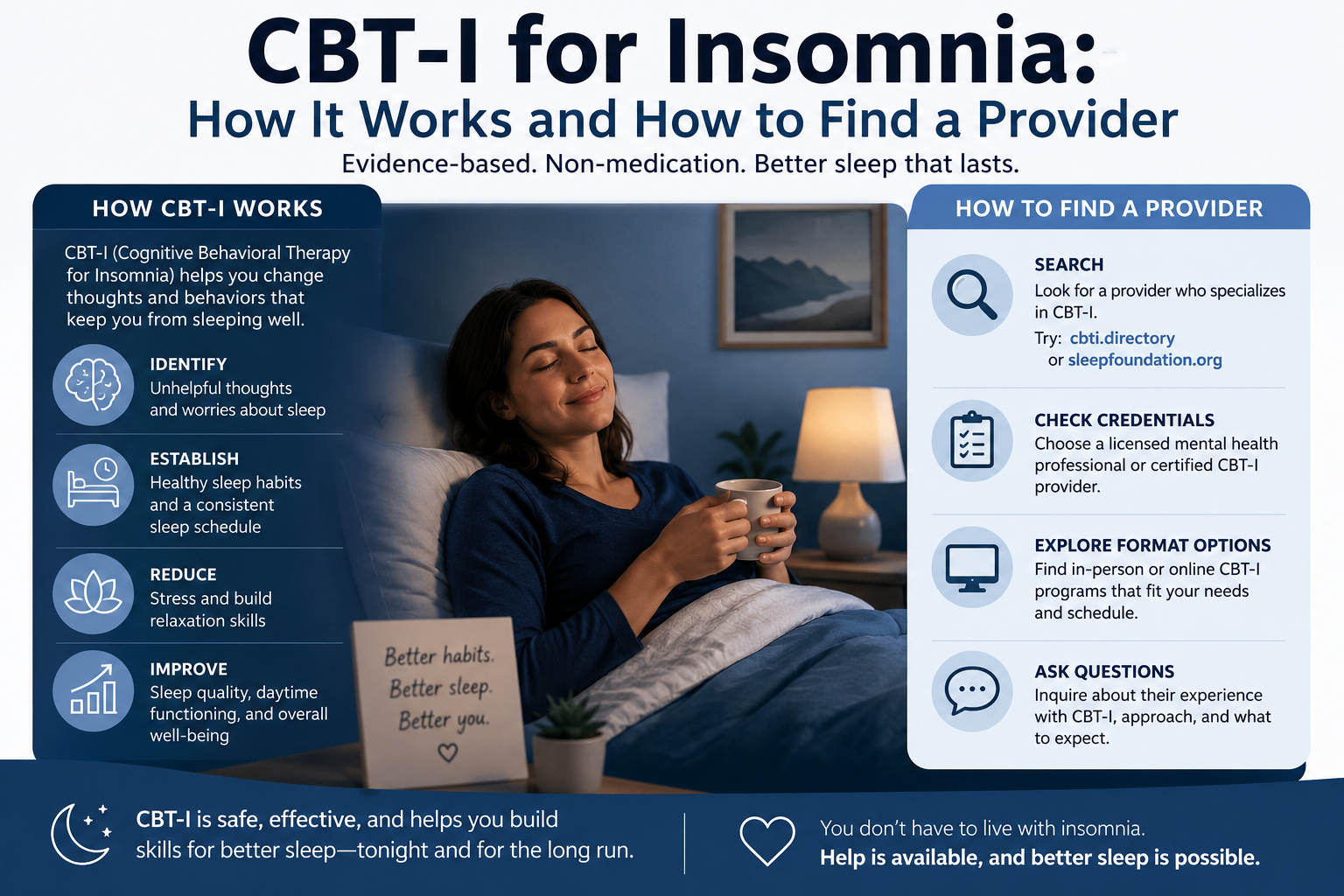
If this is your reality three or more nights a week, for three months or longer, you have chronic insomnia. And there's a treatment for it that most people have never heard of, one that works better over the long term than any sleeping pill: Cognitive Behavioral Therapy for Insomnia, or CBT-I.
CBT-I is recommended as the first-line treatment for chronic insomnia by the American College of Physicians and the American Academy of Sleep Medicine. Not medication. Therapy. And the evidence is strong: most people who complete CBT-I see meaningful improvement, and those gains tend to last long after treatment ends, which is exactly where sleeping pills fall short.
This guide explains how CBT-I actually works, what to expect when you do it, and how to find a qualified provider.
What CBT-I Is (and Isn't)
CBT-I is a structured, short-term therapy, typically 4 to 8 sessions, that targets the specific thoughts and behaviors keeping your insomnia alive. It's not general talk therapy, and it's not the same as "sleep hygiene" tips you've read online.
Here's the key idea: whatever originally triggered your insomnia (stress, illness, a new baby, grief) is often no longer the thing keeping you awake. Over weeks and months, your brain learns a new, unhelpful pattern. The bed becomes a place of frustration. You start "trying" to sleep, which creates pressure that makes sleep impossible. You spend more and more time in bed hoping to catch rest, which paradoxically makes your sleep shallower and more broken.
CBT-I breaks these learned patterns. It retrains your brain to associate the bed with sleep again, and it rebuilds the natural sleep drive that anxiety and bad habits have eroded.
CBT-I vs. Sleep Medication
| Factor | CBT-I | Sleep Medication |
|---|---|---|
| How long results last | Improvements persist after treatment ends | Benefit usually stops when you stop taking it |
| Side effects | Minimal | Grogginess, dependence, tolerance, fall risk |
| Addresses root cause | Yes, retrains the underlying pattern | No, masks the symptom |
| Time to work | A few weeks | Same night |
| Risk of rebound insomnia | None | Common when discontinuing |
| Recommended for chronic use | Yes, first-line | No, short-term only |
Medication can have a role, especially short-term or in combination with therapy, but for chronic insomnia, CBT-I is the treatment with lasting power.
The Core Components of CBT-I
CBT-I isn't one technique. It's a package of several evidence-based components, usually delivered together and tailored to your specific sleep pattern. Here's what each one does.
1. Sleep Restriction Therapy
This is the most powerful, and most counterintuitive, part of CBT-I. Despite the alarming name, it's not about depriving you of sleep. It's about matching the time you spend in bed to the time you actually sleep.
Most people with insomnia spend far too long in bed. If you're in bed for 9 hours but only sleeping 6, those 3 extra hours of wakefulness are training your brain that the bed is a place for lying awake. Sleep restriction temporarily shrinks your time in bed to consolidate your sleep into a solid block.
Here's roughly how it works:
- You track your sleep for one to two weeks to find your average actual sleep time
- Your provider sets a fixed time-in-bed "window" close to that amount (never below about 5 hours)
- You keep a consistent wake-up time every day, including weekends
- As your sleep becomes more solid and efficient, the window is gradually expanded
The early days can be tough, you may feel more tired at first, because mild sleep deprivation is part of the mechanism. That deprivation builds up sleep drive, so you fall asleep faster and stay asleep more deeply. Within a couple of weeks, most people find their sleep dramatically more consolidated.
This component should be done with professional guidance, especially if you have certain medical conditions, bipolar disorder, a seizure disorder, or do safety-sensitive work like driving.
2. Stimulus Control
Stimulus control rebuilds the mental link between your bed and sleep. The rules are simple but require discipline:
- Go to bed only when sleepy, not just tired, but genuinely drowsy
- Use the bed only for sleep and sex, no scrolling, working, worrying, or watching TV
- If you're awake for about 20 minutes, get up, leave the bedroom, do something calm and boring in dim light, and return only when sleepy
- Repeat as many times as needed, however frustrating
- Keep the same wake time every morning regardless of how you slept
The goal is to make your bed a cue for sleep, the way it is for good sleepers, rather than a cue for the anxious, wide-awake frustration that insomnia breeds.
3. Cognitive Restructuring
This component targets the thoughts and beliefs that fuel sleeplessness. People with insomnia often develop catastrophic thinking about sleep: "If I don't sleep tonight, tomorrow will be a disaster." "I need exactly 8 hours or I can't function." "My insomnia is ruining my health."
These thoughts create anxiety, and anxiety is the enemy of sleep. Cognitive restructuring helps you identify these unhelpful patterns and replace them with more accurate, less alarming ones. You learn to challenge the worry, reduce the pressure you put on sleep, and break the cycle where fear of not sleeping becomes the very thing that keeps you awake.
4. Relaxation Training
Insomnia is fundamentally a disorder of hyperarousal, a nervous system stuck in "on." Relaxation techniques help dial down that arousal so your body can transition into sleep. Common methods include:
- Progressive muscle relaxation
- Diaphragmatic (deep) breathing
- Guided imagery
- Mindfulness and body-scan practices
These aren't magic switches, they're skills that improve with practice, and they're most effective as part of the broader CBT-I program rather than on their own.
5. Sleep Hygiene Education
Sleep hygiene, the familiar advice about caffeine, alcohol, screens, light, and a consistent schedule, is part of CBT-I, but it's the smallest part. On its own, sleep hygiene rarely fixes chronic insomnia. It works as a supporting foundation alongside the more active components above.
What to Expect: A Typical CBT-I Course
CBT-I is structured and goal-oriented. While every provider works a little differently, a typical course looks something like this:
Session 1: Assessment and education. Your provider reviews your sleep history, has you start a sleep diary, and explains how insomnia works and why CBT-I is effective.
Session 2: Setting your sleep window. Based on your diary, you set up sleep restriction and stimulus control. This is where the active work begins.
Sessions 3-5: Adjusting and troubleshooting. You review your sleep diary each session, gradually adjust your sleep window, and work on cognitive restructuring and relaxation skills.
Sessions 6-8: Consolidating and preventing relapse. As your sleep stabilizes, you fine-tune your schedule and build a plan for handling the occasional bad night without sliding back into old patterns.
The sleep diary is central to the whole process. You'll track when you go to bed, how long it takes to fall asleep, how often you wake, and when you get up. This data drives every adjustment, and seeing your sleep efficiency improve week by week is often what keeps people motivated through the harder early stage.
A realistic expectation: things may feel harder before they feel better, particularly in the first one to two weeks of sleep restriction. Sticking with it through that phase is what produces the lasting results.
Who CBT-I Is For
CBT-I is appropriate for most adults with chronic insomnia, including:
- People who want to avoid or stop relying on sleep medication
- Those whose medication has stopped working or causes side effects
- Older adults, for whom sleeping pills carry higher risks
- People whose insomnia coexists with anxiety, depression, or chronic pain (CBT-I still works, and can improve those conditions too)
- Pregnant or breastfeeding women who want to avoid medication
A few cautions: the sleep restriction component needs to be adapted or supervised carefully if you have bipolar disorder, a seizure disorder, untreated sleep apnea, or a job involving driving or heavy machinery. And if you have symptoms of sleep apnea (loud snoring, witnessed breathing pauses, waking unrefreshed despite enough time in bed), get evaluated for that first, treating insomnia alone won't fix a breathing problem. See our guide on telling insomnia and sleep apnea apart if you're unsure which you have.
How to Find a CBT-I Provider
The biggest barrier to CBT-I has always been access, there simply aren't enough trained providers. But options have expanded considerably. Here's how to find quality care.
Behavioral Sleep Medicine Specialists
The gold standard is a provider with specific training in behavioral sleep medicine. Look for these credentials:
- DBSM (Diplomate in Behavioral Sleep Medicine), the current board certification from the Board of Behavioral Sleep Medicine
- CBSM (Certified in Behavioral Sleep Medicine), an earlier credential still held by many experienced providers
These specialists are often psychologists, but may also be physicians, nurse practitioners, or social workers with focused CBT-I training. The Society of Behavioral Sleep Medicine maintains a provider directory that lets you search by location.
Through a Sleep Clinic
Accredited sleep centers increasingly offer CBT-I alongside their other services, and this is often the most reliable route. A sleep clinic can also rule out other sleep disorders (like apnea) before or during treatment, which matters because insomnia frequently coexists with other conditions. Ask whether the clinic has a behavioral sleep medicine provider on staff or accepts referrals for CBT-I.
Digital CBT-I Programs
For people who can't find a local provider, or prefer to work at their own pace, digital CBT-I (sometimes called dCBT-I) delivers the same evidence-based components through an app or online program. Several have been studied in clinical trials and shown to be effective. These programs are more affordable and available anytime, though they offer less personalization than working with a clinician. Some require a prescription; others are available directly.
Digital programs are a reasonable starting point, especially for straightforward insomnia, but consider an in-person specialist if your insomnia is severe, complicated by other health conditions, or doesn't respond to a self-guided program.
Questions to Ask a Potential Provider
- Are you specifically trained in CBT-I (not just general therapy)?
- What credentials do you hold in behavioral sleep medicine?
- How many sessions does your program typically involve?
- Do you use sleep restriction and stimulus control? (If not, it may not be true CBT-I.)
- Do you screen for other sleep disorders like sleep apnea?
- Is this covered by my insurance, and what's the out-of-pocket cost?
A Note on Cost and Insurance
Coverage varies. Some insurance plans cover CBT-I when delivered by a licensed provider, particularly when coded as therapy for a diagnosed condition. Digital programs range from modest subscription fees to prescription-based products that may be covered. Compared to years of ongoing medication costs, and the risks that come with long-term sleeping pill use, CBT-I is often the better value as well as the better medicine.
The Bottom Line
Chronic insomnia is not something you have to "just live with," and it's not something you should have to medicate indefinitely. CBT-I addresses the actual mechanisms keeping you awake, the learned associations, the hyperarousal, the anxious thinking, and the disrupted sleep schedule, and it produces results that last.
It takes effort. The first couple of weeks can be genuinely difficult. But unlike a pill that works only while you take it, CBT-I gives you skills and patterns that keep working long after treatment ends. For most people with chronic insomnia, it's the most effective path to real, durable sleep.
Ready to get started? Use our sleep clinic directory to find an accredited sleep center near you, and ask whether they offer CBT-I or can refer you to a behavioral sleep medicine specialist.
Written by
Daniel Marin
Sharing insights on sleep health and wellness to help you achieve better rest and improved quality of life.