You did everything right. You got diagnosed with obstructive sleep apnea, started CPAP, adjusted to the mask, and started sleeping through the night. Then your follow-up data, or a repeat sleep study, shows something confusing: your obstructive events are gone, but a new kind of event has shown up in their place. You still have an elevated AHI. You might still feel tired.
This is a real, recognized phenomenon called complex sleep apnea, also known as treatment-emergent central sleep apnea (TECSA), and it's worth understanding on its own terms, because it isn't a sign that CPAP failed, and it isn't necessarily a mask or pressure problem. It's a specific physiological response that shows up in a meaningful minority of patients starting CPAP, and it has its own explanation and its own management path.
What's Actually Happening
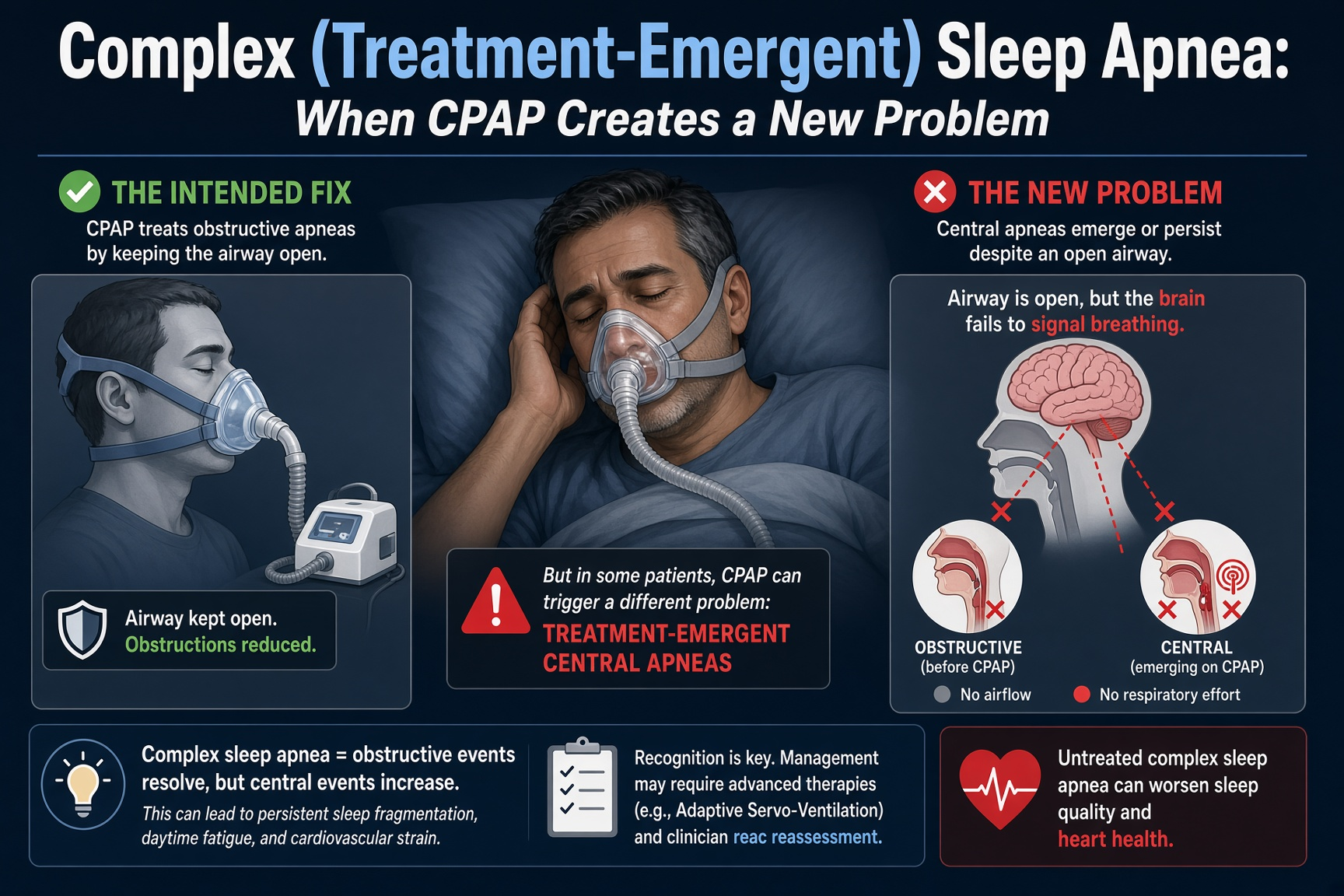
To understand complex sleep apnea, it helps to first understand the two apnea types it sits between. Our guide on central versus obstructive sleep apnea covers the full distinction, but the short version: obstructive apnea is a mechanical blockage of the airway, while central apnea is the brain briefly failing to signal the breathing muscles at all, with no blockage present.
Complex sleep apnea describes a specific sequence: a patient is diagnosed with straightforward obstructive sleep apnea, starts CPAP (or has pressure titrated during a sleep study), and the CPAP successfully eliminates the obstructive events, exactly as intended. But central apnea events then appear, or increase, once the obstruction is resolved, in a way that wasn't apparent, or wasn't as prominent, on the original diagnostic study.
In effect, treating the mechanical problem unmasks or triggers a separate, signaling-based one.
Why This Happens
The precise mechanism isn't fully settled, but the leading explanation involves how your body regulates breathing through carbon dioxide levels.
CO2 threshold instability. Your brainstem monitors carbon dioxide levels in the blood and triggers each breath partly in response to it. In some people, particularly once an obstruction is no longer artificially keeping CO2 elevated during sleep, CPAP-corrected breathing can push CO2 below the threshold that normally sustains the drive to breathe. The result is a brief central pause until CO2 builds back up enough to trigger the next breath. This is sometimes described as the system briefly "overshooting" in the other direction once the obstruction is removed.
Pre-existing but masked central tendency. Some patients may have had an underlying predisposition toward central breathing instability that was obscured by the obstructive events on their original diagnostic study, an obstructive apnea can sometimes prevent a central one from fully expressing, so removing the obstruction reveals what was there all along.
Arousal-related overshoot. The arousals that occur when CPAP pressure is adjusted, or during the general process of adapting to the device, can trigger transient overbreathing that drops CO2 and provokes a subsequent central pause.
Risk factors that make it more likely. Complex sleep apnea appears more often in men, older patients, those with higher pressure requirements, and those with more severe obstructive apnea at baseline, though it can occur in patients without any of these risk factors too.
How Common Is It, and Does It Resolve on Its Own?
Estimates of how often complex sleep apnea appears when someone starts CPAP vary across studies, partly because definitions and follow-up periods differ, but it's recognized as occurring in a meaningful minority of patients starting therapy, not a rare curiosity.
The genuinely reassuring part: for many patients, treatment-emergent central events resolve on their own with continued, consistent CPAP use over several weeks to a few months, as the breathing control system adapts to the new, unobstructed pattern. This is why sleep specialists often recommend a period of continued CPAP use with follow-up monitoring, rather than immediately concluding the treatment has failed or switching devices at the first sign of central events.
For a smaller subset, the central events persist and require a different treatment approach.
How to Know If This Is What's Happening to You
Complex sleep apnea is not something you can diagnose from how you feel. The clues that should prompt a conversation with your sleep specialist:
- Your follow-up data or a repeat sleep study shows a persistently elevated AHI despite consistent CPAP use, particularly if the event type has shifted from what your original study showed
- You continue to feel unusually tired or find your sleep unrefreshing despite good CPAP adherence and a mask that fits well and doesn't leak significantly
- Your CPAP machine's own data (many modern devices estimate and report a breakdown of events) shows a rise in central or unclassified events after you started treatment, worth bringing directly to your provider even before a formal repeat study
- You were diagnosed with severe obstructive apnea, required relatively high pressure, or are an older male, the profile associated with higher risk, though again, it can occur outside this profile too
If any of this applies, the right response is not to assume your mask is broken or your pressure is wrong and troubleshoot endlessly on your own. It's to loop in your sleep physician for evaluation, which may include a repeat in-lab study to precisely characterize what's happening.
How It's Managed
Watchful continuation. Given how often treatment-emergent central events resolve with time, the first step for many patients is simply continuing CPAP consistently with scheduled follow-up, rather than an immediate device change.
Adjusting CPAP pressure. In some cases, a pressure adjustment, sometimes counterintuitively lowering it slightly, can reduce the central events while still adequately controlling the obstructive ones.
Adaptive servo-ventilation (ASV). For persistent complex sleep apnea, ASV, a more sophisticated device that continuously adjusts support breath by breath to smooth out irregular breathing patterns, is often effective and is the treatment most specifically designed for this exact situation. As covered in our guide on central versus obstructive sleep apnea, ASV carries an important exception: it's contraindicated in patients with symptomatic heart failure and a significantly reduced ejection fraction, where trials found it associated with worse outcomes. This is exactly why a cardiac history needs to be part of the conversation before this device is chosen.
Bilevel PAP with a backup rate. Another device option that delivers a minimum number of breaths per minute regardless of the patient's own drive, useful in some cases of persistent central apnea.
Addressing contributing factors. If opioid medications, heart failure, or another underlying condition is contributing, managing that condition is part of the overall approach, as it is with primary central sleep apnea generally.
None of these decisions should be made unilaterally by adjusting your own machine settings. This is squarely a "call your sleep specialist" situation, not a "troubleshoot the mask yourself" one.
Why This Isn't a Reason to Give Up on CPAP
It's understandable to feel discouraged if you've done the hard work of adjusting to CPAP only to learn there's a new complication. But a few things are worth keeping in perspective.
This is a recognized, well-studied phenomenon, not a sign that something went wrong with your care or your effort. Sleep specialists see this regularly and know how to manage it.
Your original obstructive apnea is genuinely being treated. The mechanical problem CPAP was designed to fix is fixed. What's emerged is a separate, additional issue layered on top, not a failure of the original treatment.
Effective options exist. Between watchful continuation, pressure adjustment, and ASV for persistent cases, the large majority of patients with treatment-emergent central apnea reach an effective long-term solution.
Stopping CPAP altogether is rarely the right response. Discontinuing treatment brings back the original obstructive apnea and its associated risks, discussed in our guide on what untreated sleep apnea does to your brain, heart, and metabolism, while not necessarily resolving anything. The path forward is adjustment, not abandonment.
When to Bring This Up With Your Doctor
Raise this specifically if:
- You've started CPAP and don't feel the improvement you expected after a reasonable adjustment period
- Your device's reported data shows an AHI that remains elevated despite consistent use
- You notice your device flagging central or unclassified events, if your machine reports this breakdown
- A follow-up sleep study shows a different apnea pattern than your original diagnosis
The Bottom Line
Complex sleep apnea is a genuine, well-recognized response some patients have to starting CPAP: the obstructive events resolve as intended, and central events appear or increase in their place, most often through a CO2 threshold mechanism that the breathing control system needs time to recalibrate around. For many patients, this resolves on its own with continued use. For those where it persists, specialized treatment, most notably adaptive servo-ventilation, is usually effective, with important exceptions for certain heart failure patients.
If your CPAP data still shows an elevated AHI despite doing everything right, that's a reason to talk to your sleep specialist about what type of events are actually occurring, not a reason to assume CPAP has failed you.
Not seeing the improvement you expected on CPAP? Use our sleep clinic directory to find an accredited sleep center near you and get properly re-evaluated.
Written by
Daniel Marin
Sharing insights on sleep health and wellness to help you achieve better rest and improved quality of life.