Your doctor suspects sleep apnea, or maybe you've finally decided to investigate why you wake up exhausted no matter how long you sleep. The next step is a sleep study. But now you're facing a choice you didn't expect: do it at home with a small device, or spend the night in a sleep lab wired up to monitors?
The answer matters more than most people realize. A home sleep test is cheaper, more convenient, and perfectly adequate for many people. But it also misses things, and for certain patients, relying on a home test can mean a wrong diagnosis or a missed condition entirely.
This guide explains exactly what each test measures, who each one is right for, and how to make sure you get the test that will actually answer your question.
The Two Tests at a Glance
| Factor | Home Sleep Test (HSAT) | In-Lab Sleep Study (PSG) |
|---|---|---|
| Where | Your own bed | Sleep lab or hospital |
| What it primarily detects | Obstructive sleep apnea | Apnea plus many other sleep disorders |
| Data measured | Breathing, airflow, oxygen, effort, heart rate | All of the above plus brain waves, sleep stages, leg movement, body position |
| Measures actual sleep? | No, estimates time in bed | Yes, tracks true sleep via brain waves |
| Cost | Lower (often a few hundred dollars) | Higher (can be several thousand) |
| Convenience | Sleep in your own home | Overnight stay, wired to sensors |
| Best for | Likely moderate-to-severe OSA, otherwise healthy | Complex cases, other suspected disorders, prior negative HSAT |
What a Home Sleep Test Actually Measures
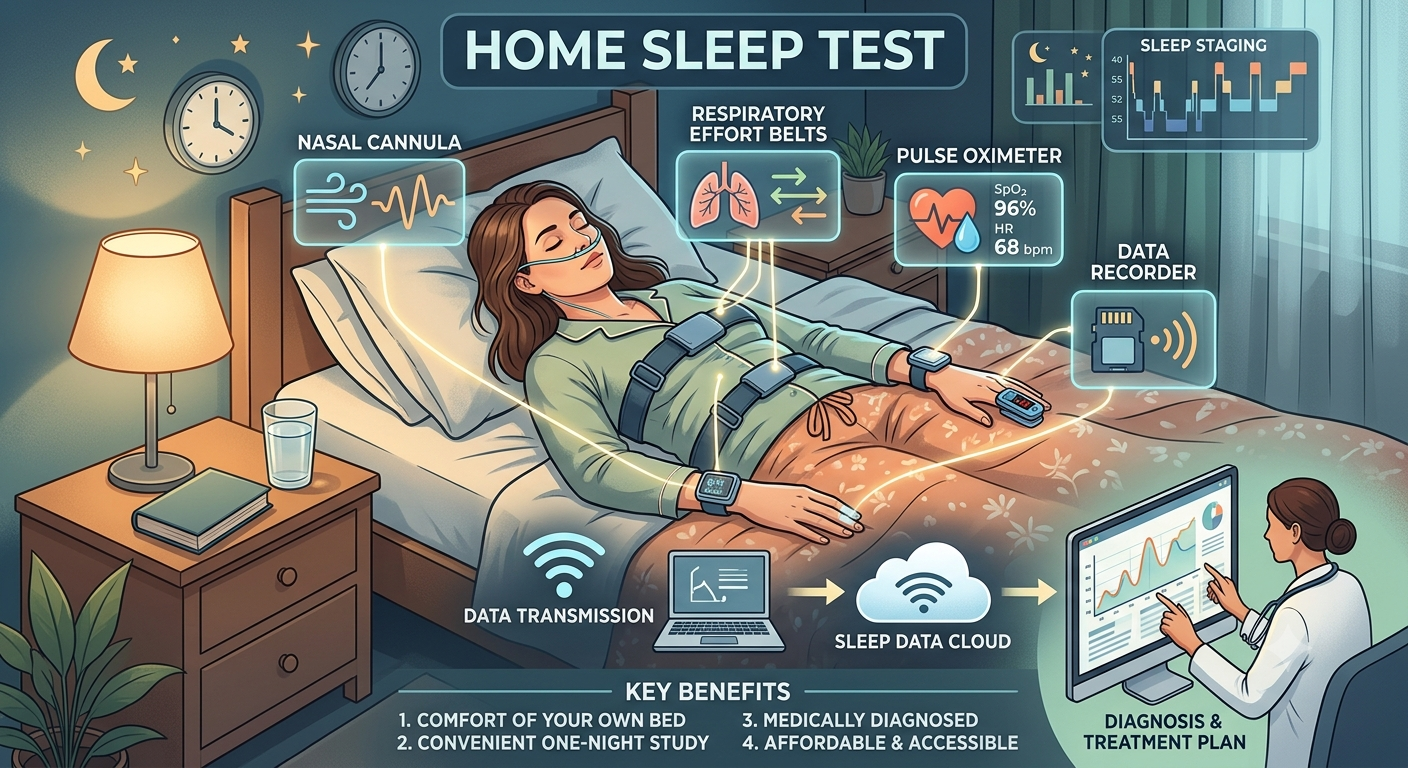
A home sleep apnea test (HSAT) is a portable device you take home and wear for one or more nights. It's designed to do one job well: detect obstructive sleep apnea.
A typical home test records:
- Airflow through a small sensor under your nose
- Breathing effort via an elastic belt around your chest or abdomen
- Blood oxygen levels through a fingertip sensor (pulse oximeter)
- Heart rate
- Sometimes body position and snoring
From this data, the test calculates your AHI (apnea-hypopnea index), the number of breathing interruptions per hour, which is the key number used to diagnose and grade sleep apnea.
The Critical Limitation
Here's what a home test does not do: it doesn't measure your brain waves, so it doesn't actually know when you're asleep. Instead of dividing breathing events by hours of true sleep, it divides them by total recording time (time in bed).
This matters. If you lie awake for two hours, the device counts those hours as if you might have been sleeping, which dilutes your AHI and can make your apnea look milder than it is. This is why home tests tend to underestimate severity and can produce false negatives, telling you that you're fine when you're not.
That's the central trade-off: a home test is great at confirming apnea in people who clearly have it, but less reliable at ruling it out.
What an In-Lab Sleep Study Measures
An in-lab study, called polysomnography (PSG), is the comprehensive, gold-standard sleep test. You spend the night in a sleep center while a technologist monitors a wide array of sensors.
In addition to everything a home test records, polysomnography adds:
- Brain waves (EEG) to track when you're actually asleep and which sleep stage you're in
- Eye movements (EOG) and muscle activity (EMG) to identify REM sleep
- Leg movements to detect periodic limb movement disorder and restless legs
- Full body position monitoring
- Video and audio recording
- Often a technologist who can adjust sensors and respond to problems during the night
Because it measures true sleep, the PSG calculates an accurate AHI based on actual sleep time, and it can detect a much wider range of conditions.
What Only an In-Lab Study Can Catch
A home test is essentially blind to anything that isn't obstructive sleep apnea. An in-lab study can diagnose:
- Central sleep apnea (where the brain fails to signal breathing, common in heart failure and with opioid use)
- Periodic limb movement disorder and restless legs syndrome
- Narcolepsy and other disorders of excessive sleepiness (often with a follow-up daytime test)
- REM sleep behavior disorder (acting out dreams, an early warning sign for some neurological conditions)
- Parasomnias like sleepwalking or night terrors
- Nocturnal seizures
If your symptoms point to any of these, a home test won't find them.
Who Should Get a Home Sleep Test
Home testing is appropriate, and often the smart first choice, when all of the following are true:
- Your symptoms strongly suggest obstructive sleep apnea (loud snoring, witnessed breathing pauses, gasping, daytime sleepiness)
- Your apnea is likely moderate to severe rather than borderline
- You're otherwise relatively healthy, with no significant heart, lung, or neuromuscular disease
- You have no symptoms of other sleep disorders (no restless legs, no acting out dreams, no narcolepsy signs)
For this group (a large share of suspected apnea patients) a home test is convenient, affordable, lets you sleep in your familiar environment, and is often more representative of a normal night than a wired-up lab stay.
If you're not sure whether your symptoms point to apnea at all, our guide on telling insomnia and sleep apnea apart can help you sort out what you're dealing with before testing.
Who Needs an In-Lab Study
An in-lab polysomnogram is the better, and sometimes essential, choice when:
- You have significant medical conditions: heart failure, chronic lung disease (COPD), neuromuscular disease, or a history of stroke
- Central sleep apnea is suspected (for example, with heart failure or chronic opioid use)
- You have symptoms of other sleep disorders: restless legs, periodic limb movements, narcolepsy, REM sleep behavior disorder, parasomnias, or possible nocturnal seizures
- A home test came back negative but your symptoms persist (a negative home test never fully rules out apnea)
- You need a CPAP titration, an in-lab study where pressure is calibrated to your needs while you sleep (sometimes combined with diagnosis in a "split-night" study)
- Your situation is otherwise complex, or earlier testing was inconclusive
The guiding principle: a home test can confirm apnea, but only an in-lab study can confidently rule it out or uncover something else.
What Each Test Is Like
The Home Test Experience
You'll pick up the device from a clinic or receive it by mail, often with a short tutorial or video. At bedtime, you attach the sensors yourself: the nasal cannula, the chest belt, and the finger oximeter. You sleep as normally as you can, then return or mail the device. A sleep physician interprets the data and sends results to your doctor.
Some people get clean data on the first try; others have to repeat a night if a sensor slips off. Many protocols record two or three nights to improve accuracy.
The In-Lab Experience
You arrive at the sleep center in the evening. A technologist applies the sensors, a process that takes 45 to 60 minutes and involves attaching small electrodes to your scalp, face, chest, and legs with gentle adhesive. You sleep in a private bedroom while the technologist monitors from another room. Wires are bundled to allow you to turn over and use the bathroom.
It's not the most natural night of sleep, and many people worry they "won't sleep at all." In practice, you usually sleep enough for a valid study, and the comprehensive data is worth the trade-off when it's needed.
How to Decide: A Simple Framework
-
Start with your symptoms. Classic obstructive apnea signs (snoring, witnessed pauses, daytime sleepiness) in an otherwise healthy person point toward a home test. Symptoms of other disorders point toward the lab.
-
Factor in your health. Significant heart, lung, or neurological conditions generally call for an in-lab study, regardless of convenience.
-
Let your doctor guide the choice. A sleep physician will weigh your symptoms, medical history, and risk factors. Insurance often requires a home test first for straightforward suspected apnea, with in-lab testing reserved for complex cases or after a negative home result.
-
Don't accept a negative home test as the final word if your symptoms are real and ongoing. Ask about an in-lab study as the next step.
-
Make sure a board-certified sleep physician interprets the results. The quality of interpretation matters as much as the test itself, for either type.
The Bottom Line
Neither test is universally "better." They answer different questions.
- A home sleep test is convenient, affordable, and well-suited to confirming obstructive sleep apnea in otherwise healthy people with clear symptoms.
- An in-lab sleep study is comprehensive, measures true sleep, and is essential for complex cases, other suspected sleep disorders, significant medical conditions, or when a home test doesn't add up.
The worst outcome is a missed or wrong diagnosis that leaves a serious condition untreated. So match the test to your situation, lean on a sleep specialist's judgment, and don't let a convenient negative result close the book if you still feel exhausted.
Ready to take the next step? Use our sleep clinic directory to find an accredited sleep center near you that offers both home sleep testing and in-lab studies, and can recommend the right one for your symptoms.
Written by
Daniel Marin
Sharing insights on sleep health and wellness to help you achieve better rest and improved quality of life.