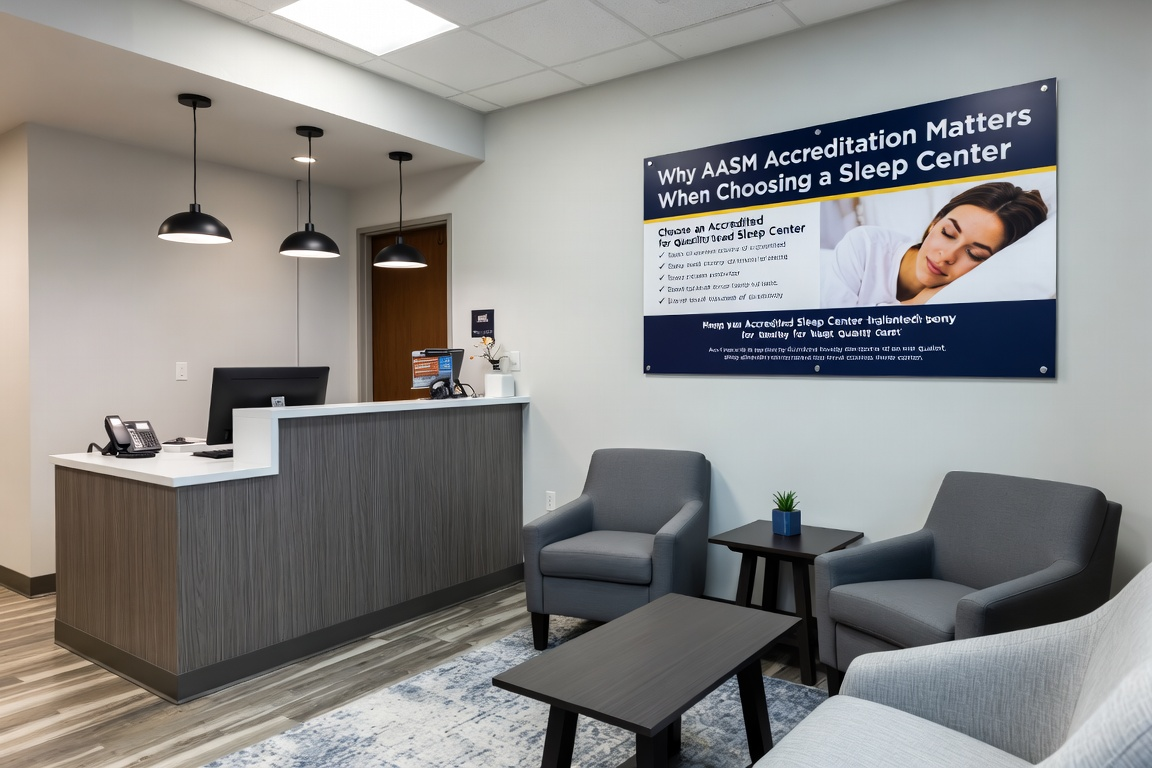
Almost every sleep center's website looks the same: soft lighting, a reassuring photo of a bedroom, language about "board-certified experts" and "state-of-the-art care." From the outside, it's genuinely difficult to tell a rigorously run sleep lab from one that's cutting corners. The equipment looks similar in photos. The waiting rooms all have the same calm color palette. The marketing copy is nearly interchangeable.
There is, however, one credential that cuts through all of that: accreditation from the American Academy of Sleep Medicine (AASM). It's not a marketing badge a clinic can claim informally. It's an earned, verified, and periodically re-reviewed designation that tells you a facility has been independently checked against a detailed set of standards, and passed.
If you take away one thing from choosing a sleep center, it should be this: check for AASM accreditation before you book. Here's why it matters so much, and exactly what it verifies.
What AASM Accreditation Actually Is
The AASM is the leading professional medical society in sleep medicine. Accreditation through the AASM is a voluntary process, meaning no one is forced to pursue it, that certifies a sleep center meets rigorous, standardized requirements across personnel, equipment, policies, and patient care.
To become accredited, a facility submits detailed documentation and undergoes review covering everything from who is running the lab to how individual sleep studies are scored. This isn't a one-time checkbox. Accredited centers are subject to periodic re-review to maintain their status, which means accreditation reflects an ongoing standard of care, not a credential earned once and never revisited.
Because it's voluntary, the fact that a center has gone through the process at all is itself a signal: it means the facility was willing to be independently scrutinized rather than simply asserting its own quality.
What Accreditation Actually Verifies
AASM accreditation isn't a single stamp. It covers six distinct domains, each addressing a different way that sleep care can go wrong if left unchecked.
Medical Director Requirements
Every accredited center must have a medical director who is board-certified in sleep medicine (through the American Board of Medical Specialties or the American Osteopathic Association), holds an active medical license, and is responsible for clinical policy and quality oversight. This person must also be available for consultation and emergencies, not simply listed on a letterhead.
This matters because the quality of interpretation, particularly for complex cases like narcolepsy or unusual sleep patterns, depends heavily on the expertise of the physician reading the study. A facility without a qualified medical director at the helm has no guaranteed floor on that expertise.
Personnel Qualifications
Accredited centers must staff Registered Polysomnographic Technologists (RPSGT) or the equivalent, maintain adequate staffing ratios for patient safety, and require ongoing continuing education and competency assessments.
The technologist is the person physically attaching your sensors, monitoring you overnight, and responding if something goes wrong. Their training and credentialing directly affects both your comfort and the reliability of your data.
Facility Requirements
This covers dedicated sleep testing rooms with appropriate amenities, readily available emergency equipment and protocols, proper infection control, and attention to patient privacy and comfort. In plain terms: is this a purpose-built, safe environment for overnight monitoring, or a repurposed space with minimal investment in the actual testing environment?
Equipment Standards
Accredited facilities must use FDA-approved polysomnography equipment, follow regular calibration and maintenance schedules, and maintain backup systems for critical equipment. A malfunctioning or poorly calibrated sensor doesn't just produce an uncomfortable night, it can produce inaccurate data that leads to a missed or wrong diagnosis.
Quality Assurance
This is one of the most important and least visible standards: inter-scorer reliability testing. Sleep study interpretation involves a degree of subjective scoring (identifying sleep stages, counting events), and different technologists or physicians can score the same data slightly differently. Accredited centers are required to test and monitor consistency across their scorers, along with ongoing quality review of studies and patient satisfaction monitoring.
This standard exists specifically because sleep study interpretation quality can vary between practitioners, and accreditation forces a center to actively measure and manage that variability rather than ignore it.
Policies and Procedures
Accredited centers must maintain a comprehensive policy manual, standardized protocols for performing studies, clear scoring and interpretation procedures, and documented record-keeping standards. This is the operational backbone that keeps a center consistent, patient to patient and night to night, rather than dependent on whichever staff happen to be on shift.
The Two Types of AASM Accreditation
Not every accredited facility offers the same services, and it's worth knowing the distinction:
Sleep Disorders Center accreditation applies to full-service facilities offering comprehensive evaluation and treatment for the full range of sleep disorders, including in-lab polysomnography, MSLT/MWT testing (used for narcolepsy and hypersomnia workups), and ongoing patient management under board-certified sleep specialist oversight.
Out of Center Sleep Testing (OCST) accreditation applies specifically to home sleep apnea testing programs, verifying that portable monitoring devices are properly administered, patients are properly instructed, and results are accurately interpreted by qualified physicians.
If your situation might require more than a straightforward apnea test, MSLT testing for suspected narcolepsy, evaluation for restless legs or periodic limb movements, or management of complex insomnia, a full Sleep Disorders Center accreditation matters more than OCST accreditation alone. Our guide on home sleep tests vs. in-lab studies can help you figure out which type of testing you're likely to need.
Why This Matters Beyond a Checkbox
Diagnostic accuracy. The entire value of a sleep study rests on accurate scoring and interpretation. Inter-scorer reliability testing, standardized protocols, and board-certified physician oversight are the specific mechanisms that keep results trustworthy. An unaccredited facility may still produce a valid study, but there's no independent verification that it consistently does.
Patient safety. Overnight studies involve monitoring a sleeping patient in a facility, sometimes with underlying health conditions like heart disease. Accredited centers are required to have emergency protocols and equipment in place. This isn't a hypothetical concern, it's a baseline safety standard that unaccredited facilities aren't obligated to meet.
Insurance recognition. Many insurance companies prefer, and some require, AASM accreditation for coverage of sleep studies and related treatment. Choosing an unaccredited facility can, in some cases, complicate reimbursement even when the underlying test would otherwise be covered.
A meaningful floor on quality, even when you can't personally evaluate clinical expertise. Most patients have no way to judge whether a specific technologist or physician is skilled at their job. Accreditation substitutes an independent, standardized review for that judgment, which is exactly the situation where a credential is most useful.
How to Verify a Sleep Center's Accreditation
Don't take a "state-of-the-art" claim at face value. Accreditation status is independently verifiable:
- Ask the clinic directly: "Is your facility accredited by the AASM, and is it Sleep Disorders Center or OCST accreditation?" A legitimate, accredited center will answer this immediately and specifically.
- Check the AASM's own accreditation search. The AASM maintains a database of accredited facilities that you can search directly.
- Use our directory's accreditation filter. You can search for AASM-accredited facilities directly in our sleep clinic directory.
For a deeper look at accreditation standards, types, and verification, see our full AASM Accreditation guide, which covers the complete standards framework in detail.
Questions to Ask Alongside Accreditation
Accreditation is the single strongest signal, but it's worth pairing with a few related questions when you're evaluating a center:
- Is your facility accredited by the AASM?
- Is the medical director board-certified in sleep medicine?
- Are your technologists registered (RPSGT)?
- What types of sleep studies do you perform?
- How quickly will I receive my results, and who interprets them?
- Do you offer follow-up care and treatment, not just diagnosis?
- Does my insurance cover services at your center?
For a broader walkthrough of how to evaluate a clinic beyond accreditation alone, including follow-up care, testing options, and cost considerations, see our guide on how to choose the right sleep clinic.
The Bottom Line
Sleep centers are hard to evaluate from the outside. The websites look similar, the language is similar, and unless you have a clinical background, you have no independent way to judge whether the equipment is properly calibrated or the scoring is consistent. AASM accreditation exists precisely to solve that problem: it's an independent, periodically renewed verification that a facility meets a real, detailed standard across medical leadership, staffing, equipment, safety, and quality assurance.
It doesn't take long to check. It's one of the highest-value questions you can ask before committing a night, and real money, to a sleep study.
Ready to find an accredited center? Use our sleep clinic directory to search specifically for AASM-accredited sleep centers near you.
Written by
Daniel Marin
Sharing insights on sleep health and wellness to help you achieve better rest and improved quality of life.