Advertising disclosure: this article contains a sponsored link to CPAP.com, a retailer we have an affiliate relationship with. If you buy through it we may earn a commission, at no extra cost to you. The conclusion below reduces the number of things you need to buy rather than increasing it.
Search "CPAP vs APAP" and you will find page after page framing this as a purchase decision, usually with a line about APAP costing more. In the US retail market in 2026, that framing is mostly wrong, and acting on it can cost you money.
Here is the short version. CPAP and APAP are not two categories of machine you choose between at checkout. They are two modes, and nearly every machine sold to American patients today does both. Which one you run is set by your prescription, not by your shopping cart. Your sleep physician makes that call, and they can change it later without you buying anything.
What follows is what the two modes actually do, what the clinical evidence says about choosing between them, the specific situations where the difference matters a great deal, and the questions worth asking your clinician.
What the two modes actually do
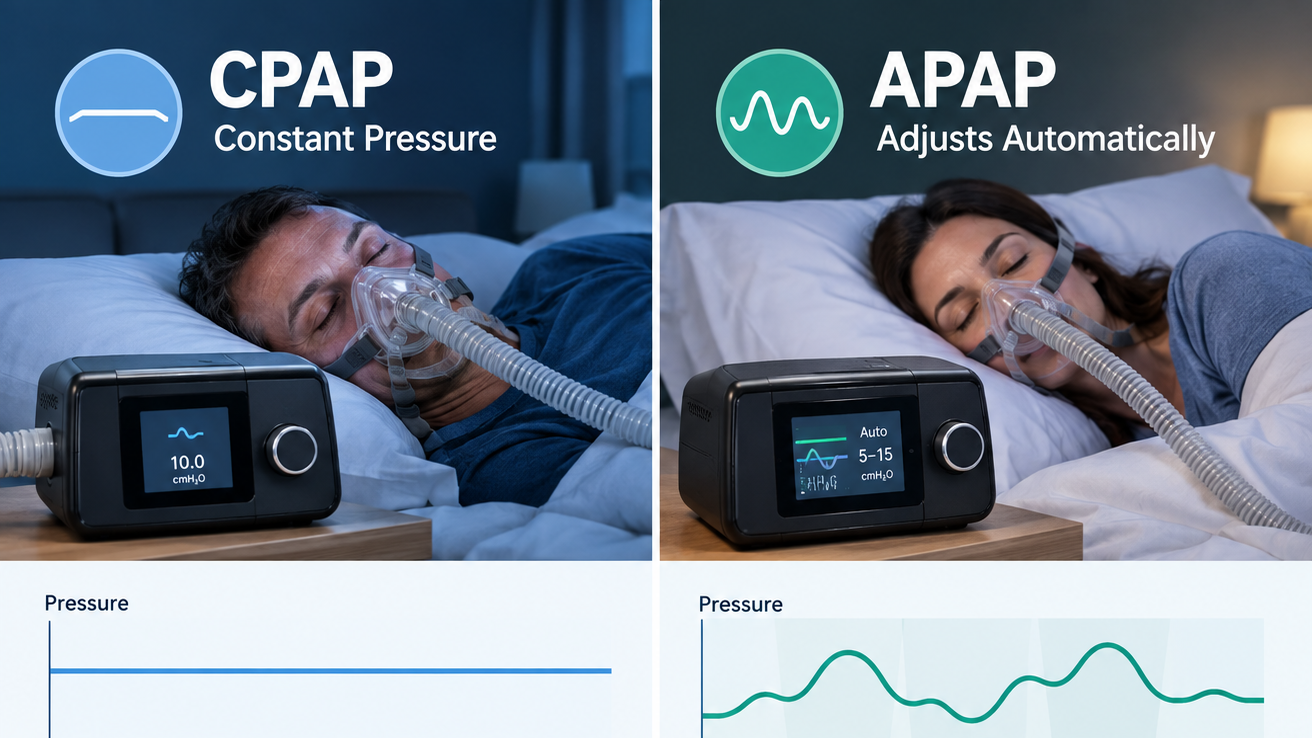
CPAP (continuous positive airway pressure) delivers one fixed pressure all night. If your prescription says 10 cm H2O, the machine holds 10 whether you are on your back in deep sleep or on your side in REM.
APAP (auto-titrating positive airway pressure) works inside a range, say 5 to 15 cm H2O. It monitors your breathing and raises pressure when it detects the airway starting to close, then eases off when it does not need to. Over a night the pressure moves continuously.
Both are treating the same thing the same way: holding your airway open with air pressure. The difference is whether the amount is fixed in advance or adjusted in real time.
A third term you will see is bilevel (BiPAP), which uses separate inhale and exhale pressures. That is a different category with its own prescribing reasons, not a premium version of the two above.
Why this is not really a shopping decision
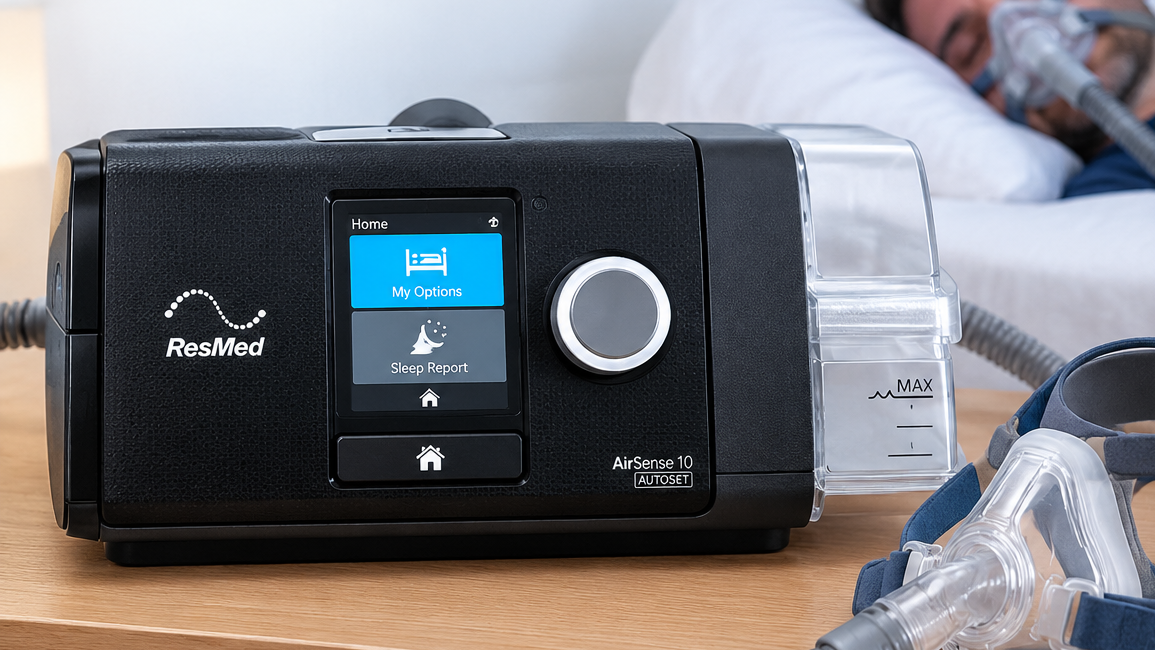
Every machine on CPAP.com's main machine listing today is an auto-adjusting model: the ResMed AirSense 11 AutoSet at $1,004, the AirSense 10 AutoSet at $960, the React Health G3 X Auto at $873, and the travel machines. There is no cheaper fixed-pressure version sitting next to them waiting to save you money. Prices checked September 27, 2026.
Every one of those machines will also run in fixed CPAP mode. That is how an auto machine works: the fixed setting is the same machine with the range collapsed to a single number.
So if you are shopping with a prescription in hand:
- Prescribed fixed CPAP? Buy one of those auto machines. Your clinician sets it to your fixed pressure. You have lost nothing, and if your prescription changes later the machine can follow.
- Prescribed APAP? Same machines. Same prices.
Fixed-pressure-only models do exist, mostly through clinical and DME channels rather than retail shelves. If a supplier offers you one, there is nothing wrong with it. Just know you are not getting a discount for the missing capability, and you are giving up the option of switching modes later without new hardware.
The common claim that "CPAP is usually more affordable" was true once. At US retail today, it is not the decision you are making.
What the evidence says
The American Academy of Sleep Medicine's 2019 clinical practice guideline on PAP treatment for adult OSA addresses this directly, and its recommendation is unusually clean:
"We recommend that clinicians use either APAP or CPAP for ongoing treatment of OSA in adults."
That is rated STRONG, the guideline's highest confidence level. The meta-analyses behind it found no clinically significant differences between the two modes in adherence, in self-reported or objectively measured sleepiness, or in quality of life.
In plain terms: for a typical adult with obstructive sleep apnea and no complicating conditions, neither mode is the better therapy. If you have been prescribed one and you were hoping the other is secretly superior, it is not.
Where that evidence stops, and why it matters
This is the part most comparison articles leave out, and it is the reason this page exists.
The AASM's recommendation rests on studies that excluded patients with:
- Congestive heart failure
- Chronic opioid use
- Significant lung disease, such as COPD
- Neuromuscular disease
- A history of uvulopalatopharyngoplasty (UPPP surgery)
- A need for supplemental oxygen during sleep
- Expected nocturnal oxygen desaturation from causes other than OSA, including hypoventilation syndromes and central sleep apnea syndromes
If any of those describe you, "APAP and CPAP are equivalent" is not a finding that has been tested in people like you. It does not mean APAP is unsafe for you. It means the evidence is silent, and your clinician is making a judgment that deserves a conversation rather than an assumption.
This matters most with central apnea. Auto algorithms detect a reduction in airflow and respond by raising pressure. When the cause is obstruction, that is exactly right. When the cause is that your brain briefly stopped sending the signal to breathe, more pressure does not help and can make things worse. If your diagnosis is central rather than obstructive, or you have treatment-emergent central apnea, you are in different territory entirely. See our explainers on central versus obstructive sleep apnea and complex, treatment-emergent sleep apnea.
When a clinician tends to choose fixed CPAP
- You had a full in-lab titration study that established a pressure that controls your apnea. There is often no reason to reintroduce variability.
- You have one of the comorbidities above, where predictable pressure is easier to reason about clinically.
- Auto mode is chasing its tail. Some people get pressure swings that fragment their sleep more than the apnea did. A fixed setting stops that.
- Your pressure need is stable. If your data shows the auto algorithm sitting at roughly the same number every night, the range is not buying you anything.
When APAP genuinely earns its keep
- Your pressure need varies. Many people need meaningfully more pressure on their back than on their side, or during REM sleep than in other stages. A fixed pressure has to be set high enough for the worst case, which means most of the night is spent at more pressure than you need.
- Your weight is changing. Pressure requirements move with weight, in both directions. A range absorbs that without a clinic visit.
- Nasal congestion comes and goes. Seasonal allergies, colds, and the changes in pressure need they cause.
- You are being titrated at home. The AASM guideline also states, again STRONG, that PAP therapy can be initiated using either APAP at home or in-lab titration in adults with OSA and no significant comorbidities. This is why many people start on auto for a few weeks, and are then either left on it or switched to the fixed pressure the data identified. If that happens to you, it is the system working as designed, not a downgrade.
What insurance thinks
Nothing, as far as your wallet is concerned. Medicare's coverage of PAP devices puts both auto-titrating and single-level CPAP machines under the same billing code, E0601, on the same 13 month capped rental. A supplier is not paid more for giving you an auto machine, and you should not be charged an upgrade fee for the mode.
If a supplier presents APAP as a paid upgrade over CPAP, ask them to show you where that cost comes from. On the Medicare fee schedule it does not exist, and most commercial plans follow the same structure. Our new diagnosis guide covers the rental mechanics and the adherence rule that comes with them.
What actually changes how the air feels
If the reason you are researching modes is that therapy is uncomfortable, mode is unlikely to be the lever. In order of how often they are the real cause:
- Mask fit and leak. By a wide margin the most common cause of everything people dislike about CPAP.
- Exhale pressure relief, called EPR on ResMed machines. It drops pressure as you breathe out and is the standard fix for "it feels like exhaling against a wall."
- Humidification. Dry mouth, dry nose, and morning congestion.
- Ramp. For the feeling that the pressure is too much at bedtime.
- The mode. Last, and usually only after the first four have been addressed.
The first four are all adjustable without buying anything. Our starter guide walks through them.
What to ask your clinician
- Which mode am I on, and what are my exact settings?
- What was that based on, an in-lab titration or auto data from home?
- If I am on auto, what pressure is the machine actually using most nights? Would a fixed setting at that number be simpler?
- If I am on fixed, does my data show I need more pressure in some positions or sleep stages?
- Do any of my other conditions change how we should think about auto mode?
- Is EPR enabled, and at what level?
You are not asking to be handed the controls. You are asking to understand the prescription you are already using every night, and any good sleep clinic will welcome the question. If you do not have one yet, find an accredited sleep clinic.
The bottom line
Buy the machine, not the mode. Every current retail machine does both, at the same price, and your prescription decides which one runs. If you are shopping, our 2026 machine comparison is the more useful page.
For uncomplicated obstructive sleep apnea, the AASM is clear that neither mode is better. If you have heart failure, COPD, central apnea, use opioids, or need oxygen at night, that equivalence has not been demonstrated in people like you, and the mode is a genuine clinical decision worth discussing with your physician rather than a preference you settle by reading buying guides.
Sources
- Patil SP et al., "Treatment of Adult Obstructive Sleep Apnea with Positive Airway Pressure: An American Academy of Sleep Medicine Clinical Practice Guideline," Journal of Clinical Sleep Medicine, 2019
- CMS Local Coverage Determination L33718, Positive Airway Pressure (PAP) Devices for the Treatment of Obstructive Sleep Apnea
- CMS Policy Article A52467, Positive Airway Pressure (PAP) Devices for the Treatment of Obstructive Sleep Apnea
- CPAP.com machine listings and pricing, checked September 27, 2026
This article is general information, not medical advice. CPAP and APAP settings are prescribed, and changing your own pressure or mode can make your therapy less effective. Talk to your sleep physician about which mode suits your diagnosis.
Shop CPAP masks, machines, and supplies
CPAP.com carries a wide range of machines, masks, cushions, filters, and cleaning supplies, with guidance to help you find the right fit for your therapy.
Shop CPAP.comAdvertising disclosure: this is a paid partnership. We may earn a commission if you sign up through this link, at no extra cost to you.
Written by
Daniel Marin
Sharing insights on sleep health and wellness to help you achieve better rest and improved quality of life.