Advertising disclosure: this article contains a sponsored link to CPAP.com, a retailer we have an affiliate relationship with. If you buy through it we may earn a commission, at no extra cost to you. Nothing below depends on where you buy, and the section that matters most, choosing a mask, applies wherever you get it.
You have a diagnosis and a prescription, and somewhere in the paperwork is the word CPAP. If you are searching for the best machine to start on, here is the thing worth knowing before you spend an hour comparing models: the machine is the smallest of the three decisions in front of you.
The other two are where you get it from, which determines what it costs, and which mask you put on your face, which determines whether you are still using it in six months. Roughly half of people prescribed CPAP do not use it enough to benefit, and mask problems are the most common reason. Almost nobody quits because they picked the wrong model of machine.
So this guide covers all three, in the order they will actually matter to you. Machine prices quoted were checked on CPAP.com on September 25, 2026.
First: where your machine comes from
Most newly diagnosed people never shop for a machine at all. Your clinic sends the prescription to a durable medical equipment (DME) supplier, and the supplier sends you whatever they stock. That is a legitimate path, and often the cheapest one, but it is worth understanding what you are signing up for.
Through insurance. Medicare and most commercial plans do not buy you a machine outright. Medicare's coverage policy for PAP devices (LCD L33718) runs a 13 month capped rental. During an initial trial period you have to prove you are using it, commonly applied as at least 4 hours a night on 70% of nights in a consecutive 30 day window within the first three months. Miss that window and coverage can be withdrawn, which can leave you holding the cost. Most commercial plans copy this structure.
Buying it yourself. You can decline the supplier and buy a machine with your prescription. You pay the full price up front, you choose the exact model, and there is no adherence report going to a payer. That last part is not permission to use it less. The reason the rule exists is that the therapy only works on the nights you use it. It just means the decision stays between you and your sleep physician.
Which is cheaper depends entirely on your plan. With a high deductible, the cash price can beat coinsurance across a 13 month rental. With a low deductible and good DME coverage, insurance usually wins. Get the rental terms from your supplier and compare them against the cash price before you commit, because switching later is harder than choosing now.
One more thing about the DME path: you can generally ask for a specific machine. Suppliers stock what they stock, but "I would like an AirSense 11 rather than whatever is on the shelf" is a reasonable request, and it costs nothing to ask.
What your prescription decides, and what you decide
Your prescription controls the mode (fixed CPAP or auto-adjusting APAP), the pressure or pressure range, and any bilevel requirement. You do not change these, and no retailer will change them for you. Adjusting your own pressure is the fastest way to make therapy worse.
You control the machine brand and model, the mask, the humidification setup, and the comfort settings your clinician leaves open to you (ramp time, and often exhale relief).
Federal law requires a valid prescription before any machine ships in the US, whoever you buy from. A site that offers to skip that step is telling you something about the rest of its operation.
If you have not actually been diagnosed with a sleep study yet, that comes first. Find an accredited sleep clinic and read our comparison of home sleep tests and in-lab studies.
The machine: what to start on
For a first machine, the feature that matters is not airflow. Every current machine delivers prescribed pressure competently. What matters is how much help you get during the first month, because that is when people quit.
ResMed AirSense 11 AutoSet, $1,004. The default first machine, and the one most US clinics hand out. It is worth the premium for beginners specifically because of the setup coaching: guided onboarding with video tutorials, a TestDrive mode that lets you practice breathing on the mask while awake, mask fit and leak checks, and check-in prompts through the first weeks. Built-in cellular means your therapy data uploads on its own, which quietly removes a step people forget when a payer needs adherence records.
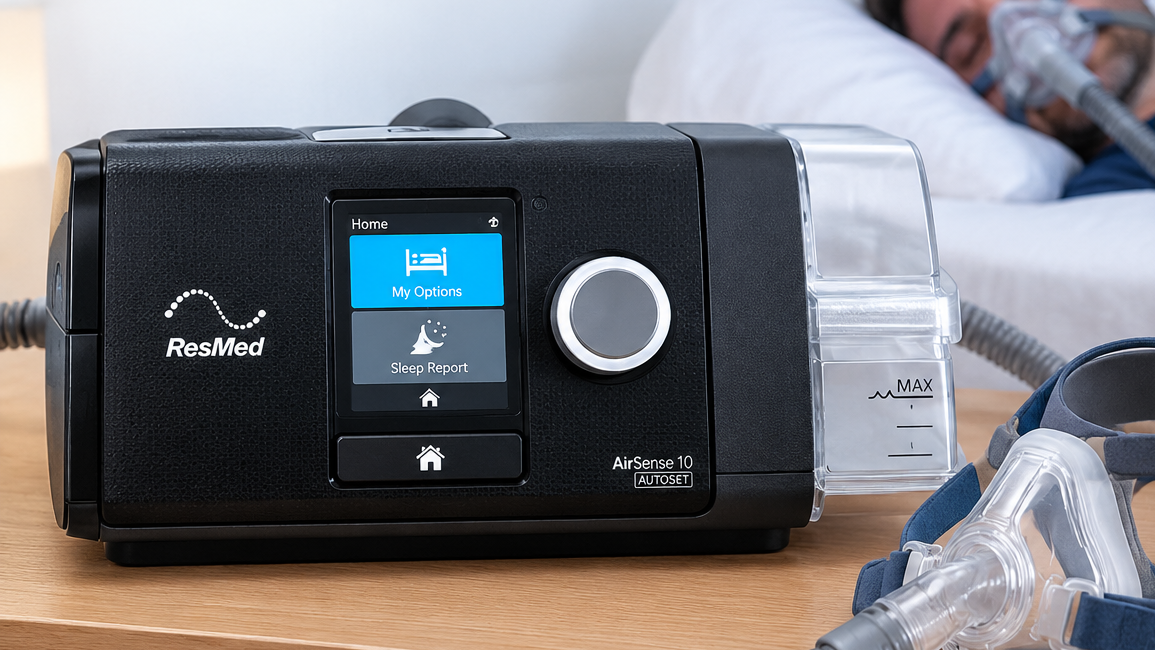
ResMed AirSense 10 AutoSet, $960. Same AutoSet algorithm, same pressure range, a physical dial instead of a touchscreen, and none of the onboarding software. Forty-four dollars cheaper. If you are buying your first machine, the coaching is worth more than the saving. We compare the two in detail in AirSense 11 vs AirSense 10.
React Health G3 X Auto, $873. The value option, with a five year warranty and a heated hose in the box. A good machine, but a smaller support community, which matters more when you are new and something behaves oddly at 3am.
That is deliberately short. For the full market, including travel machines and the reason the 2026 lineup looks the way it does, see our comparison of the CPAP machines you can actually buy this year.
The decision that actually predicts whether you stick with it
The mask. This is where beginners lose, and where almost no buying guide spends enough words.
There are three interface types, and the right one depends on how you breathe at night and how you sleep, not on price.
| Type | What it covers | Suits | Watch out for |
|---|---|---|---|
| Nasal pillow | Two soft inserts at the nostrils | Side sleepers, people who feel closed in, beard wearers | Higher pressures can feel harsh; no help if you breathe through your mouth |
| Nasal mask | A cushion over the nose | Most people, most pressures | Needs you to keep your mouth closed, or add a chinstrap |
| Full face | Nose and mouth | Mouth breathers, blocked noses, high pressures | Bulkier, more surface to leak, harder on side sleepers |
Start here: if you breathe through your nose and your nose is usually clear, a nasal mask or nasal pillows will be more comfortable and less leaky than a full face mask. If you wake with a bone-dry mouth, or you know you are a mouth breather, do not fight it with willpower. Either use a full face mask or ask about a chinstrap with a nasal mask.
Size is not cosmetic. A cushion one size too large leaks, and the usual reaction is to overtighten the headgear, which makes it leak more and leaves marks. If your mask leaks, loosen it first and re-seat it before you tighten anything.
Use the fit guarantee. CPAP.com's policy is a one-time 60 night mask fit guarantee: an opened mask can be exchanged for a different mask or size within 60 nights of shipping, with an ongoing 30 night guarantee on exchanges after that. Other retailers offer comparable programs. This exists because mask fit is genuinely hard to predict, so treat your first mask as a starting hypothesis rather than a purchase.
What comes in the box, and what does not
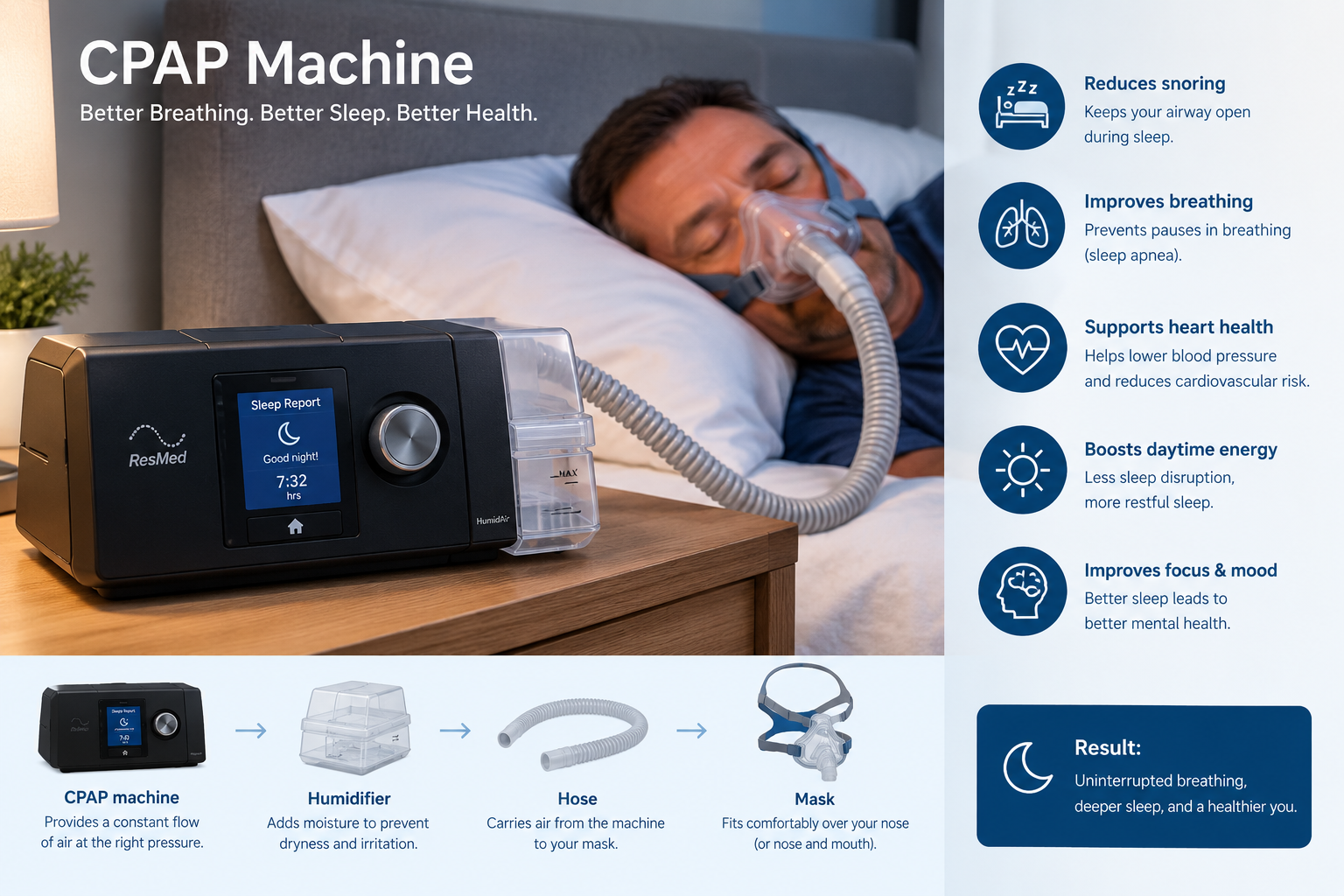
A new machine typically ships with the device, a humidifier chamber, a hose, a power supply, one filter and a manual. It usually does not include:
- A mask. Bought separately unless you buy a bundle.
- A heated hose, on the ResMed machines. Separate purchase, and the thing that solves rainout and dry air.
- Distilled water. Use distilled, not tap. Mineral scale ruins chambers.
- Spare filters and a spare cushion. Cushions wear out fastest of anything in the system.
Budget $150 to $300 beyond the machine for a mask and starter supplies. Over five years, consumables usually cost more than the machine did.
Your first 30 nights
Most of what alarms beginners is normal and fixable. Here is what to expect and what to do.
Air feels like too much when you lie down. Use the ramp. It starts you at a low pressure and builds to your prescribed setting as you fall asleep.
Exhaling feels like pushing against a wall. This is the single most common early complaint and it has a specific fix: exhale pressure relief, called EPR on ResMed machines. It drops pressure slightly as you breathe out. Ask your clinician whether it is enabled and at what level.
Dry mouth, dry nose, or a blocked nose in the morning. Turn humidification up. If you get condensation in the hose instead ("rainout"), that is a heated hose problem, not a humidity problem.
Red marks, sores, or a leak into your eyes. Mask fit. Loosen, re-seat, then consider a different size or type. Do not sleep through pressure sores.
Swallowing air, bloating, burping. Called aerophagia. Common early, often improves, sometimes needs a pressure or mask adjustment. Tell your clinic if it persists.
You take the mask off in your sleep without remembering. Extremely common in week one and not a sign of failure. Wear the mask for an hour while awake, reading or watching television, so your brain stops treating it as an intruder. The AirSense 11's practice mode is the same idea.
You do not feel better yet. Some people feel transformed after three nights. Many take weeks, and some feel worse before better because fragmented sleep does not reorganize overnight. Judge at four to six weeks of consistent use, not at day four.
When to call the clinic rather than the retailer
A retailer can solve mask and equipment problems. These are clinical, and belong to your sleep physician:
- You are using it consistently and still profoundly sleepy after a month
- The pressure feels wrong, or you feel short of breath on it
- Chest pain, palpitations, or severe morning headaches
- Pressure sores that are not resolving with fit changes
- Your data shows a high residual AHI despite good usage
- You were diagnosed with central sleep apnea rather than obstructive, in which case a standard auto CPAP may not be the right device at all. See central versus obstructive sleep apnea.
The five beginner mistakes
- Tightening the mask to stop a leak. It usually makes it worse. Loosen and re-seat first.
- Skipping nights early on. The first weeks build the habit and, on an insurance rental, the record that keeps your coverage.
- Changing your own pressure. Not yours to change, and it makes the data your clinician needs meaningless.
- Buying a full face mask by default. Many people who assume they need one do better on a nasal mask, which leaks less and feels lighter.
- Suffering in silence for three months. Almost every early problem has a fix, and most fixes take one phone call.
If you are buying online for the first time
- Upload your prescription. Every legitimate US retailer requires it.
- Know the return terms before you buy. At CPAP.com, machines carry a one-time 60 night risk-free return from the ship date, in original packaging, undamaged and free of heavy wear, with return shipping at your cost. Other retailers differ, so check rather than assume.
- Know what cannot go back. Cushions, headgear, frames, filters and tubing bought separately are non-returnable once opened. The mask fit guarantee covers complete masks, not parts.
- Buy the mask where you can exchange it. Given how often a first mask is the wrong one, the exchange policy is worth more than a small price difference.
The bottom line
If you want a single answer: start on the ResMed AirSense 11 AutoSet and spend real attention on the mask. The machine will do its job. The mask is what you will either tolerate or abandon.
And before you buy anything, price the insurance path against the cash price with your actual plan. That comparison is worth more money than any difference between the machines on this list.
Sources
- CPAP.com product listings, pricing and published refund and mask fit guarantee policies, checked September 25, 2026
- CMS Local Coverage Determination L33718, Positive Airway Pressure (PAP) Devices for the Treatment of Obstructive Sleep Apnea
- ResMed AirSense 11 and AirSense 10 product specifications
This article is general information, not medical advice. CPAP machines are prescription devices, and pressure settings should only be changed by your sleep physician. If you have a new diagnosis, your clinic is the right first call with any question about your therapy.
Shop CPAP masks, machines, and supplies
CPAP.com carries a wide range of machines, masks, cushions, filters, and cleaning supplies, with guidance to help you find the right fit for your therapy.
Shop CPAP.comAdvertising disclosure: this is a paid partnership. We may earn a commission if you sign up through this link, at no extra cost to you.
Written by
Daniel Marin
Sharing insights on sleep health and wellness to help you achieve better rest and improved quality of life.