Advertising disclosure: this article contains a sponsored link to CPAP.com, a retailer we have an affiliate relationship with. If you buy through it we may earn a commission, at no extra cost to you. It did not affect the comparison below, and both machines are sold by the same retailer at the prices quoted.
If you are choosing between the ResMed AirSense 11 AutoSet and the AirSense 10 AutoSet, here is the part most comparison pages bury: these are not two different levels of therapy. They run the same AutoSet algorithm across the same 4 to 20 cm H2O range, with the same exhale relief, the same ramp, and the same two-year warranty. Whichever you pick, the air you get is effectively the same air.
At the time of writing CPAP.com lists the AirSense 11 at $1,004 and the AirSense 10 at $960. A $44 gap on a machine you will use for five years is not a budget decision, so the usual "is it worth the upgrade" framing does not really apply. The real question is which interface and which data setup fits you, and, if you already own an AirSense 10, what the switch quietly costs in accessories.
Prices and specifications here were checked on CPAP.com on September 23, 2026. This is a specification and feature comparison, not a hands-on test: we have not run either machine on a bench or slept on both.
The short answer
Buy the AirSense 11 if you are new to CPAP, or you want the machine to handle its own data and updates. The guided setup, the practice mode, and built-in cellular are worth more in your first month than anything else on this list.
Buy the AirSense 10 if you already own one and your accessories still work, you prefer a physical dial to a touchscreen, or you want a machine your clinic and DME supplier have been troubleshooting for a decade.
Do not switch from a working AirSense 10 to an AirSense 11 expecting better therapy. You will spend the machine price plus roughly $150 to $250 replacing parts that do not carry over, for the same pressure delivered through a nicer screen.
Everything below is the reasoning.
What is identical
Worth stating plainly, because the marketing around the AirSense 11 does not make it obvious:
- The AutoSet algorithm. Same breath-by-breath pressure adjustment, same underlying therapy logic.
- Pressure range. 4 to 20 cm H2O on both.
- Expiratory Pressure Relief (EPR). The setting that drops pressure as you breathe out, and the most common fix when someone says CPAP feels like exhaling against a wall.
- AutoRamp and SmartStart. Gradual pressure at bedtime, automatic start when you breathe into the mask.
- Built-in heated humidification, with climate control available through a heated hose.
- Masks. Every ResMed mask, and every other brand's mask, fits both. Mask choice is completely independent of this decision.
- Warranty. Two years on both.
- Prescription. Federal law requires one before either ships.
If your sleep physician prescribed auto-adjusting CPAP in a normal pressure range, both machines fulfil that prescription identically.
What actually differs
The interface
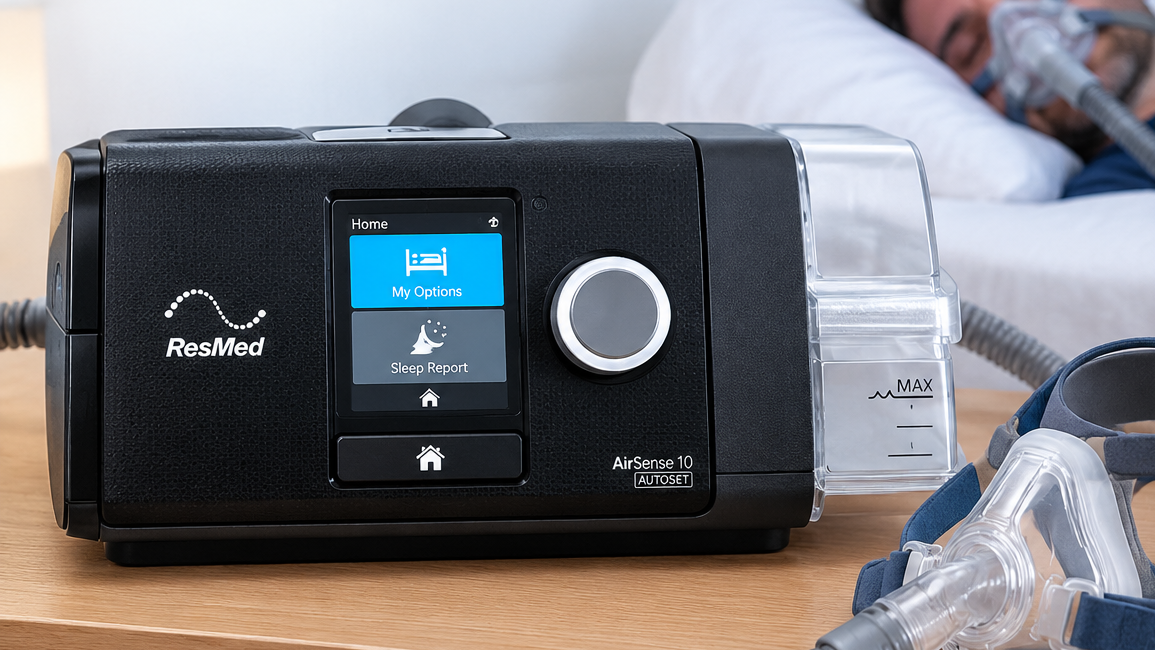
The AirSense 11 has a 3.5 inch color touchscreen. The AirSense 10 has a small display with a physical push-and-turn dial.
This is genuinely a preference, not an upgrade, and it splits people more sharply than you would expect. The dial can be operated in the dark, half asleep, without looking, and it does not register a stray touch when you nudge the machine. The touchscreen is easier to read and to navigate through menus. Long-term users are noticeably more likely to defend the dial; new users generally find the touchscreen friendlier.
Connectivity and data
This is the most substantive difference.
The AirSense 11 has Bluetooth, Wi-Fi and built-in cellular. It uploads therapy data on its own, supports over-the-air firmware updates, and lets your clinician view data and adjust settings remotely through ResMed's AirView.
The AirSense 10 sold by CPAP.com connects over Bluetooth to the myAir app on your phone. It works well, but your phone is part of the chain.
Two practical consequences:
If you are on a rental or an insurance plan that requires adherence reporting, a machine that uploads by itself removes a step that people routinely forget. Coverage often hinges on documented nightly use, so this is not a trivial convenience.
If you would rather your machine did not transmit anything by itself, that argument runs the other way, and the AirSense 10 gives you more control over what leaves the device.
Onboarding software
The AirSense 11 adds guided setup features the AirSense 10 does not have: a Personal Therapy Assistant with video tutorials, a TestDrive mode for practising with the mask while awake, mask fit and leak checks, and Care Check-In prompts during the first weeks.
It is easy to dismiss this as software fluff. It is the single best reason to choose the AirSense 11 anyway. Whether CPAP works for you is decided in the first month, by whether you can get the mask sealed and tolerate the pressure, and a machine that coaches you through exactly that is solving the actual problem. By month six you will not open any of it.
Size, weight and noise
The AirSense 11 is 2.5 lbs; the AirSense 10 is 2.75 lbs. A quarter of a pound.
On noise, ResMed's own figures are 27 dBA for the AirSense 11 and 26.6 dBA for the AirSense 10. The older machine is marginally quieter on paper. Both figures are manufacturer specifications measured under standardized conditions, the difference is far below what anyone can hear, and in a real bedroom the noise you notice is mask leak, not the motor. Do not let either number decide this.
Power supply
The AirSense 11 uses a 65W power supply, the AirSense 10 a 90W one. They are not interchangeable, which matters if you own spares or a travel battery set up for one of them.
Side by side
| AirSense 11 AutoSet | AirSense 10 AutoSet | |
|---|---|---|
| Price (CPAP.com) | $1,004 | $960 |
| Algorithm | AutoSet | AutoSet |
| Pressure range | 4-20 cm H2O | 4-20 cm H2O |
| Interface | 3.5" touchscreen | Display with dial |
| Connectivity | Bluetooth, Wi-Fi, cellular | Bluetooth to myAir |
| Firmware updates | Over the air | Not over the air |
| Guided setup, TestDrive | Yes | No |
| Weight | 2.5 lbs | 2.75 lbs |
| Noise (manufacturer) | 27 dBA | 26.6 dBA |
| Power supply | 65W | 90W |
| Humidifier | Built in, heated | Built in, heated |
| Warranty | 2 years | 2 years |
If you already own an AirSense 10
This is where the $44 price gap stops being the number that matters.
Carries over: your mask, your headgear, and standard 22mm or SlimLine 15mm tubing.
Does not carry over:
- The water chamber. The AirSense 11 chamber is a different shape and does not fit the AirSense 10, or the reverse.
- The ClimateLineAir heated hose. Model specific. An AirSense 10 climate hose will not run an AirSense 11, and you need the ClimateLineAir 11 instead.
- Filters. The AirSense 11 uses a smaller filter with a different tab, made for the 11 and AirCurve 11 only. Your stock of AirSense 10 filters becomes useless.
- The power supply. 65W against 90W.
Replacing a heated hose, a water chamber and a filter pack is realistically $150 to $250 depending on what you buy. Budget for it, or the upgrade costs meaningfully more than the shelf price suggested.
None of this is a reason to avoid the AirSense 11. It is a reason not to be surprised, and a reason to order the accessories at the same time rather than discovering mid-week that your hose does not fit.
Two things to check before you buy an AirSense 10
Which variant it is. During the chip shortage ResMed produced a "card-to-cloud" AirSense 10 that records to an SD card and has no wireless connection, so it does not work with the myAir app at all. Both versions are still in circulation across retailers. The one CPAP.com lists is the Bluetooth and myAir version, but if you are shopping around, read the listing carefully. A card-to-cloud machine is a legitimate device and often cheaper, it just cannot do the thing people assume every CPAP does now.
Whether certified pre-owned makes sense. CPAP.com also lists a certified pre-owned AirSense 10, professionally restored and tested, with possible cosmetic blemishes. Pricing is by phone rather than listed. The catch is the warranty: 60 days, against two years on a new machine. On a device you will run nightly for years, that is the trade you are actually making.
What neither machine will fix
If you are choosing between these two because your current therapy is uncomfortable, change the variable that is actually causing it. Leaks, pressure sores, dry mouth and claustrophobia are mask and humidification problems, and both machines are equally capable of delivering the fix. A different screen will not help.
If pressure itself is the problem, that is a conversation with your sleep physician about your settings or about whether a different mode suits you better. Our guide to CPAP alternatives covers what exists beyond adjusting the machine you have, and our 2026 machine comparison covers the wider market, including the foam-free React Health G3 X and the travel models.
If you have not been diagnosed yet, that is the step before any of this. Find an accredited sleep clinic and read our comparison of home sleep tests and in-lab studies.
The bottom line
The AirSense 11 is the better machine for someone starting therapy: the guided setup, practice mode and hands-off data upload all matter most in the weeks when people quit. For $44 over the AirSense 10, there is no real argument for saving the money if you are buying your first machine.
The AirSense 10 is the better machine for someone who already lives with one, prefers the dial, and has a drawer of accessories that fit it. It is not a compromise. It is the same therapy with an older interface and a slightly lower noise figure.
And if you already have a working AirSense 10, the honest advice is to keep it, spend the money on a mask that fits properly, and revisit machines when this one wears out.
Sources
- CPAP.com product listings and pricing for the AirSense 11 AutoSet, AirSense 10 AutoSet and certified pre-owned AirSense 10, checked September 23, 2026
- ResMed AirSense 11 product specifications, including connectivity and onboarding features
- ResMed AirSense 10 product specifications, including the card-to-cloud variant
- Accessory compatibility confirmed against ResMed AirSense 11 filter, humidifier chamber and ClimateLineAir 11 product documentation
This article is general information, not medical advice. CPAP machines are prescription devices, and pressure settings should only be changed by your sleep physician. Talk to your clinician about which machine and settings suit your diagnosis.
Shop CPAP masks, machines, and supplies
CPAP.com carries a wide range of machines, masks, cushions, filters, and cleaning supplies, with guidance to help you find the right fit for your therapy.
Shop CPAP.comAdvertising disclosure: this is a paid partnership. We may earn a commission if you sign up through this link, at no extra cost to you.
Written by
Daniel Marin
Sharing insights on sleep health and wellness to help you achieve better rest and improved quality of life.