Advertising disclosure: this article contains a sponsored link to CPAP.com, a retailer we have an affiliate relationship with. If you buy through it we may earn a commission, at no extra cost to you. One of the conclusions below is that many travelers do not need a travel machine at all.
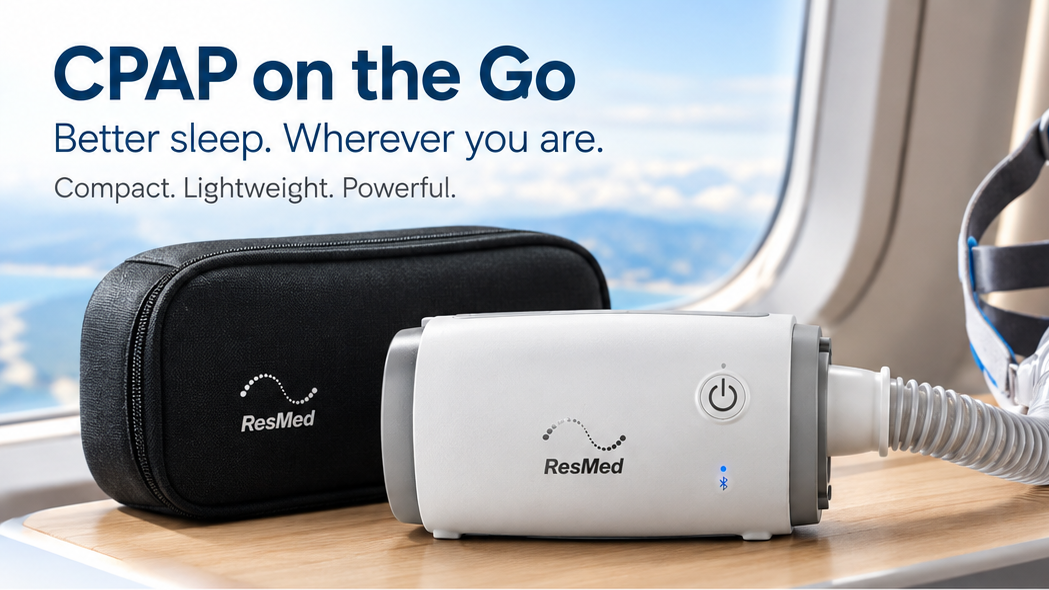
A travel CPAP machine is a second machine. That framing matters, because it changes the question from "which is best" to "what problem am I paying about $900 to solve?" If the answer is a couple of flights a year, your home machine in a padded bag may be the right choice. If you fly weekly, camp off grid, or want something that disappears into a backpack, a travel machine earns its price quickly.
In the US in 2026, two travel machines dominate that decision: the ResMed AirMini AutoSet and the Transcend Micro 510. They are closer in size and price than most comparisons suggest. What separates them is mask compatibility, batteries, and warranty, and each of those shifts the real cost by hundreds of dollars.
Prices and specifications were checked on CPAP.com on September 30, 2026. This is a specification comparison, not a hands-on test.
The short answer
Choose the Transcend Micro 510 if you want to use the mask you already own, you need battery power for camping or flights, or you want the longest warranty. It takes standard masks, and its battery is built for it.
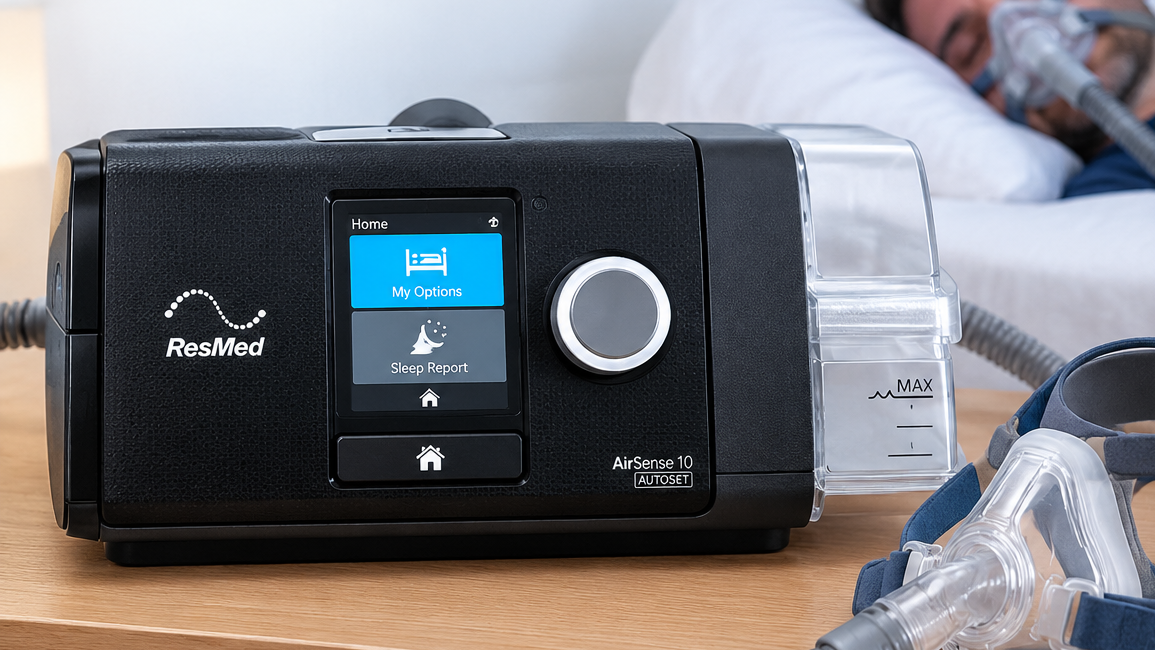
Choose the AirMini if you already use one of its compatible ResMed masks, you want your travel data in the same myAir app as your AirSense, or you prefer ResMed's ecosystem.
Choose neither if you travel a few times a year, mostly by car or with room in your luggage. A current home machine weighs about 2.5 lbs, and airlines must let you carry it on free.
Side by side
| ResMed AirMini AutoSet | Transcend Micro 510 | |
|---|---|---|
| Price (CPAP.com) | $919 | $829 |
| Weight | 0.66 lbs | 0.48 lbs |
| Pressure range | 4-20 cm H2O | 4-20 cm H2O |
| Modes | Auto and fixed | Auto and fixed |
| Masks | Seven specific ResMed masks | Most standard 22mm masks |
| Waterless humidification | HumidX, sold separately | AirMist HME, starter kit included |
| Noise (manufacturer) | 29 dBA | 25-29 dBA with included muffler |
| In the box | Machine, 20W power supply, filter, bag | Machine, hose, muffler, hard case, AirMist, AC power supply |
| Warranty | 2 years | 3 years |
The mask question decides most of this
This is the difference that changes both cost and convenience, and it is where most buyers get surprised.
The AirMini works only with specific ResMed masks. ResMed lists seven as compatible: the AirFit P10 nasal pillows, the AirFit N20, AirTouch N20 and AirFit N30 nasal masks, and the AirFit F20, AirTouch F20 and AirFit F30 full face masks. They connect through AirMini-specific setup parts rather than a standard hose, and the machine ships with no mask and no tubing.
So if your nightly mask is on that list, you need a setup pack. If it is not, you need a new mask as well, and your travel machine is now running on a mask you do not use at home, which is a risk for anyone whose fit took months to get right.
The Transcend Micro takes most standard CPAP masks through a normal 22mm connection, with a 6 foot hose in the box. Whatever you wear at home will almost certainly work. The one exception is masks designed specifically for the AirMini, which will not fit it.
That single difference is why the $90 gap in machine price understates the real gap. An AirMini buyer who needs a new mask can spend well over $100 before the first trip.
Humidification without water
Neither machine has a water tank. Both use a heat moisture exchanger (HME), a small cartridge that captures warmth and moisture from your exhaled breath and returns it on the next inhale.
- AirMini: HumidX, sold separately, in versions matched to specific masks.
- Transcend Micro: AirMist HME, with a starter kit included.
Be realistic about what an HME does. It is noticeably better than dry air and far easier than hauling distilled water. It is not the same as a heated humidifier. If you rely on high humidity at home because of dry mouth or congestion, expect some difference, and consider testing the travel setup for a few nights at home before a long trip.
Batteries and power
If you want to sleep without an outlet, whether camping, in a van, or using the machine on a long flight, the battery becomes part of the purchase.
Transcend Micro: its own PowerAway battery, $349.95 at CPAP.com at the time of writing, around 71 Wh. Transcend rates it at up to 17.5 hours on a charge, but actual runtime depends heavily on your pressure. CPAP.com also sells the Micro in bundles: an Essentials bundle at $988.90 and a Power bundle, which includes the battery, at $1,338.85.
AirMini: ResMed does not make a battery for it. The common option is the Medistrom Pilot-24 Lite, $339 at CPAP.com, which sits just under the 100 Wh airline threshold and needs the correct AirMini cable. Other third-party options exist; check compatibility before buying.
The honest total for off-grid use is therefore about $1,180 for the Transcend Micro with its battery and about $1,260 for the AirMini with a Pilot-24 Lite, before masks. Compare the Transcend Power bundle against buying the machine and battery separately: with the battery on sale when we checked, buying separately came out cheaper, though the bundle may include extras worth having. Treat any runtime figure as a best case, and test a full night at home with your actual pressure before depending on it somewhere remote.
Flying with a CPAP: the rules that actually apply
It does not count as your carry-on. Under the Air Carrier Access Act, implemented in 14 CFR Part 382, a CPAP is an assistive device. Airlines must let you bring it into the cabin, and it does not count toward your carry-on or personal item allowance. Keep it in its own case, and pack it in the cabin rather than in checked luggage, where it can be lost or damaged.
Security screening. Expect to take it out of the bag for X-ray, much like a laptop. A clear bag for the mask and tubing keeps them cleaner when screeners handle them.
Using it during the flight. Both machines are marketed as suitable for in-flight use; the AirMini specifies Airplane Mode. Airlines can ask for advance notice, commonly 48 hours, if you plan to use the machine onboard, and seat power is not guaranteed, so a battery is usually required. Call your airline before the trip rather than finding out at the gate.
Battery rules. These are FAA rules for lithium-ion batteries, and the medical device exemption does not raise them:
- Up to 100 Wh: allowed without airline approval.
- 101 to 160 Wh: allowed only with airline approval, with a limit of two spare batteries.
- Over 160 Wh: not allowed on passenger aircraft.
- Spare batteries go in carry-on luggage only, never checked, with terminals protected.
Both the PowerAway and the Pilot-24 Lite sit under 100 Wh, which is why they are the default choices. Carry the battery's rating documentation in case a gate agent asks.
International trips. Both machines include power supplies that accept a range of voltages, so a plug adapter is usually enough. Confirm this on the power brick label before you rely on it.
When you do not need a travel machine
Worth stating plainly, since this page is sponsored by a retailer:
- You fly a few times a year. Your home machine fits in a carry-on case, and airlines must allow it free. You keep your heated humidifier, your data, and your mask setup.
- You usually drive. Size barely matters in a car.
- Your home setup took a long time to get right. A travel machine changes the airflow feel, the humidification and possibly the mask. For some people that is enough to disturb a routine that works.
A travel machine is worth it when you travel frequently, need battery power, or pack light enough that 2.5 lbs plus a humidifier genuinely matters.
A few practical tips
- Test before you leave. Spend at least three or four nights at home on the travel setup, with the HME and battery if you will use them.
- Pack spares. A spare cushion and filter weigh almost nothing and prevent a ruined trip.
- Bring your prescription. A copy on your phone helps at international customs and if you need supplies away from home.
- Keep it clean. Both machines need regular filter changes, and HME cartridges are consumables with their own replacement schedules.
The bottom line
For most travelers who buy a dedicated travel machine, the Transcend Micro 510 is the easier recommendation: it is lighter, $90 cheaper, works with the mask you already use, includes a case and waterless humidification in the box, and carries a three year warranty.
The AirMini is the better choice when you already wear one of its compatible ResMed masks and want your travel data alongside your home AirSense data in myAir.
And if you travel only occasionally, bring your home machine. It is the setup you know works.
For the wider market, including home machines, see our 2026 CPAP machine comparison. If you are still settling into therapy, our guide for a new diagnosis covers mask choice and the first 30 nights, which matter more than any travel decision.
Sources
- CPAP.com product listings and pricing for the AirMini AutoSet, Transcend Micro 510 and bundles, PowerAway battery and Medistrom Pilot-24 Lite, checked September 30, 2026
- ResMed, AirFit masks for AirMini
- FAA PackSafe, Batteries Carried by Airline Passengers
- 14 CFR Part 382, Nondiscrimination on the Basis of Disability in Air Travel
This article is general information, not medical advice. Travel machines deliver the same prescribed therapy but can feel different from your home setup. Talk to your sleep physician if you notice a change in how you feel after switching machines.
Shop CPAP masks, machines, and supplies
CPAP.com carries a wide range of machines, masks, cushions, filters, and cleaning supplies, with guidance to help you find the right fit for your therapy.
Shop CPAP.comAdvertising disclosure: this is a paid partnership. We may earn a commission if you sign up through this link, at no extra cost to you.
Written by
Daniel Marin
Sharing insights on sleep health and wellness to help you achieve better rest and improved quality of life.