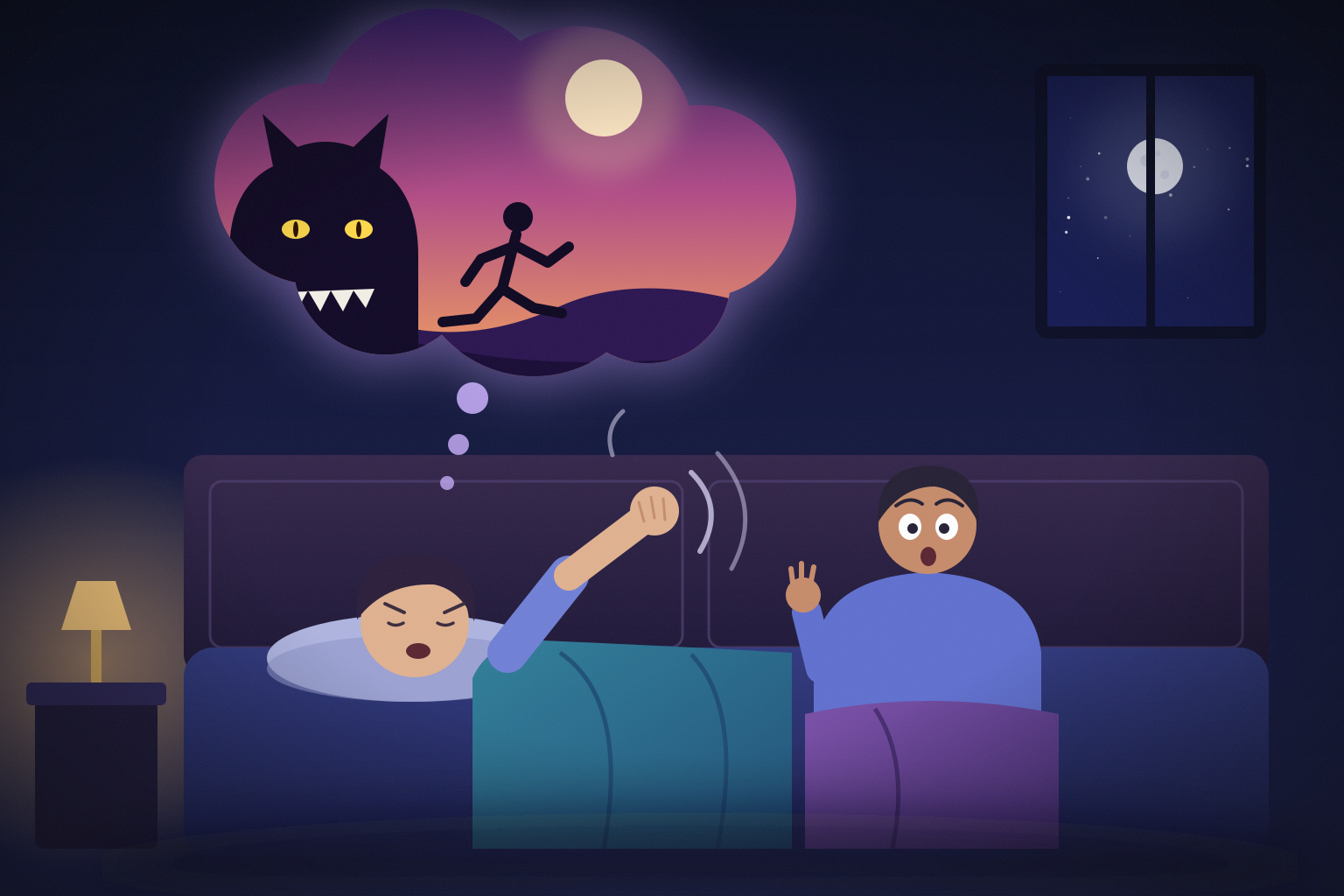
Your partner wakes you at 3 AM because you've been shouting, flailing, or swinging an arm. You remember a dream in which you were being chased or attacked, and you were fighting back. In the morning there may be a bruise, a broken lamp, or a bed partner who has started sleeping in another room.
Most people assume this is simply vivid dreaming, or stress, or a quirk of sleep. For many it is nothing more than an occasional restless night. But when it happens repeatedly, and especially in middle-aged and older adults, it can be REM sleep behavior disorder (RBD), a distinct and clinically significant condition. RBD matters for two reasons: the injuries it can cause, and what it can signal about the brain years before other symptoms appear.
This article covers what RBD is, what the research says about its link to Parkinson's disease, and how it's diagnosed and managed. The link is real, but it deserves a calm and accurate explanation rather than a frightening one.
What Happens in a Normal Dream, and What Goes Wrong in RBD
During REM sleep, the stage in which most vivid dreaming occurs, your brain is highly active, but your body is essentially paralyzed. This REM atonia is produced by brainstem circuits that switch off the voluntary muscles, sparing the eyes and the muscles that keep you breathing. Our guide to the four stages of sleep explains why this paralysis exists: it prevents you from physically acting out what you're dreaming.
In RBD, that protective paralysis fails. The muscles remain active during REM sleep, and the person acts out the dream with real movement: talking, shouting, laughing, punching, kicking, flailing, sitting up, or leaping from the bed.
What an episode looks like:
- Occurs during REM sleep, which means typically in the second half of the night, though it can happen at other times
- The movements and vocalizations match the content of a dream, often an action-filled or threatening one (being chased, attacked, or defending someone)
- The person usually wakes quickly and becomes alert, and can often describe the dream in detail that matches what the partner saw
- Eyes are typically closed during the episode
- Episodes can be violent enough to injure the sleeper or a bed partner
That quick, clear awakening with detailed dream recall is one of the features that helps distinguish RBD from sleepwalking, in which the person is hard to wake, confused, and remembers nothing. Our guide on sleepwalking in adults covers that contrast.
Who Gets It
RBD occurs mostly in men over 50, though it can affect women and younger people. In a large population-based study, about 1 percent of middle-aged and older adults had RBD confirmed by sleep testing, which suggests it is more common than most people realize and widely under-recognized.
It can occur in several different settings:
Isolated (idiopathic) RBD. This is RBD with no other known neurological condition at the time of diagnosis, and it's the form most closely tied to the Parkinson's connection discussed below.
RBD associated with neurological disease. It occurs in people who already have Parkinson's disease, dementia with Lewy bodies, or multiple system atrophy, and often appears before the other symptoms.
RBD associated with narcolepsy. This is the form most often seen in younger people. Our guide to narcolepsy covers that condition.
Medication-related RBD. Certain drugs, most notably several classes of antidepressants (SSRIs, SNRIs, and tricyclics), can trigger or worsen dream enactment. This is an important reason to review your medication list with your physician rather than assuming the cause is neurological.
The Link to Parkinson's Disease
This is the part of RBD that draws the most attention, and the one most in need of careful explanation.
What the research shows. Parkinson's disease, dementia with Lewy bodies, and multiple system atrophy share an underlying biology: abnormal buildup of a protein called alpha-synuclein in the brain. Collectively they are called synucleinopathies. RBD is now recognized as one of the earliest and most reliable warning signs of this group of conditions, often appearing years, and in some cases decades, before tremor, stiffness, or memory problems show up.
Long-term follow-up studies of people with isolated RBD have found that a large proportion go on to develop one of these conditions. In the largest multicenter follow-up study to date, about three quarters of people with isolated RBD had developed a synucleinopathy after roughly 12 years. Many of these studies come from specialist referral centers, which may overstate the figures somewhat for the general population, but the overall conclusion is well established: isolated RBD in an older adult is a strong marker of future neurodegenerative disease.
What this does and doesn't mean for you.
- RBD is a risk marker, not a diagnosis of Parkinson's disease. Many people with RBD feel entirely well in every other respect when they're diagnosed.
- The interval is long. Years or decades can pass between the onset of RBD and any other symptom, and during that time the person may live a full and active life.
- Not everyone with RBD will develop one of these conditions, and the outcome can't be predicted for any one individual.
- Other early signs sometimes accompany RBD, including a reduced sense of smell, chronic constipation, and lightheadedness when standing. Their presence is worth mentioning to a neurologist.
An honest account of the uncertainty. There is currently no treatment proven to slow or prevent the progression of these diseases. Some people find the knowledge of increased risk distressing, and some prefer not to dwell on it. That is a personal decision, and a good specialist will discuss it sensitively rather than leading with worst-case scenarios. The case for diagnosis rests on three things: safety, symptom treatment, and monitoring. RBD patients are also the people best positioned to take part in research aimed at developing protective therapies, which is an active area of study.
Other Things That Can Look Like RBD
Several conditions can mimic dream enactment, which is one reason a sleep study is needed to confirm the diagnosis:
- Sleepwalking and other NREM parasomnias, which arise from deep sleep, occur earlier in the night, and leave the person confused and without memory of the event
- Obstructive sleep apnea, in which repeated arousals can produce movements and vocalizations that closely resemble RBD, sometimes called "pseudo-RBD." Treating the apnea can resolve them. Our guide on sleep apnea symptoms covers the warning signs
- Nocturnal seizures, which tend to be brief, repetitive, and stereotyped
- Periodic limb movement disorder, which produces rhythmic leg movements rather than complex, dream-linked behavior
- Nightmares, which wake the person without any physical enactment
This overlap is exactly why accurate diagnosis matters so much: the treatments, and the implications, differ.
How RBD Is Diagnosed
Diagnosis requires two things: a history of dream enactment behavior, and video polysomnography showing REM sleep without atonia, meaning muscle activity during REM sleep that should be absent.
Why a home test can't do it. Detecting REM sleep without atonia requires measuring brain waves, eye movements, and muscle tone simultaneously, and the video recording documents the actual behaviors. A home sleep apnea test measures none of these. This is an in-lab study. Our guides on home tests versus in-lab studies and what to expect during a sleep study explain how the night works.
A thorough evaluation also includes a medication review, an assessment for sleep apnea and other sleep disorders that may be contributing, and typically a neurological evaluation, including a check for subtle early signs of Parkinson's-related changes.
Treatment and Safety
Safety comes first, and it can't wait for a diagnosis. Injuries are the most immediate danger. Practical steps include:
- Removing sharp or breakable objects from around the bed, including lamps and glass
- Moving the bed away from windows and furniture
- Placing a mattress on the floor, or using padding or cushions around the bed
- Padding or removing bed rails that could cause injury
- Having the bed partner sleep separately, at least temporarily, until the condition is controlled
- Not trying to restrain the person during an episode, which can cause injury to both people
Medication. Two treatments are most commonly used. Melatonin, at higher doses than the amount used for jet lag, is widely used as a first choice because it is generally well tolerated and effective for many people. Clonazepam, a sedative, is effective for many patients but carries more cautions, especially in older adults, because it can worsen sleep apnea, cause daytime drowsiness, and increase fall risk. Choosing between them depends on your age, other health conditions, and whether you have sleep apnea. Neither should be started without a physician's guidance.
Treat contributing conditions. If sleep apnea is present, treating it can reduce episodes. If an antidepressant is implicated, your prescriber may be able to adjust it, but never stop an antidepressant on your own.
Ongoing neurological follow-up. Regular monitoring is recommended, so that any early changes are recognized and addressed promptly.
When to See a Specialist
Seek evaluation if you or a bed partner notice:
- Physical movement, shouting, or violent behavior during sleep, especially in association with vivid dreams
- Injuries to yourself or a partner during sleep
- Dream enactment that is new, especially after age 50
- Dream enactment that began after starting a new medication
Because RBD involves both sleep medicine and neurology, look for an accredited sleep center with board-certified sleep physicians experienced in parasomnias. Our guides on choosing a sleep clinic and what a board-certified sleep medicine physician is explain what to look for. Our symptom checklist also includes a parasomnia section that can help you describe what you're experiencing.
The Bottom Line
RBD occurs when the brain's normal paralysis during REM sleep fails and a person physically acts out vivid dreams. It's common enough to be worth knowing about, treatable, and diagnosed only through an in-lab sleep study with video. It can cause real injuries, so safety measures and treatment are worthwhile in their own right.
It is also one of the strongest early warning signs known for Parkinson's disease and related conditions. That's important information, but it's a signal rather than a verdict: the interval is long, the outcome isn't certain, and a diagnosis puts you in the best position to protect yourself now and to benefit from advances in care later.
Acting out your dreams? Use our sleep clinic directory to find an accredited sleep center near you that can perform a full video polysomnogram and evaluation.
Written by
Daniel Marin
Sharing insights on sleep health and wellness to help you achieve better rest and improved quality of life.