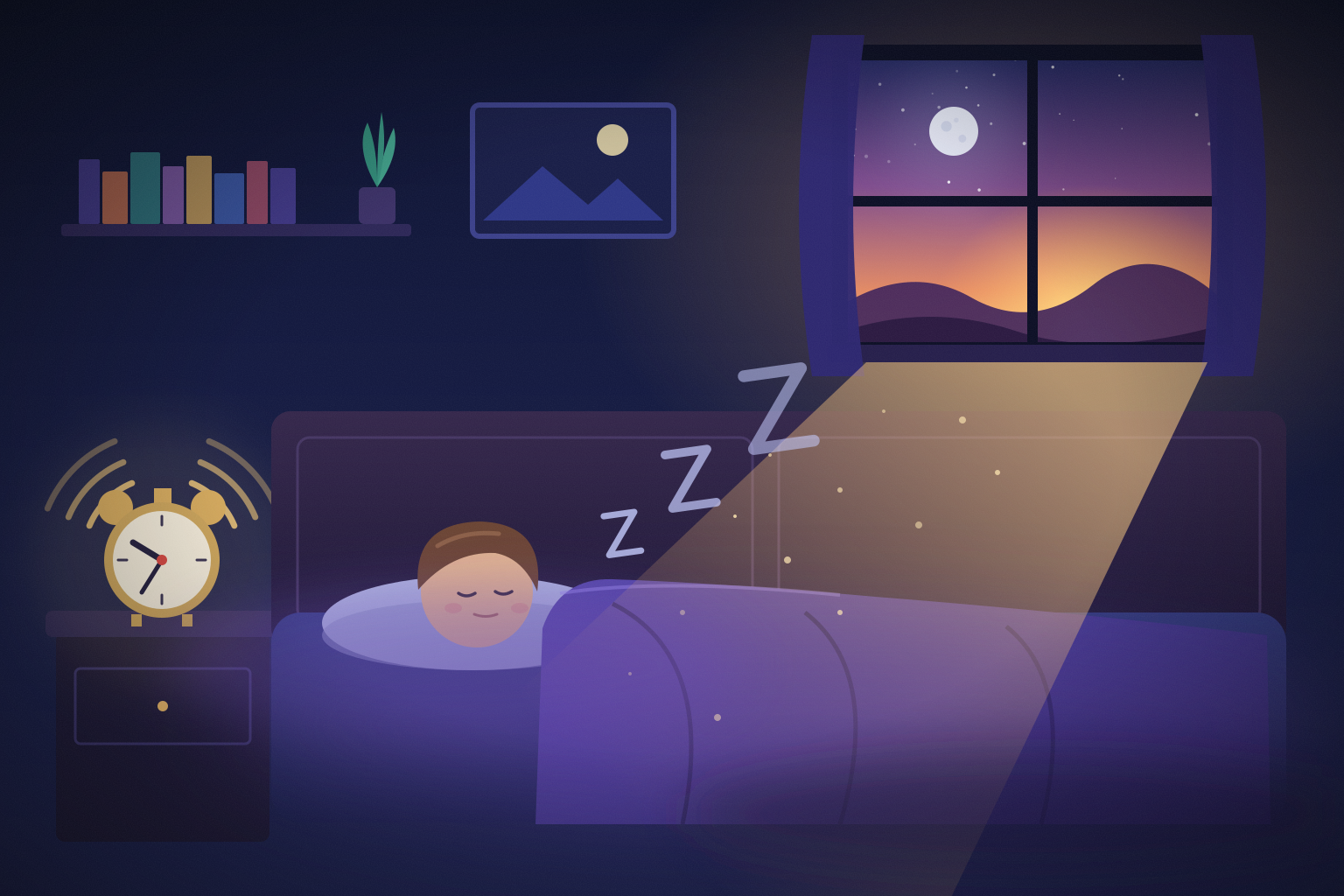
You sleep ten, eleven, sometimes twelve hours a night. You wake up feeling like you've been pulled up from the bottom of a lake, groggy and confused, sometimes for an hour or more. You nap during the day, and the nap doesn't help: you wake from it just as foggy as before. You've been told it's depression, or poor sleep habits, or that you're simply not trying hard enough. Your sleep study didn't find sleep apnea. And you still can't stay awake.
That pattern has a name: idiopathic hypersomnia (IH). It's a rare and poorly understood disorder, one of the central disorders of hypersomnolence, and it's frequently confused with narcolepsy, which it resembles on the surface and differs from in important ways. Because both conditions are diagnosed with the same testing and both are routinely missed for years, understanding the differences can save a long and frustrating search for answers.
What "Idiopathic" Means Here
"Idiopathic" simply means the cause is unknown. IH is diagnosed when a person has a persistent, severe need for sleep that can't be explained by anything else: not sleep apnea, not insufficient sleep, not a medication, not a medical or psychiatric condition.
It is a diagnosis of exclusion, which is a large part of why it takes so long to identify. Before anyone can say a person has IH, the far more common explanations have to be ruled out, and the person has to complete a specific sequence of testing. Our guide to excessive daytime sleepiness covers that wider list of possible causes, and it's the right starting point if you aren't sure whether what you have is true hypersomnolence or something more common.
Symptoms typically begin in adolescence or young adulthood, and the condition is chronic. Reliable figures on how many people have IH are hard to come by, because it is so frequently undiagnosed and the diagnostic criteria have shifted over time. What's clear is that it is considerably less well known than narcolepsy, among patients and among many clinicians.
The Core Symptoms
Excessive daytime sleepiness. The defining feature, and a severe one. It isn't ordinary tiredness. It's a persistent, irrepressible need to sleep, with lapses into sleep during the day that can happen during activities where sleep should be impossible. This is the same symptom that defines narcolepsy, which is exactly why the two get confused.
Long, unrefreshing naps. This is one of the most useful distinguishing features. In IH, naps are often an hour or longer, and the person typically wakes from them no more refreshed than before, sometimes more groggy. In narcolepsy, short naps often feel genuinely restorative, at least for a while.
Severe sleep inertia, sometimes called "sleep drunkenness." Difficulty waking up is a hallmark of IH, and it can be extreme: prolonged grogginess, confusion, disorientation, irritability, and sometimes automatic behavior in which the person acts without awareness and has no memory of it afterward. Some people need multiple alarms, or another person to physically rouse them, and may remain impaired for an hour or more after getting up.
Long nighttime sleep. Many, though not all, people with IH sleep far longer than typical, often well over ten hours, and still wake unrefreshed. Others sleep a normal amount at night and are simply unable to stay awake during the day.
Cognitive symptoms. "Brain fog," trouble concentrating, memory lapses, and slowed thinking are commonly reported, and they're often the symptoms that do the most damage at work and school.
Other reported symptoms. Headaches, lightheadedness when standing, and cold hands and feet are reported by many people with IH. These features aren't part of the formal criteria, but they appear often enough in clinical descriptions that they're worth mentioning to a specialist.
How IH Differs From Narcolepsy
The two disorders share their headline symptom and their diagnostic test, but the details separate them. Our complete guide to narcolepsy covers that condition in depth. Here's how they compare.
| Feature | Idiopathic Hypersomnia | Narcolepsy |
|---|---|---|
| Daytime sleepiness | Severe, constant | Severe, often in sudden "attacks" |
| Naps | Long (often an hour or more), unrefreshing | Short, often refreshing at least temporarily |
| Waking up | Severe sleep inertia, "sleep drunkenness" | Usually wakes alert, especially from naps |
| Nighttime sleep | Often very long, but can be normal | Usually short and fragmented |
| Cataplexy (sudden muscle weakness with emotion) | Absent | Present in type 1 |
| Sleep paralysis and hallucinations at sleep edges | Uncommon | Common |
| MSLT: how fast you fall asleep | Short (pathologically sleepy) | Short (pathologically sleepy) |
| MSLT: sleep-onset REM periods | Fewer than two | Two or more |
| Cause | Unknown | Type 1: loss of hypocretin-producing neurons |
The most reliable separating line on formal testing is the number of sleep-onset REM periods (SOREMPs). In narcolepsy, the brain drops into REM sleep within minutes of falling asleep, repeatedly. In IH, people fall asleep quickly but do not enter REM abnormally fast.
The line is genuinely blurry in places. Narcolepsy type 2, which has no cataplexy, and IH can look very similar clinically, and MSLT results can vary from one test to the next in the same person. Specialists sometimes revisit the diagnosis over time as the picture clarifies. That uncertainty is a feature of the field, not a sign that a particular clinician has made a mistake.
How IH Is Diagnosed
There is no blood test or scan for IH. Diagnosis rests on a careful history and a structured sequence of tests, performed at an accredited sleep center.
1. A thorough clinical evaluation. Your physician takes a detailed history of your sleepiness, sleep schedule, naps, and how you feel on waking, and reviews your medications and medical conditions. A sleep diary kept for one to two weeks is standard, and many centers add actigraphy, a wrist-worn motion sensor that estimates sleep patterns over days.
2. Ruling out the common causes. Sleep apnea, insufficient sleep, restless legs syndrome and periodic limb movements, medication effects, depression, thyroid disease, and neurological conditions all need to be excluded. Sleep apnea is by far the most common explanation for severe sleepiness, which is why it's checked first. Our guide on why you might always be tired covers the wider differential.
3. An overnight polysomnogram. This in-lab study looks for sleep apnea and other disorders that could explain the sleepiness, and it confirms you slept enough the night before the daytime test. A home sleep test can't do this job, because it doesn't record brain waves. See our guide on home tests versus in-lab studies.
4. The Multiple Sleep Latency Test (MSLT). The day after the overnight study, you're given several scheduled nap opportunities across the day. The test measures how fast you fall asleep and whether you enter REM sleep abnormally quickly. In IH, the average time to fall asleep is typically very short, and there are fewer than two sleep-onset REM periods.
5. Evidence of long total sleep. Because MSLT results in IH can be inconsistent, the criteria also allow the diagnosis to be made when total sleep time over 24 hours is very long, about eleven hours or more, documented by extended monitoring or by actigraphy combined with a sleep log over at least a week of unrestricted sleep.
Preparation matters. As with narcolepsy testing, medications that affect sleep, including stimulants and many antidepressants, usually need to be stopped for about two weeks beforehand, only under your physician's direction. A poorly prepared MSLT can produce misleading results. Our guide on what to expect during a sleep study walks through the overnight portion if you're anxious about the process.
Treatment
IH can't be cured, but it can often be managed, and the treatment landscape has improved.
Oxybate therapy. In 2021, the FDA approved a low-sodium oxybate formulation for adults with idiopathic hypersomnia, making it the first treatment approved specifically for the condition. It's taken at night, and it's a tightly controlled medication with specific safety requirements, so it's prescribed and monitored by a specialist.
Wake-promoting medications and stimulants. Modafinil and armodafinil, and in some cases traditional stimulants, are widely prescribed for IH, generally off-label. Response varies considerably from person to person, and finding an effective regimen often takes time.
Strategies for sleep inertia. This is often the hardest symptom to treat and the one that most disrupts mornings. Practical approaches include a consistent wake time, bright light on waking, and alarm strategies that work for you, though none is reliably effective for everyone. Some people need support from household members to get up safely and on time.
Scheduled naps are less useful than in narcolepsy. Because IH naps are typically long and unrefreshing, the strategic short nap that helps many people with narcolepsy often doesn't help here, and can lengthen the grogginess.
Safety and daily life. Drowsy driving is a genuine risk, and people with IH should discuss it frankly with their physician. Workplace and school accommodations can make a real difference, and the disorder is recognized as a disability under the Americans with Disabilities Act where it significantly limits major life activities.
The Emotional Weight of a Rare Diagnosis
It's worth naming something clinicians see often: many people with IH spend years being told, in effect, that the problem is their character. Sleeping eleven hours and still being unable to function reads, to people who don't understand it, as laziness. Depression is a common misdiagnosis, and antidepressants prescribed for it do nothing for the underlying sleepiness.
Depression and IH can coexist, and each can make the other harder to live with, so a thorough evaluation looks at both. But a mood disorder is not an explanation for a documented, objectively measured inability to stay awake. A diagnosis, when it finally comes, is often described as an enormous relief.
When to Seek Evaluation
Consider seeing a sleep specialist if you:
- Sleep far more than most people and still feel unrefreshed
- Have severe, prolonged grogginess after waking, or struggle to be roused
- Take long naps that leave you no better, or worse
- Have been treated for depression or told your sleep is "just a habit" without improvement
- Have had a sleep study that ruled out sleep apnea but left your sleepiness unexplained
- Have fallen asleep, or nearly so, while driving or at other dangerous moments
Because IH and narcolepsy are diagnosed through the same specialized testing, the quality of the sleep center matters. Look for an accredited center with board-certified sleep physicians who regularly perform MSLTs. Our guides on how to choose a sleep clinic and what board certification in sleep medicine means explain what to look for. If you aren't sure which sleep problem you're dealing with, our symptom checklist by category can help you organize what you're experiencing before an appointment.
The Bottom Line
Idiopathic hypersomnia and narcolepsy both cause severe, objectively measurable daytime sleepiness, and both are diagnosed through an overnight study followed by an MSLT. The difference is in the texture: IH brings long, unrefreshing naps, extreme difficulty waking, and often very long sleep, without cataplexy and without the repeated early REM periods that define narcolepsy.
IH is rare, under-recognized, and treatable. If severe sleepiness has gone unexplained despite a normal sleep apnea workup, ask specifically whether a hypersomnolence evaluation, including an MSLT, is appropriate.
Struggling to stay awake despite sleeping plenty? Use our sleep clinic directory to find an accredited sleep center near you that performs full hypersomnolence evaluations.
Written by
Daniel Marin
Sharing insights on sleep health and wellness to help you achieve better rest and improved quality of life.