Advertising disclosure: this article contains a sponsored link to CPAP.com, a retailer we have an affiliate relationship with. If you buy through it we may earn a commission, at no extra cost to you. We earn nothing if you buy elsewhere, which is a reason to weigh our comparison carefully, so every figure below comes from the sellers' own published pages and you can check each one.
Buying a CPAP machine online is easy to do and surprisingly easy to do badly. The machine is a prescription device, the manufacturer's warranty follows rules most buyers never read, and the same new machine is sold with very different return terms depending on who ships it.
This guide covers the three things worth settling before you click order: what you need in hand, how the main online options differ on price and returns, and how to tell a legitimate seller from a risky one. It is a comparison of published policies, not a test of any seller's service, and we have not placed orders with every seller mentioned.
Prices and policies were read from the sellers' own pages on October 17, 2026.
The short answer
You need a prescription first. The two sellers we read, CPAP.com and ResMed's own store, will not ship a machine without one, and both say so on their own pages.
Choose on returns as much as price. For the same machine, ResMed's store is about $46 to $50 higher than CPAP.com, but the bigger difference is that CPAP.com lets you try a machine for 60 nights, while ResMed's store takes back only unopened, unused products within 30 days.
Buy new, from a seller who states the warranty. ResMed's warranty goes only to the first buyer and is not transferable, so a used or resold machine usually comes with none.
If a seller skips the prescription, stop. That is the clearest sign you are dealing with someone who is not following the rules the legitimate sellers say they follow.
What you need before you order
A valid prescription
CPAP, APAP and bilevel machines require one. CPAP.com says federal and Texas law require it and that it cannot process an order for a machine without a valid prescription on file, noting that the FDA classifies these devices as Class II. ResMed's store states the same requirement for PAP devices, and also for complete mask packs, heated tubing, HumidX waterless humidification parts and AirMini setup packs.
The two sellers ask for slightly different details, so bring all of it. A complete prescription includes:
- Your full name and date of birth
- Your diagnosis
- The device type (CPAP, APAP or bilevel) and its settings, meaning the mode and your pressure or pressure range
- The mask and accessories
- The length of need, which is often written as 99 months or "lifetime"
- Your physician's name, signature and contact information
ResMed's store lists those items as the requirements for a valid prescription. CPAP.com's list is shorter, but it asks for the pressure setting to be added if your prescription lacks one, so it is safest to have it written in.
Expired prescriptions. CPAP.com says a prescription marked for a lifetime or 99 months can be reused, and one with an expiration date is valid through that date. If yours has lapsed, it offers a renewal service that connects you with licensed physicians who can evaluate you and renew it if appropriate.
If you do not have one yet, the diagnosis comes first. ResMed's store lays out the path: talk to your clinician, take a sleep test if they advise one, and get a prescription if you are diagnosed. CPAP.com offers a home sleep test of its own and will contact your doctor on your behalf. Our guides to home sleep tests versus in-lab studies and what a sleep study costs cover that step, and a directory of sleep clinics can help you find one.
What does not need a prescription
Replacement supplies are treated more loosely, but the rules differ by seller. CPAP.com says mask assembly kits, separately sold headgear, replacement tubing and filters, and cleaning supplies can be bought without one, while a complete mask with headgear needs one. ResMed's store lists mask packs and heated tubing as needing a prescription. Check the seller's rule for the specific part rather than assuming.
The decisions around the order
- Your budget and whether insurance applies. See what a CPAP machine costs without insurance, which prices a full setup and five years of supplies.
- Your mask plan. The mask matters more than the machine, as we explain in our guide for a new diagnosis.
- Your machine. Our 2026 comparison covers the options.
- Whether you want a bundle, which at CPAP.com costs the same as the parts. See bundle vs buying separately.
Where you can buy online
There are four kinds of seller, and they are not interchangeable.
Specialty online retailers. CPAP.com is one. They stock several brands, handle the prescription, and set their own return and warranty-handling terms.
The manufacturer's own store. ResMed runs one, operated by a company called Expedite. You buy new product direct from the maker.
Durable medical equipment suppliers. These are the suppliers an insurer or your clinic sends you to. If your plan covers a machine, this is usually the route, and it is a different path from retail.
Marketplaces and individual resellers. We could not establish what the big marketplaces allow for prescription devices. Their own policy pages did not give us a clear answer, and the seller blogs that discuss it contradict each other, so we are not going to guess. Treat any marketplace or individual-seller listing as needing the full checklist below.
Two sellers compared
We compared CPAP.com with ResMed's own store, because both publish their policies and both sell the same machines.
| CPAP.com | ResMed's own store | |
|---|---|---|
| AirSense 11 AutoSet, standard hose | $1,004 | $1,054 |
| AirSense 11 AutoSet with a heated hose | $1,050 ($1,004 + $46 hose) | $1,096 |
| AirSense 10 AutoSet with a heated hose | $960 | $1,008 |
| AirMini AutoSet travel machine | $919 | $919 |
| Machine returns | One-time, 60 night risk-free return from the ship date; original packaging, undamaged, free of heavy wear; return shipping at your cost | 30 days from delivery; unopened, unused and in original packaging; needs prior authorization |
| Mask policy | 60 night mask fit guarantee: an opened mask can be exchanged once | 30 day exchange for full mask systems; exchange only, no refunds |
| Prescription handling | Upload, email or fax; will contact your doctor for you; confirm after checkout | Upload or fax; support can work with your provider with your permission; order may be canceled without a valid one |
| Where it ships | Not stated on the pages we read | 43 states and DC, where its operator is a licensed supplier |
| Warranty | Manufacturer's, 2 years on ResMed machines | Manufacturer's, 2 years, handled through the store |
Three things stand out.
The price gap is small and the return gap is large. CPAP.com is $46 to $50 cheaper for the same AirSense setups, and the AirMini is identical. But the AirSense 11 you open and use for a few nights can go back to CPAP.com, and at ResMed's store a machine that has been opened and used cannot. For a first-time buyer who does not yet know whether they will tolerate therapy, that is the more important difference.
ResMed's store does not sell everywhere. It sells only to residents of states where its operator is a licensed supplier, which excludes Alabama, Florida, Kentucky, Montana, North Dakota, Ohio and Tennessee. State licensing is part of how this business is regulated, so check that any seller ships to your state before you spend time on an order.
The mask rules differ in kind. CPAP.com's guarantee lets you try a mask and swap it. ResMed's store offers an exchange within 30 days only, and no refunds.
Our verdict: for a cash buyer who wants a chance to try the machine, CPAP.com's return terms are the more forgiving. For someone who wants to buy straight from the maker and have it handle warranty claims, ResMed's store is the direct route, at a higher price. For anyone with coverage, a durable medical equipment supplier may beat both, and that is a number to check before you pay cash.
Why the warranty rules matter
The warranty is where buying from the wrong seller costs you most.
ResMed's published warranty is two years on CPAP and bilevel devices, but it says the limited warranty is only available to the initial consumer and is not transferable. It adds that warranty claims must be made by the initial consumer at the point of purchase, and that the warranty is void on product sold or resold outside the region of original purchase.
ResMed's terms of sale go further. They bar its own dealer customers from reselling its products online unless ResMed authorizes it in writing, state that a sale in violation of that rule voids ResMed's warranties where the law permits, and say the warranty is not extended to unauthorized purchasers or their customers.
What that means for you, in practical terms:
- A used machine usually has no manufacturer warranty, because you are not the initial consumer.
- A machine sold outside the seller's authorization may not be covered, and you may have no way to tell from the listing.
- A listing that does not say who honors the warranty is a warning. Ask before you buy.
We could not confirm from public pages whether any particular retailer is an authorized ResMed seller, including CPAP.com, so confirm authorization for any seller you are unsure about by asking ResMed or the seller directly.
Telling a legitimate seller from a risky one
None of these checks proves a seller is trustworthy, but a seller that fails them is not worth the risk.
1. It asks for your prescription. Both sellers we read treat a machine as a prescription device and will not ship without one. A seller that offers to skip the step is not following the rules the legitimate ones say they follow, and it is a signal about everything else it does.
2. It sells new product with the manufacturer's warranty, or tells you plainly that it is used or refurbished and what warranty it gives. CPAP.com, for instance, sells certified pre-owned machines with a 60-day warranty, clearly labeled.
3. The return terms are written down and cover machines, not just masks. Look for the window, the condition required, who pays return shipping, and whether the machine has to be unopened.
4. The listing says exactly what is in the box. Machine, mask, hose type, water chamber, filters. Our bundle comparison shows why: a bundle can omit a heated hose or include a year of supplies.
5. It is a real business you can reach. A working phone number, a physical address, a named customer service process. Both sellers we read publish contact details and describe how to reach a person.
6. It ships to your state, and says so.
7. The price makes sense. A new AirSense 11 listed far below $1,004 should prompt a question. It may be used, refurbished, a different model from the one shown, or sold outside the manufacturer's authorization, and none of those are what the price implies.
8. It does not offer a model that should not exist. Philips has said it cannot currently sell new respiratory devices in the US under its 2024 consent decree, as we explain in our 2026 machine comparison. A seller offering a brand-new Philips machine deserves questions. If you are considering any used or refurbished device, check it against the FDA's recall information first, since a recalled device is not one to buy.
What ordering looks like
You can often place an order before the prescription is on file. CPAP.com collects it afterward through a confirmation step on your invoice, and says it can request it from your doctor on your behalf if the doctor is in the US, Canada or certain US territories. ResMed's store says that if it cannot obtain a valid prescription from you or on your behalf, it cannot process the order and it may be canceled.
The practical advice is to have the prescription in hand and uploaded before you order, so the shipment is not held up and the order is not canceled.
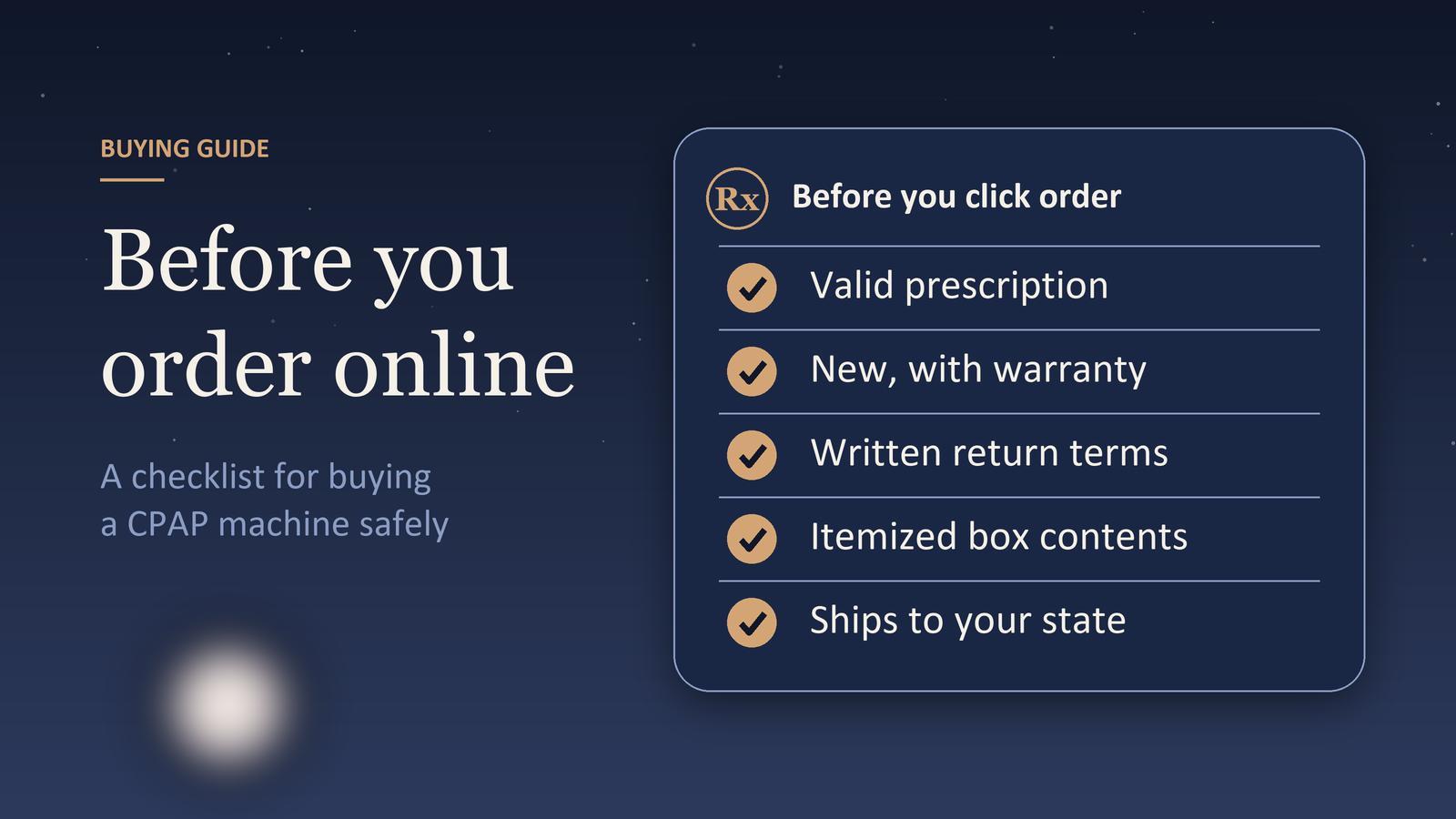
Before you click order
- Have a complete prescription: diagnosis, device type and settings, mask, length of need, physician details.
- Confirm the seller ships to your state.
- Read the machine return policy, not only the mask policy.
- Confirm the machine is new, with the manufacturer's warranty, or that the seller labels it otherwise.
- Find the itemized contents, including the hose type.
- Compare the total at checkout, since sale banners and shipping can change the number.
- Price the insurance path first, if you have coverage.
The bottom line
The best place to buy a CPAP machine online is one that checks your prescription, sells you a new machine with the manufacturer's warranty, tells you in writing how returns work, and ships to your state.
On the two sellers we compared, CPAP.com costs less and lets you try the machine for 60 nights, and ResMed's own store is the direct route at a higher price with a much stricter return policy. Whichever you choose, the prescription and the return terms matter more than a few dollars of price.
Sources
- CPAP.com support pages on prescriptions, its refund and return policy, its mask fit guarantee, and its product listings, read October 17, 2026
- ResMed's online store: its prescription FAQs, refund policy, terms of use and product listings, read October 17, 2026
- ResMed, product warranty information
- ResMed, general terms and conditions of sale
- FDA, recalled Philips ventilators, BiPAP machines and CPAP machines
This article is general information, not medical or legal advice. CPAP machines are prescription devices, and pressure settings should only be changed by your sleep physician. Policies and prices change, so confirm them on the seller's own pages before you order.
Shop CPAP masks, machines, and supplies
CPAP.com carries a wide range of machines, masks, cushions, filters, and cleaning supplies, with guidance to help you find the right fit for your therapy.
Shop CPAP.comAdvertising disclosure: this is a paid partnership. We may earn a commission if you sign up through this link, at no extra cost to you.
Written by
Daniel Marin
Sharing insights on sleep health and wellness to help you achieve better rest and improved quality of life.