Advertising disclosure: this article contains a sponsored link to HealSend, an online telehealth service we have an affiliate relationship with. If you become a HealSend customer through that link, we may be paid. The tirzepatide on HealSend's sign-up page is compounded, not Zepbound, and a section below explains the difference. Every coverage rule and price here comes from CMS, Medicare.gov, Lilly, the IRS, the FDA or the American Academy of Sleep Medicine.
Being prescribed Zepbound for sleep apnea and being able to get it are two different things. The medication is approved, the clinical evidence is strong for the people it was tested in, and the price of the injection is still the part that stops many patients. What decides it is usually coverage: which plan you have, whether it is willing to pay, and what paperwork it asks for.
This guide is about that access side. Our earlier article on tirzepatide for sleep apnea covers what the FDA approved, who qualifies, and the trial results. Here we cover how Medicare Part D handles it, what commercial insurance and Lilly's savings programs do, how to appeal a denial, what to do if you have no coverage, and what the first year of treatment looks like.
Policies and prices were checked on October 25, 2026. Coverage rules change, so confirm with your plan. This is general information, not medical or legal advice.
The short answer
- Medicare Part D can cover Zepbound for sleep apnea. CMS lists moderate to severe obstructive sleep apnea among the uses eligible for Part D coverage, and uses Zepbound for sleep apnea as an example.
- Medicare's weight-loss program is not the route. The Medicare GLP-1 Bridge is for people who want the drug solely for weight. Someone with moderate to severe sleep apnea is directed to their Part D plan instead.
- If your plan does not list Zepbound, you can still ask for an exception. CMS says plans must continue to use their existing formulary exception process for these requests.
- Commercial plans set their own rules. Lilly's savings card can bring a covered prescription down to as little as $25, but it caps what it pays, so it does not mean $25 for everyone.
- If you are denied, you have 65 days to appeal. You can ask for a fast decision if waiting could seriously harm your health.
- Treatment takes months to ramp up, and it is not a short course. Weight regain is likely if the medication is stopped, according to the AASM.
What a plan needs to see
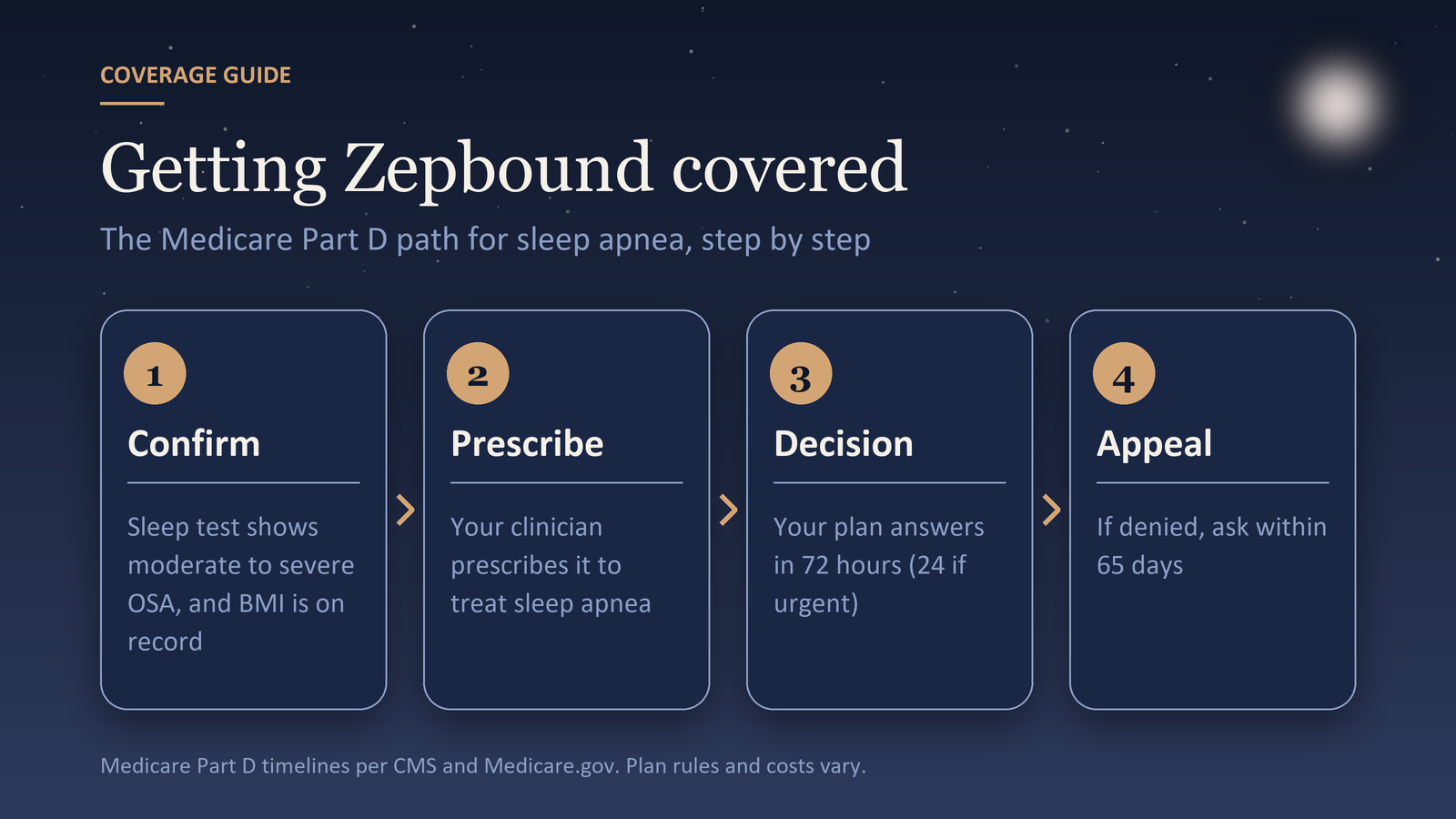
A plan decides whether to cover a drug by checking that it is prescribed for a use it covers. For Zepbound that use is moderate to severe obstructive sleep apnea in adults with obesity, which is the approved indication. The AASM's clinician guidance describes the same criteria: an apnea-hypopnea index (AHI) of 15 or higher and a body mass index (BMI) of 30 or higher.
Plans set their own paperwork requirements, so ask yours for its criteria in writing. As a starting point, these are the records most likely to matter:
- Your sleep test report, showing your AHI and the type of sleep apnea. A home sleep test or an in-lab study both produce one.
- A BMI documented by your clinician, with your height and weight.
- A prescription and a note from your prescriber that state the diagnosis accurately.
- Your treatment history, including whether you use CPAP.
Accuracy matters more than anything else here. Medicare Part D can cover Zepbound when it is prescribed for moderate to severe sleep apnea in an adult with obesity, so your clinician needs to document that you actually have both. A prescription written only for weight loss is handled differently, and the paperwork should reflect your real diagnosis either way.
Medicare Part D
What CMS says
CMS states that moderate to severe obstructive sleep apnea is an indication eligible for Part D coverage. It says people with that diagnosis get GLP-1 drugs through their Part D plan and are not eligible for the Medicare GLP-1 Bridge, even if they would otherwise meet its criteria.
CMS also gives Zepbound for the treatment of moderate to severe OSA in adults with obesity as an example of a use that is coverable under the basic Part D benefit regardless of whether the drug is on the plan's formulary. It says Part D plan sponsors must continue to follow their existing formulary exception processes for these requests.
Medicare.gov repeats the point for patients: if you have moderate to severe sleep apnea you are not eligible for the Bridge, but your Part D plan might cover your GLP-1.
How to ask your plan
You or your prescriber can ask your plan for a coverage determination, and for an exception if the drug is not on its list. Medicare.gov says you can do this by sending a completed Model Coverage Determination Request form, writing a letter, or calling your plan. For an exception, your prescriber must provide a statement explaining the medical reason it should be approved.
CMS sets the plan's response time at 72 hours for a standard request and 24 hours for an expedited one. For an exception, the clock starts when the plan receives your prescriber's supporting statement, so that statement should go in with the request.
You can ask for the fast track if your plan decides, or your prescriber tells it, that waiting for a standard decision could seriously jeopardize your health.
If you are denied
Your plan's denial letter explains how to appeal. Medicare.gov and CMS give the main steps and deadlines:
| Step | Deadline to ask | Time for a decision |
|---|---|---|
| Level 1: redetermination by your plan | 65 days from the date on the denial notice | 7 days, or 72 hours if fast |
| Level 2: independent review entity | 60 days from the plan's decision | 7 days, or 72 hours if fast |
You, your representative or your prescriber can file. If you miss the deadline, you must give a reason for filing late. Ask your prescriber for a supporting statement, since Medicare.gov lists that as one of the things that can help your case.
What you pay
Your cost depends on your plan's cost sharing. Lilly's savings cards cannot be used with Medicare: the commercial card's terms exclude anyone enrolled in Medicare, Medicare Part D, Medicare Advantage, Medicaid or other government programs.
Commercial insurance
Commercial plans decide for themselves whether to cover Zepbound for sleep apnea and what they require first. If you are denied, your plan's denial letter describes its own appeal process, and the steps and deadlines differ from Medicare's.
If your plan does cover it, Lilly's savings card may lower your cost. Lilly's published terms for the commercial card, read on October 25, 2026, say:
- If your plan covers the single-dose pen, you may pay as little as $25 for a 1, 2 or 3 month fill.
- The savings are capped. The card pays up to $100 a month, and up to $1,300 per calendar year, over a maximum of 13 fills. If your plan's cost share is higher than $125, you pay the difference, so the card does not guarantee $25.
- If your plan does not cover the pen, the card lowers the price of a one-month fill to as low as $499.
- If your plan does not cover the KwikPen, you may pay as low as $299, $399 or $449 for a one-month fill depending on the dose.
- It requires a prescription for an approved use, a valid HIPAA authorization, and no enrollment in a government healthcare program.
- It expires on December 31, 2026, and Lilly can change or end it at any time.
If you have no coverage
Lilly's self-pay prices are covered in our tirzepatide guide. In short, the OSA maintenance doses of 10 mg or 15 mg are as low as $449 a month with on-time refills, and $699 without them.
HSA and FSA funds. The IRS defines a prescribed drug as one that requires a prescription by a doctor for its use by an individual, and says you can include amounts you pay for prescribed medicines and drugs in medical expenses. Zepbound prescribed for sleep apnea fits that description. Your plan administrator makes the final call, so keep your prescription and receipts.
Compounded tirzepatide and HealSend
If you cannot get coverage, you will see telehealth services selling cheaper tirzepatide. Read the product description closely.
The FDA says compounded drugs should only be used for patients whose medical needs cannot be met by an FDA-approved drug, and that unapproved versions do not undergo its review for safety, effectiveness and quality before they are marketed. Among its telehealth warning signs is a company claiming that a compounded drug is the same as an approved one.
We read HealSend's sign-up page on October 21, 2026. Its tirzepatide is labeled compounded tirzepatide, fulfilled by state-licensed compounding pharmacies, at $199 for the first month and $319 a month after. It is not Zepbound, it is not what the sleep apnea trials tested, and the page does not mention sleep apnea. Lower price does not make it equivalent. We explain this in more detail, with questions to ask any telehealth prescriber, in our tirzepatide guide.
If cost is the obstacle, a sensible first step is an exception request or an appeal, since either can change what you pay for the approved product. Ask your sleep clinic whether it can help with the paperwork.
What to expect on treatment
This follows the prescribing information and the AASM's guidance for sleep physicians. Your clinician sets the exact timing.
| Stage | What happens |
|---|---|
| Weeks 1 to 4 | Start at 2.5 mg once a week. This is a starting dose, not a maintenance dose. |
| After 4 weeks | Increase in 2.5 mg steps, no sooner than every 4 weeks, as tolerated. |
| Maintenance | 10 mg or 15 mg once a week for sleep apnea. The maximum is 15 mg. |
| Follow-up | Monitor weight, AHI, sleepiness and side effects. Consider a repeat sleep test once weight has stabilized. |
Reaching 10 mg takes at least about three months, because each step lasts at least four weeks.
Things the AASM tells clinicians to watch for:
- Hydration. Dehydration from vomiting or diarrhea can cause kidney problems, so patients need to keep up fluids, generally about 2 liters a day.
- Birth control pills. They may work less well. Use a non-oral method or add a barrier method for 4 weeks after starting and after each dose increase.
- Gallbladder disease and pancreatitis. The AASM says to stop the medication in patients with either. Lilly's safety summary says to stop Zepbound and call your provider right away for severe stomach pain that will not go away (possible pancreatitis), and to tell your provider right away about upper stomach pain, fever, yellowing of the skin or eyes, or clay-colored stools (possible gallbladder problems).
- Low blood sugar. The risk is higher if you also use insulin or similar medicines, and your clinician may reduce their doses.
- Side effects. Nausea, diarrhea, vomiting, constipation, abdominal pain, fatigue and injection site reactions are the common ones, and they are dose related.
CPAP does not stop. The AASM says to reassess your CPAP needs as your AHI improves, which means a sleep test and a conversation with your sleep physician, not stopping on your own. It also notes that many patients will still need PAP or other therapy.
It is not a short course. The AASM says patients are likely to regain weight if the medication is stopped, and that continued weight management is needed to keep the benefit. Before you start, ask your clinician what the long-term plan is, and what you would do if coverage ended.
Questions to ask
Your clinician:
- Do my sleep study and BMI meet the approved criteria?
- Will you write the prescription and prior authorization for sleep apnea, and will you support an exception or appeal if needed?
- How will we measure whether my sleep apnea has improved, and when do we repeat the sleep test?
- What happens to my CPAP?
Your plan:
- Is Zepbound covered for moderate to severe obstructive sleep apnea?
- What documents do you require, and can you send the criteria in writing?
- If it is not on the formulary, how do I request an exception?
- What will I pay at each dose?
The bottom line
For sleep apnea, Medicare Part D and many commercial plans are the first place to look, because that is where the approved product can cost the least. Medicare's weight-loss program is not the route, but your Part D plan can cover Zepbound for sleep apnea, and CMS says plans must keep using their exception process for these requests. If you are denied, you have 65 days to appeal, and a fast decision is available when waiting could harm you.
Treat the price as the start of the conversation, not the end. A diagnosis from a sleep test, a prescription that states it accurately, and a clinician who will see you through retesting matter more than the first quote you are given. If you do not have a sleep specialist yet, find an accredited sleep clinic near you.
Sources
- CMS, Medicare GLP-1 Bridge: information for Part D plans
- Medicare.gov, weight loss drugs and the Medicare GLP-1 Bridge
- Medicare.gov, appeals in a Medicare drug plan
- CMS, Medicare Part D coverage determination and appeals process
- Eli Lilly, Zepbound commercial savings card terms and conditions
- Eli Lilly, Zepbound KwikPen self-pay savings card terms and conditions
- American Academy of Sleep Medicine, Zepbound for obstructive sleep apnea provider fact sheet, 2026
- American Academy of Sleep Medicine, Zepbound for obstructive sleep apnea patient fact sheet, 2026
- FDA, FDA's concerns with unapproved GLP-1 drugs used for weight loss
- IRS Publication 502, Medical and Dental Expenses
- HealSend sign-up page, read October 21, 2026
This article is general information, not medical, legal or tax advice. Zepbound is a prescription medicine with a boxed warning, and whether it is appropriate for you depends on your diagnosis, health history and other medicines. Do not stop CPAP or any other sleep apnea treatment without talking to your sleep physician. A clinician should review this article before it is relied on as medical guidance.
Telehealth GLP-1 care, if a clinician agrees it fits
HealSend is an online telehealth service that connects patients with licensed clinicians and pharmacies. The tirzepatide it offers is compounded, which means it is not Zepbound, it is not FDA-approved, and it is not the product tested in the sleep apnea trials. A clinician decides whether it is appropriate for you. Keep your sleep doctor informed, and do not stop CPAP or any sleep apnea treatment without their advice.
Learn about HealSendAdvertising disclosure: this is a paid partnership. We may earn a commission if you sign up through this link, at no extra cost to you.
Written by
Daniel Marin
Sharing insights on sleep health and wellness to help you achieve better rest and improved quality of life.