Advertising disclosure: this article contains a sponsored link to HealSend, an online telehealth service we have an affiliate relationship with. If you become a HealSend customer through that link, we may be paid. The tirzepatide on HealSend's sign-up page is compounded, not Zepbound, and a later section explains the difference, so you can weigh our comparison with that in mind. Every clinical figure comes from the FDA, the drug's prescribing information, the American Academy of Sleep Medicine or CMS.
If you have sleep apnea and excess weight, you have probably seen tirzepatide advertised as a fix. Some of that is accurate and some of it is not, and the difference matters because the products sold under the same drug name are not the same thing.
Here is the accurate part. In December 2024 the FDA approved Zepbound, a brand of tirzepatide, to treat moderate to severe obstructive sleep apnea in adults with obesity. It was the first drug approved for the condition. The approval rests on two 52 week trials in which people on the drug had large reductions in apnea events.
Here is what is easy to miss. That approval covers Zepbound, made by Eli Lilly. It does not cover compounded tirzepatide, which some telehealth services sell, and it does not mean tirzepatide replaces CPAP. This guide covers who may qualify, what the evidence shows, what it costs, how treatment works, and where the telehealth route differs from the approved one.
Prices and policies were checked on October 21, 2026. This is general information, not medical advice, and a clinician has to decide whether any of this applies to you.
The short answer
- Approved use. Zepbound is approved for moderate to severe obstructive sleep apnea in adults with obesity, used with a reduced-calorie diet and more physical activity.
- Who qualifies. The label's trial population had an apnea-hypopnea index (AHI) of 15 or higher and a body mass index (BMI) of 30 or higher. A clinician confirms both.
- What it did in trials. After a year, average AHI fell by about 25 to 29 events an hour, compared with about 5 on placebo, and average body weight fell about 18 to 20 percent.
- What it costs. Lilly's self-pay prices for the OSA maintenance doses are as low as $449 a month with on-time refills, and $699 otherwise. Medicare Part D plans may cover it for sleep apnea. Insurance varies.
- It does not replace CPAP. The AASM says Zepbound reduces OSA severity but does not replace CPAP or other OSA treatments, and the trials did not test stopping CPAP.
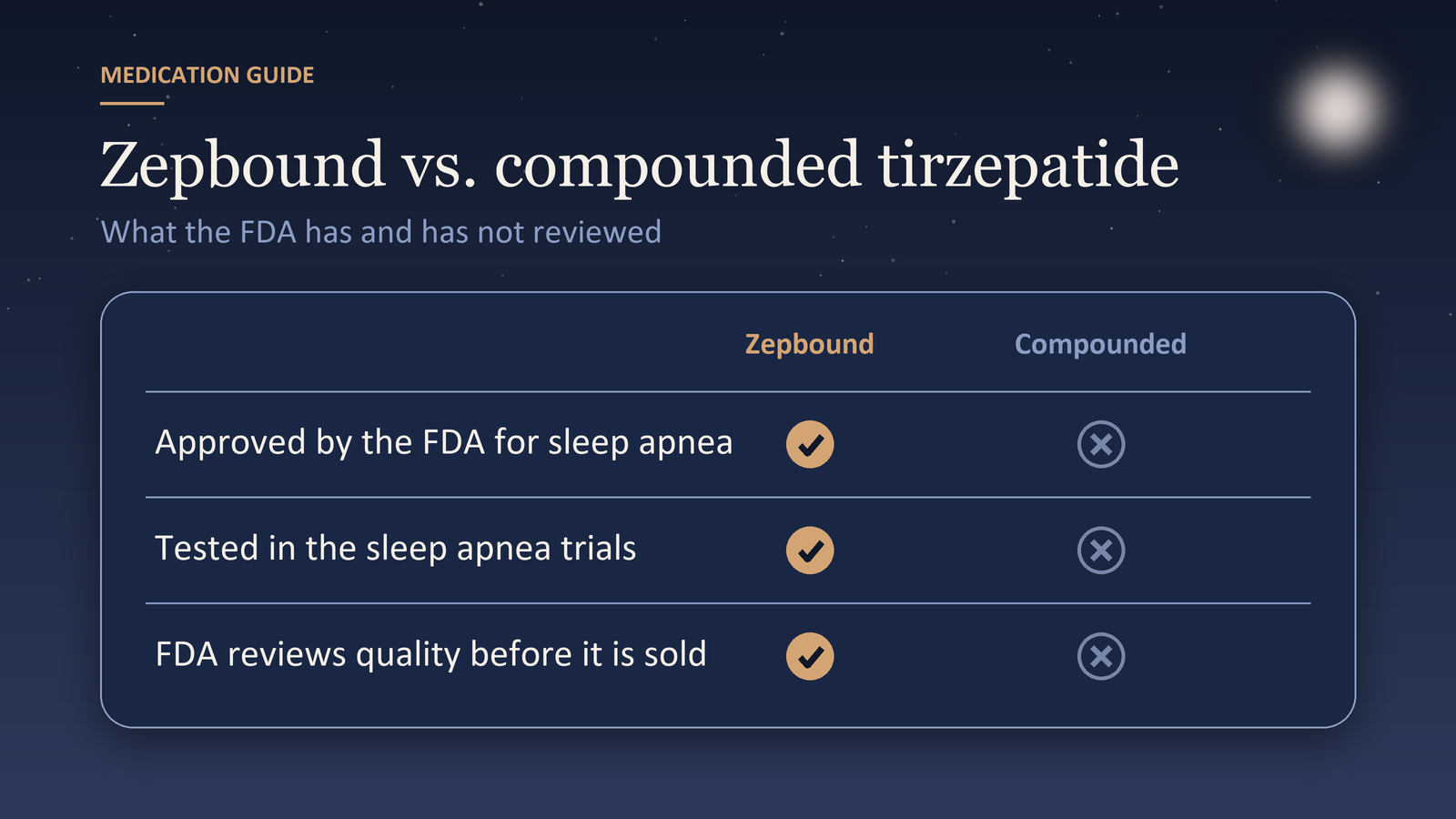
- Compounded tirzepatide is a different product. It is not FDA-approved and was not what the trials tested.
What the FDA approved
On December 20, 2024, the FDA approved Zepbound (tirzepatide) for the treatment of moderate to severe obstructive sleep apnea in adults with obesity, to be used with a reduced-calorie diet and increased physical activity. The FDA called it the first drug treatment option for certain patients with obstructive sleep apnea.
Tirzepatide works by activating two gut hormone receptors, GLP-1 and GIP, which reduces appetite and food intake. The FDA states that by reducing body weight, studies show Zepbound also improves OSA, and that the improvement is likely related to the weight reduction. In other words, it is a weight-loss medication that helps sleep apnea because excess weight narrows the airway, not a drug that acts on the airway directly.
The same drug is sold as Mounjaro for type 2 diabetes. Zepbound is also approved for weight management, which is a separate indication.
It is for obstructive sleep apnea only. The AASM's patient guidance says it is not used for central sleep apnea. If you are not sure which type you have, our guide to central versus obstructive sleep apnea explains the difference.
Who may qualify
The label's trials and the AASM's guidance describe the same criteria.
For the sleep apnea indication:
- You are an adult.
- You have moderate to severe obstructive sleep apnea, meaning an AHI of 15 or higher events an hour, confirmed by a sleep test.
- You have obesity, meaning a BMI of 30 or higher.
Both numbers matter, and both come from clinical measurement. A home sleep test or an in-lab study gives the AHI, and your clinician measures your BMI.
Who should not take it. The label contraindicates Zepbound for anyone with a personal or family history of medullary thyroid carcinoma or with Multiple Endocrine Neoplasia syndrome type 2, and for anyone with a serious allergy to tirzepatide. It carries a boxed warning about thyroid C-cell tumors seen in rats. It should not be combined with other tirzepatide products or other GLP-1 medicines, and it is not recommended in people with severe gastroparesis. The AASM adds that birth control pills may work less well and should be discussed with a doctor.
If you have other conditions, take other medicines, are pregnant or planning to be, or have a history of pancreatitis or gallbladder problems, those are conversations for your prescriber. This list is not a screening tool.
What the trials showed
The approval is based on two randomized, placebo-controlled trials of 52 weeks, run as one program called SURMOUNT-OSA. Together they enrolled 469 adults with moderate to severe OSA and obesity, and excluded people with type 2 diabetes. Participants were on average about 50 years old with a mean BMI near 39 and a baseline AHI near 50 events an hour, which is severe.
One trial enrolled people who were unable or unwilling to use PAP. The other enrolled people who were already on PAP. Everyone received diet and activity counseling, and tirzepatide doses were escalated to the highest tolerated of 10 mg or 15 mg weekly.
| At 52 weeks, tirzepatide vs placebo | Trial without PAP | Trial with PAP |
|---|---|---|
| Change in AHI (events per hour) | -25.3 vs -5.3 | -29.3 vs -5.5 |
| Reached remission or mild, non-symptomatic OSA | 42.2% vs 15.9% | 50.2% vs 14.3% |
| Change in body weight | -17.7% vs -1.6% | -19.6% vs -2.3% |
Numbers from the Zepbound prescribing information.
Some things the table does not say, and you should know:
- Many people still had sleep apnea. In the trial without PAP, about 42 percent reached remission or mild non-symptomatic OSA, which means about 58 percent did not. Results are averages, and individual responses vary widely.
- It was a year of treatment with weight loss of nearly a fifth of body weight. The AHI improvement tracks that weight loss, which is the FDA's own interpretation.
- The trial population is specific. Adults with obesity and moderate to severe OSA, without type 2 diabetes. The results do not automatically apply to people outside that group.
- In the trial with PAP, participants paused it for a week before the final measurement. The prescribing information states that the OSA studies did not evaluate the timing or appropriateness of stopping PAP in people who were previously using it successfully.
How treatment works
Zepbound is a once-weekly injection under the skin of the abdomen, thigh or upper arm. The prescribing information describes the schedule for all uses:
- Start at 2.5 mg once a week for 4 weeks. This is a starting dose, not a maintenance dose.
- Increase in 2.5 mg steps, after at least 4 weeks on each dose, as tolerated, to reduce the risk of stomach side effects.
- For sleep apnea, the maintenance dose is 10 mg or 15 mg once a week. The maximum for any use is 15 mg.
Reaching a maintenance dose therefore takes at least several months. A person who needs 10 mg moves through 2.5, 5 and 7.5 mg first.
Side effects. The FDA lists nausea, diarrhea, vomiting, constipation, abdominal discomfort and pain, injection site reactions, fatigue, hypersensitivity reactions, burping, hair loss and gastroesophageal reflux disease. The label also warns of severe gastrointestinal reactions, so tell your prescriber about persistent or severe symptoms.
Follow-up. The AASM notes that regular follow-up visits and repeat sleep studies may be needed. A repeat test is how you find out whether your AHI has actually improved, which feeling better does not show. Our guide to CPAP alternatives covers why objective retesting matters for any treatment.
What it costs
The cost depends on which route you take, and the routes are not equivalent products.
Through insurance or Medicare
Coverage varies by plan, and the AASM's own guidance is that your care team can help with insurance questions. Our guide to getting Zepbound covered for sleep apnea covers prior authorization, exceptions and appeals in detail. Some points are firm:
- Medicare Part D plans may cover Zepbound for sleep apnea. CMS's temporary Medicare GLP-1 Bridge, which charges $50 a month for weight management, excludes people with moderate to severe sleep apnea. Medicare.gov says those people may still get their GLP-1 drug covered through their Part D plan.
- What you pay then depends on your plan's formulary and cost sharing. Ask your plan whether Zepbound is covered for sleep apnea and what it requires before it will pay.
Paying cash through Lilly
Lilly's own self-pay terms, read on October 21, 2026, list these prices for a one-month supply, with a prescription for an approved use, plus any taxes and fees:
| Dose | Price with on-time refills | Regular price |
|---|---|---|
| 2.5 mg | $299 | $299 |
| 5 mg | $399 | $399 |
| 7.5 mg | $449 | $499 |
| 10 mg, 12.5 mg or 15 mg | $449 | $699 |
The lower prices apply when each refill is completed within 45 days of delivery of the previous one. The savings card expires on December 31, 2026, and Lilly can change or end the offer at any time.
For sleep apnea the maintenance doses are 10 mg or 15 mg, so the ongoing price is $449 a month with on-time refills and $699 without them.
As an illustration only: reaching 10 mg takes about three months of steps up, at $299, $399 and $449, and then $449 a month. A first year on schedule would be about $5,190. Your own course may be slower, a different dose, or covered by insurance.
The telehealth route, and what it sells
Telehealth services that prescribe compounded tirzepatide advertise lower monthly prices, and this is where the products diverge. We cover it next.
Zepbound, compounded tirzepatide, and HealSend
This section matters if you are comparing prices online.
Zepbound is the FDA-approved product. It is the tirzepatide that was tested in the sleep apnea trials and approved for the condition.
Compounded tirzepatide is not FDA-approved. The FDA's own page on GLP-1 drugs says unapproved versions do not undergo its review for safety, effectiveness and quality before they are marketed, and that compounded drugs should only be used in patients whose medical needs cannot be met by an FDA-approved drug. It also lists warning signs in telehealth, including a company that claims a compounded drug is the same as an approved one, offers medicine at prices that seem too good to be true, does not require screening and a prescription from a licensed doctor, or has no licensed doctor available to answer questions after delivery.
HealSend is a telehealth service, and what it sells is compounded. We read HealSend's sign-up page on October 21, 2026. It describes evaluation by a US-licensed physician and fulfillment by state-licensed compounding pharmacies, and it labels its tirzepatide as compounded tirzepatide. The product on that page is not Zepbound. It lists compounded tirzepatide at $199 for the first month and $319 a month after that, which comes to about $3,700 over a year. Treat these as indicative and confirm them on its site, since they can change.
Three things follow from that:
- It is a different product from the one in the trials. The sleep apnea evidence we described is for Zepbound. It does not show that a compounded version works the same way, at the same dose, or as safely.
- The page we read is about weight loss. It does not mention sleep apnea at all. A weight-loss prescription is not the same as being treated for sleep apnea, and an AHI-based diagnosis still has to come from a sleep test.
- Its screening is not the label's. The sign-up flow we read begins screening at a BMI of 25 or lower, below the BMI of 30 the Zepbound label uses for the sleep apnea indication. That is a rule for a weight-loss service, not a sign that you qualify for a sleep apnea treatment.
None of this means a telehealth clinician cannot be a reasonable route for some people. It means you should know what you are being prescribed and why, and ask the questions below.
Questions to ask any telehealth prescriber:
- Is this the FDA-approved product, or a compounded one, and why is compounded appropriate for me?
- Who is the pharmacy, and can I read the label and instructions?
- Will a licensed clinician be available after the medication arrives?
- How will we measure whether my sleep apnea has improved?
- What happens to my CPAP or other treatment?
Tirzepatide and CPAP
The American Academy of Sleep Medicine's patient guidance is direct: Zepbound helps reduce OSA severity but does not replace CPAP or other OSA treatments, and you should not stop CPAP or other therapy without medical advice. Its clinician guidance says the drug should be considered part of comprehensive care, alongside PAP, an oral appliance or surgery as appropriate, and that there is no head-to-head evidence comparing it with other OSA treatments.
That matches what the prescribing information says about the trials, which did not test stopping CPAP. Whether and when to reduce CPAP after weight loss is a decision for your sleep physician, based on repeat testing. If you are weighing treatments, our guide to CPAP alternatives covers the full menu, and our guide for a new diagnosis covers getting started on CPAP.
How to get started
- Get a diagnosis. If you suspect sleep apnea, a sleep test comes first. See how to recognize the symptoms and what to expect from a sleep study.
- See a sleep specialist, who can confirm your AHI, your BMI and which type of apnea you have. Find an accredited sleep clinic near you.
- Ask whether tirzepatide is appropriate. Bring your sleep study results, your medicines and your health history.
- Check coverage before you commit. Ask your plan about Zepbound for sleep apnea, or compare Lilly's self-pay prices.
- If you consider a telehealth service, use the questions above and keep your sleep clinic informed.
For how weight and sleep affect each other, see sleep and weight gain.
The bottom line
Zepbound is approved to treat moderate to severe obstructive sleep apnea in adults with obesity, and in two one-year trials it cut apnea events substantially on average, alongside weight loss of nearly a fifth of body weight. It is a prescription medicine with real side effects and a boxed warning, it does not replace CPAP, and many people still had apnea after a year.
If you are comparing prices, remember that the telehealth service we reviewed sells compounded tirzepatide, which is a different product from Zepbound, was not what the trials tested, and is not FDA-approved. A diagnosis from a sleep test, and a clinician who can follow your results, matter more than the price of the injection.
Sources
- FDA, "FDA approves first medication for obstructive sleep apnea," December 20, 2024
- Eli Lilly, Zepbound prescribing information
- FDA, FDA's concerns with unapproved GLP-1 drugs used for weight loss
- American Academy of Sleep Medicine, Zepbound for obstructive sleep apnea patient fact sheet, 2026
- American Academy of Sleep Medicine, Zepbound for obstructive sleep apnea provider fact sheet, 2026
- Medicare.gov, weight loss drugs and the Medicare GLP-1 Bridge
- Eli Lilly, Zepbound KwikPen self-pay savings card terms and conditions
- HealSend sign-up page, read October 21, 2026
This article is general information, not medical advice. Tirzepatide is a prescription medicine with a boxed warning, and whether it is appropriate for you depends on your diagnosis, health history and other medicines. Do not stop CPAP or any other sleep apnea treatment without talking to your sleep physician. A clinician should review this article before it is relied on as medical guidance.
Telehealth GLP-1 care, if a clinician agrees it fits
HealSend is an online telehealth service that connects patients with licensed clinicians and pharmacies. The tirzepatide it offers is compounded, which means it is not Zepbound, it is not FDA-approved, and it is not the product tested in the sleep apnea trials. A clinician decides whether it is appropriate for you. Keep your sleep doctor informed, and do not stop CPAP or any sleep apnea treatment without their advice.
Learn about HealSendAdvertising disclosure: this is a paid partnership. We may earn a commission if you sign up through this link, at no extra cost to you.
Written by
Daniel Marin
Sharing insights on sleep health and wellness to help you achieve better rest and improved quality of life.