"You need eight hours" is the most repeated piece of sleep advice in existence, and it's not quite right. Eight hours is roughly the midpoint of the recommended range for one age group (adults), and treating it as a universal target causes real problems: parents worry their teenager is oversleeping when they're actually meeting their requirement, older adults assume declining sleep is normal aging when it may signal a disorder, and plenty of healthy adults lie awake anxious about falling short of a number that was never meant to be a hard rule.
Sleep needs change substantially across the lifespan, and they vary between individuals within every age group. Here's what the evidence actually supports, and how to figure out your own number.
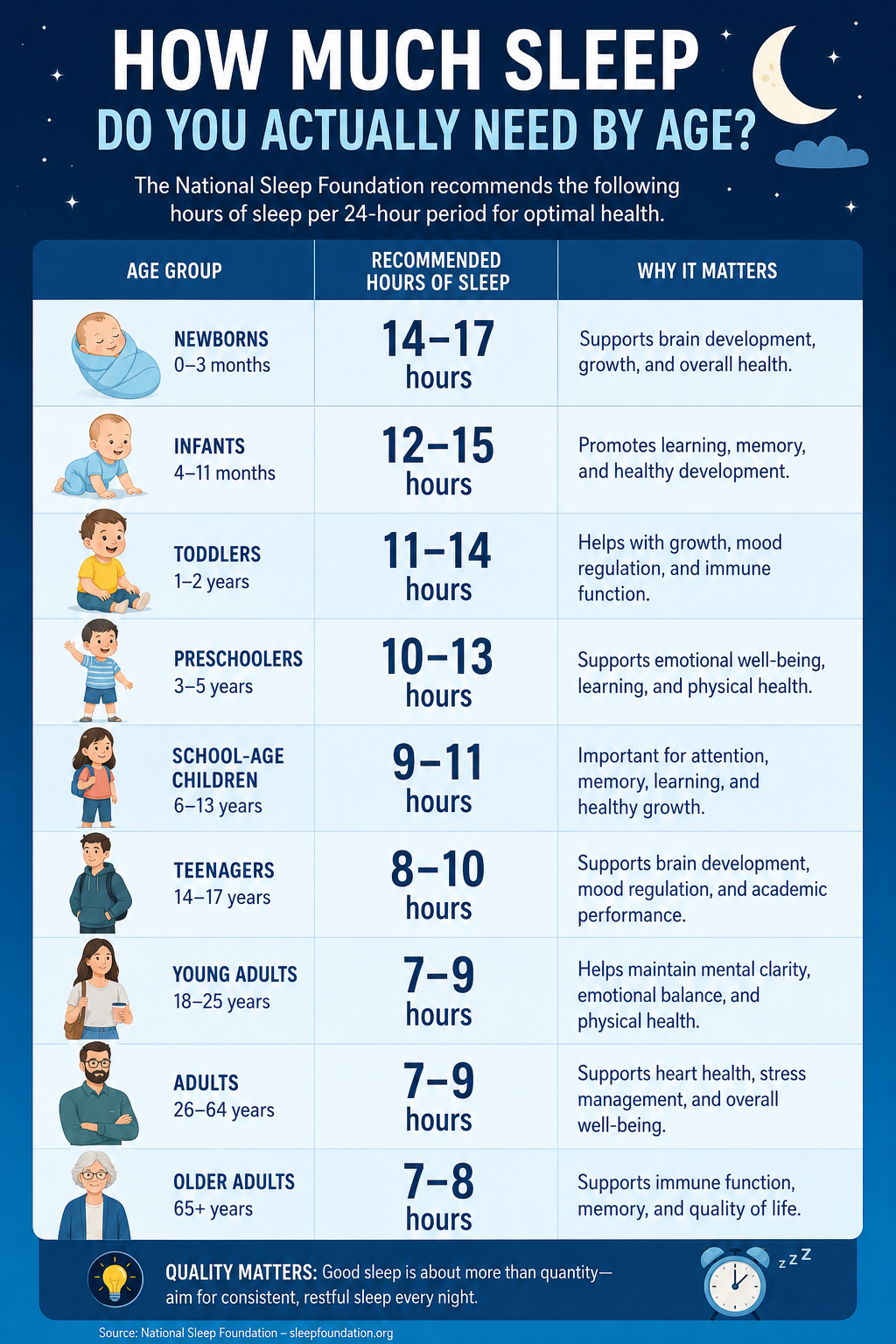
Recommended Sleep by Age: The Full Table
These ranges reflect the consensus recommendations developed by the American Academy of Sleep Medicine, the Sleep Research Society, and the National Sleep Foundation, which reviewed hundreds of studies on sleep duration and health outcomes.
| Age Group | Age Range | Recommended Sleep (per 24 hours) | |-----------|-----------|-----------------------------------| | Newborns | 0-3 months | 14-17 hours | | Infants | 4-12 months | 12-16 hours (including naps) | | Toddlers | 1-2 years | 11-14 hours (including naps) | | Preschoolers | 3-5 years | 10-13 hours (including naps) | | School-age children | 6-12 years | 9-12 hours | | Teenagers | 13-18 years | 8-10 hours | | Young adults | 18-25 years | 7-9 hours | | Adults | 26-64 years | 7-9 hours | | Older adults | 65+ years | 7-8 hours |
A few things worth noting about this table:
The ranges are wide on purpose. A 7-hour sleeper and a 9-hour sleeper can both be perfectly healthy adults. The range reflects genuine biological variation, not uncertainty in the research.
For children, the totals include naps. A toddler sleeping 10 hours overnight plus a 2-hour afternoon nap is within range at 12 hours total.
"7 or more hours" is the adult floor. Professional sleep medicine bodies specifically recommend that adults get at least 7 hours per night on a regular basis. Consistently sleeping less than that is associated with increased risk of cardiovascular disease, obesity, diabetes, impaired immune function, depression, and accidents.
Why the Numbers Change So Much Across Life
Babies and Young Children Need the Most
Sleep is when the developing brain does an enormous amount of its work: consolidating new learning, forming neural connections, and releasing growth hormone. Newborns sleep in short bursts around the clock because their circadian rhythm hasn't developed yet, which typically begins to consolidate around 3 to 6 months.
The gradual decline in sleep need through childhood tracks with the pace of brain development. By the time a child reaches school age, naps have usually dropped away and nighttime sleep has consolidated into a single long block.
Teenagers Need More Than Adults, and Get Less
Adolescents need 8-10 hours, more than adults, at exactly the point in life when they're least likely to get it. Two things collide here.
First, puberty shifts the circadian rhythm later, a genuine biological change, not laziness. Melatonin release is delayed by roughly two hours, meaning a teenager who "can't fall asleep" before midnight often physiologically can't.
Second, most high schools start early. A teen who biologically falls asleep at midnight and has to wake at 6 AM is getting 6 hours against a requirement of 8-10, a chronic deficit that accumulates across the school week. This mismatch is well documented enough that the American Academy of Pediatrics has recommended later school start times.
If your teenager sleeps until noon on weekends, that's usually not defiance. It's catch-up sleep for a real, structurally imposed deficit.
Older Adults Do Not Need Dramatically Less Sleep
This is one of the most persistent and consequential myths about sleep. The recommendation for adults 65 and over is 7-8 hours, barely different from the 7-9 hours recommended for younger adults.
What actually changes with age is sleep architecture and consolidation, not the underlying requirement. Older adults tend to experience:
- Lighter sleep with more frequent awakenings
- Less deep (slow-wave) sleep
- Earlier bedtimes and earlier wake times (an advancing circadian rhythm)
- More fragmented sleep overall
The important distinction: needing the same amount of sleep but getting less of it is not the same as needing less. Older adults who are persistently tired, sleeping poorly, or napping heavily during the day are often experiencing a treatable sleep disorder, not inevitable aging. Sleep apnea prevalence rises significantly with age, and insomnia is common but not normal. Our guide on why you might always be tired covers the medical causes worth ruling out.
Are You an Exception? Probably Not
There's a small population of genuine "short sleepers" who function well on 6 hours or less, associated with rare mutations in genes including DEC2 and ADRB1. They're real, but they're vanishingly rare, on the order of a fraction of one percent of the population.
The catch is that far more people believe they're short sleepers than actually are. Chronic sleep restriction impairs your ability to accurately judge your own impairment: after a week of 6-hour nights, performance on attention and reaction-time tasks continues to decline while subjective sleepiness plateaus. You feel like you've adapted. Measurably, you haven't.
A useful reality check: if you sleep significantly longer on weekends or vacations than on workdays, you're not a short sleeper. You're accumulating sleep debt and repaying it when circumstances allow.
How to Find Your Own Number
The ranges above are population guidance. Here's how to identify your personal requirement:
- Pick a stretch without schedule pressure, a vacation or a week without early commitments works best.
- Go to bed when you feel sleepy and let yourself wake naturally, without an alarm.
- Track it for one to two weeks. The first few nights may run long as you repay existing sleep debt. Ignore those.
- Look at the average once it stabilizes. The consistent number your body settles into is close to your actual requirement.
- Sanity-check it against your daytime function. You should feel alert through the day without needing caffeine to stay functional, and without significant afternoon crashes.
Most people who do this land somewhere in the 7-9 hour range and are mildly surprised it's higher than what they'd been getting.
Quantity Isn't the Whole Story
Here's the part that gets lost in the focus on hours: you can hit your number and still feel terrible. Sleep duration and sleep quality are different things, and quality problems are the more commonly missed issue.
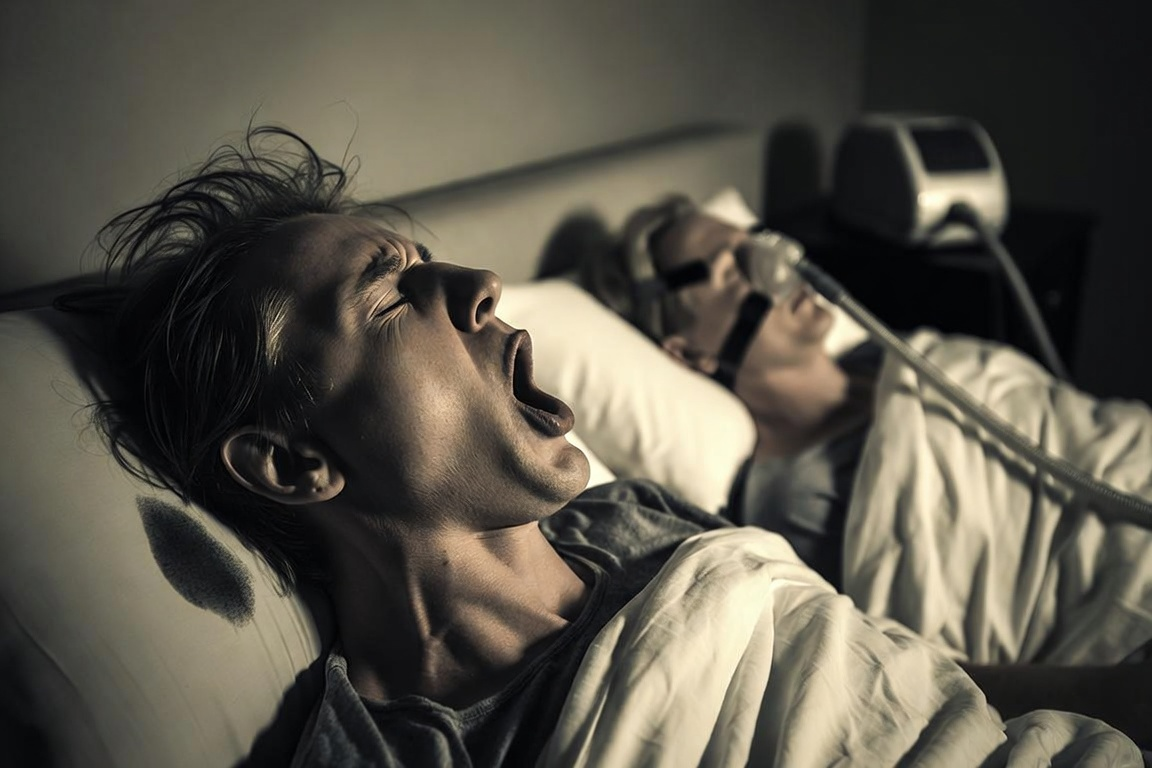
Someone with untreated obstructive sleep apnea may spend a full 8 hours in bed while their sleep is fragmented dozens or hundreds of times an hour by breathing interruptions they never consciously register. On paper, they slept 8 hours. Physiologically, they never reached sustained deep or REM sleep.
This is why "I get enough sleep but I'm still exhausted" is one of the most clinically meaningful complaints in sleep medicine. It usually means one of three things:
- A sleep disorder is degrading your sleep quality, most commonly sleep apnea, but also restless legs syndrome or periodic limb movement disorder
- Your sleep requirement is genuinely higher than what you're getting
- A separate medical cause is producing fatigue independent of sleep
If you're consistently in the recommended range and still not feeling rested, adding another hour rarely solves it. Getting evaluated does.
Warning Signs You're Not Getting Enough
Chronic insufficient sleep tends to show up in fairly consistent ways:
- Needing an alarm to wake up every single day, and hitting snooze repeatedly
- Falling asleep within five minutes of lying down (fast sleep onset can indicate significant sleep debt)
- Sleeping substantially longer on days off
- Dozing off during passive activities: reading, watching TV, or as a passenger in a car
- Difficulty concentrating, irritability, or increased emotional reactivity
- Reliance on caffeine to get through ordinary days
- Getting sick more often than usual
Falling asleep while driving is a medical emergency signal, not a sign you need more coffee. Stop driving and get evaluated.
Can You Get Too Much Sleep?
Studies have found associations between regularly sleeping more than 9-10 hours and worse health outcomes, but the relationship is likely not what it appears. Long sleep duration is more often a marker of an underlying problem, undiagnosed sleep apnea, depression, chronic illness, inflammation, or certain medications, rather than a cause of harm on its own.
If you consistently need 10 or more hours to function and still wake unrefreshed, that's worth investigating rather than accepting. Excessive sleep need is a recognized symptom pattern in conditions including narcolepsy and idiopathic hypersomnia.
Practical Ways to Actually Hit Your Number
Knowing your requirement matters only if you can meet it. The highest-yield habits:
- Keep a consistent wake time, including weekends. This anchors your circadian rhythm more effectively than a consistent bedtime.
- Work backward from your wake time to set a bedtime that allows your full requirement, plus 20-30 minutes to fall asleep.
- Protect the last hour before bed from screens, work, and stimulating activity.
- Get morning light exposure, which reinforces your circadian timing and makes evening sleepiness arrive on schedule.
- Watch caffeine timing, its half-life means an afternoon coffee can still be active at bedtime.
Our guide to evidence-based sleep hygiene habits covers the practices that actually hold up in research, and which popular ones don't.
The Bottom Line
Sleep requirements are a range, not a rule: 7-9 hours for most adults, 8-10 for teenagers, 9-12 for school-age children, and 7-8 for older adults, who need nearly as much as they always did even though it becomes harder to obtain.
But the more useful question isn't "how many hours am I getting?" It's "am I waking up restored?" If you're consistently meeting the recommended range and still feel exhausted, the problem isn't duration. It's quality, and that's a medical question worth answering rather than a habit worth tweaking.
Sleeping enough but still tired? Use our sleep clinic directory to find an accredited sleep center near you and get properly evaluated.
Written by
Daniel Marin
Sharing insights on sleep health and wellness to help you achieve better rest and improved quality of life.