You needed 8 hours and got 6. Do that five nights running and you're 10 hours short by Friday. The intuitive fix is to sleep in on the weekend, clear the balance, and start Monday even.
Sleep debt is a genuinely useful concept, and the accounting metaphor gets the basic idea right: sleep loss accumulates rather than resetting each night. But the metaphor breaks down in ways that matter. Sleep debt isn't a balance you can settle with a single large payment, some of what it costs you recovers quickly while other effects linger, and a weekend of extra sleep does considerably less than most people assume.
Here's what actually happens when you don't sleep enough, and what recovery realistically looks like.
What Sleep Debt Actually Is
Sleep debt is the cumulative shortfall between the sleep you need and the sleep you get. If your requirement is 8 hours and you average 6.5, you're running a 1.5 hour deficit per night, which compounds night over night.
The biological machinery behind this is real. While you're awake, a molecule called adenosine gradually accumulates in the brain, and rising adenosine levels are a major driver of what sleep researchers call homeostatic sleep pressure: the mounting physiological drive to sleep. Sleep clears it. Cut sleep short and clearance is incomplete, so you begin the next day with pressure already elevated. Repeat that, and pressure keeps building.
This is why the fifth consecutive short night feels considerably worse than the first. You're not just tired from last night, you're carrying the residue of the whole week.
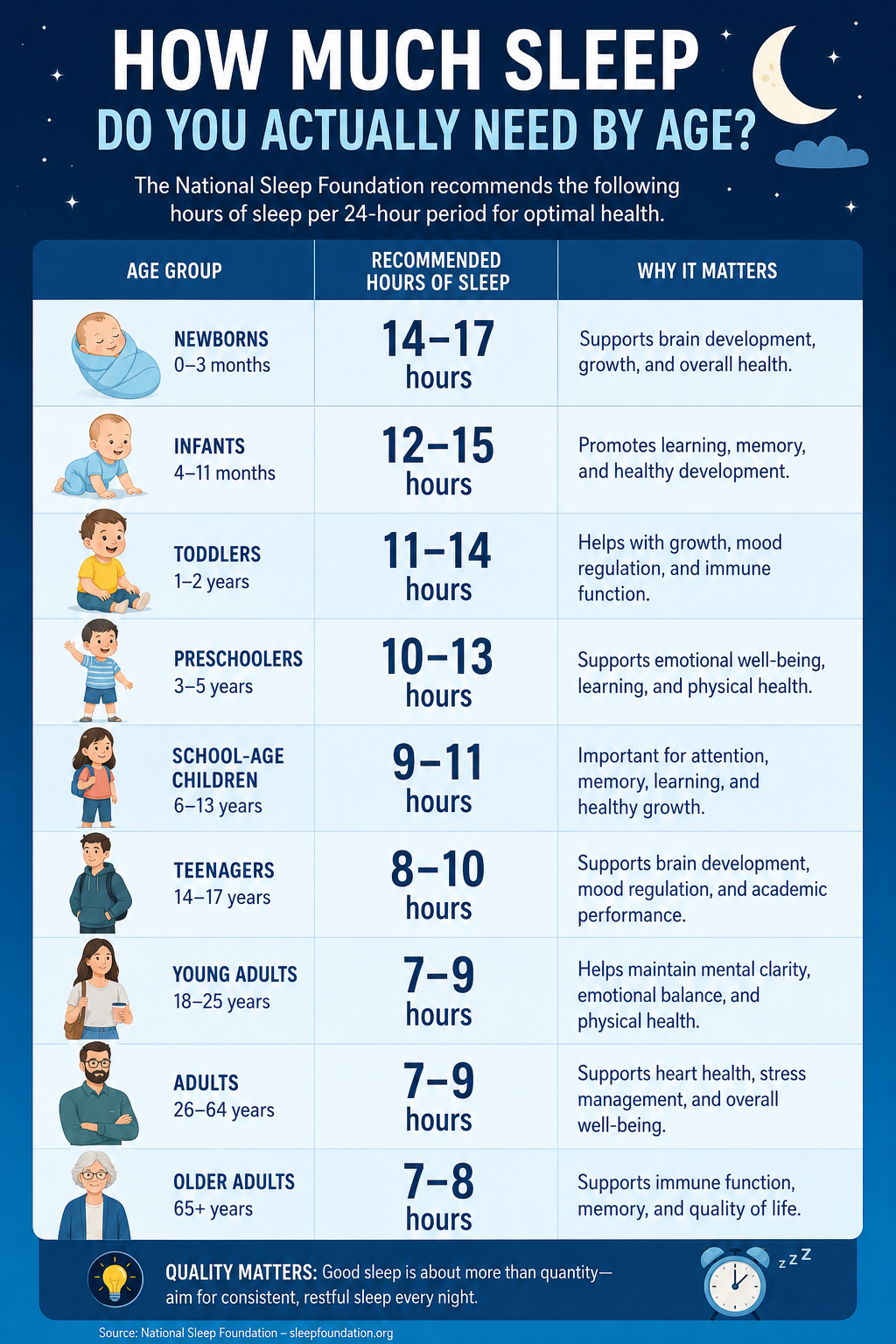
If you aren't sure what your actual requirement is, our guide on how much sleep you need by age covers the evidence-based ranges and how to identify your personal number, which is the figure your debt is measured against.
The Study That Changed How Researchers Think About This
The most influential research on chronic sleep restriction assigned adults to 4, 6, or 8 hours in bed per night for two weeks while measuring cognitive performance daily.
Two findings stand out.
First, deficits accumulated steadily. People restricted to 6 hours a night showed progressively worsening performance on attention and reaction-time tasks across the full two weeks. There was no adaptation, no plateau where the body adjusted. By the end, their performance resembled that of people who had gone one to two full nights without any sleep at all.
Second, and more unsettling: they didn't notice. Subjective sleepiness ratings rose initially, then leveled off, even as objective performance kept declining. Participants reported feeling only mildly impaired while measurably functioning far worse than that.
This gap between how impaired you feel and how impaired you are is the central practical danger of sleep debt. It's why people confidently drive, make decisions, and self-assess as "fine" while operating well below their baseline.
Can You Repay It? Partially, and Not All at Once
The honest answer is yes, but incompletely, and more slowly than the debt accumulated.
What Recovers Fast
After a period of restriction, your body prioritizes. Recovery sleep tends to be deeper, with a rebound in slow-wave sleep, and the most immediate effects respond quickly:
- Subjective alertness often improves substantially after one or two good nights
- Simple reaction time recovers relatively quickly
- Mood and irritability typically improve within a couple of nights
This fast partial recovery is exactly why the weekend catch-up feels like it works. You genuinely do feel better by Sunday.
What Recovers Slowly
Other measures lag well behind how you feel:
- Sustained attention and vigilance can take several nights of adequate sleep to return to baseline, and some research suggests certain aspects of cognitive performance don't fully normalize even after multiple recovery nights following extended restriction
- Metabolic markers are notably stubborn. Studies extending short sleep across a workweek have found impaired insulin sensitivity that a weekend of recovery sleep did not correct
- Immune function markers and inflammatory measures also take longer to normalize than subjective tiredness
So the honest framing is: a weekend restores how you feel considerably faster than it restores how you function.
The Weekend Catch-Up Problem
Sleeping in on Saturday and Sunday is the near-universal strategy, and it has real limitations worth understanding.
It doesn't fully repay the debt. Research examining ad libitum weekend recovery sleep after workweek restriction has found that metabolic disruptions were not resolved by the weekend, and that participants returned to restriction on Monday with problems intact or in some measures worse.
It shifts your circadian rhythm. Sleeping until 11 AM on weekends and 6 AM on weekdays is roughly equivalent to flying across several time zones and back every week, a pattern researchers call social jetlag. Your circadian clock drifts later over the weekend, then Monday morning arrives before your body is biologically ready. This is a meaningful contributor to Monday and Tuesday grogginess.
It can mask a real problem. If you consistently need large weekend catch-up sleep, that's information: your weekday sleep is structurally insufficient. Treating the symptom weekly is not the same as fixing the schedule.
None of this means weekend recovery sleep is worthless. Partial recovery is better than none, and sleeping in when you're short is a reasonable response. It's just not a substitute for adequate sleep during the week.
How Long Does Repayment Actually Take?
There's no precise formula, and anyone offering one is overstating the evidence. But a few practical principles hold up:
Short-term debt clears in days, not hours. A few nights of modest shortfall generally resolves with several nights of adequate, consistent sleep. Not one long night.
Recovery works better spread out than concentrated. Adding an extra hour nightly for a week tends to work better than one 12-hour marathon night. Extremely long single nights can also worsen circadian disruption.
Chronic long-term debt takes weeks. Months of consistent restriction won't resolve over a single vacation. Expect a genuine adjustment period where you sleep noticeably more than usual before your natural duration stabilizes. That extended sleep is the repayment happening.
There's a ceiling on what you can recover in one night. You cannot sleep 16 hours and erase a week. The body's capacity to consolidate recovery sleep in a single episode is limited.
Can You Sleep in Advance to "Bank" It?
Somewhat, and this is one of the more interesting findings in the field. Research on prophylactic sleep extension, deliberately sleeping longer than usual for several days before a period of known restriction, has found that people who did so performed better during the subsequent restriction and recovered faster afterward than those who entered restriction at baseline.
This has practical value if you know a demanding stretch is coming: a newborn, a deployment, exam period, or heavy travel. Extending sleep beforehand builds real resilience.
The important caveat: it buys you a buffer, it doesn't make sleep loss free. Banking a few extra hours doesn't license a week of 5-hour nights without consequence.
Practical Repayment Strategy
If you're carrying meaningful sleep debt, this approach works better than a weekend binge:
- Move your bedtime earlier, not your wake time later. Protecting a consistent wake time keeps your circadian rhythm anchored while still adding sleep. This is the single most important choice in the list.
- Add 30 to 60 minutes per night rather than several hours on one night.
- Hold it for one to two weeks. Recovery from accumulated debt is a multi-night process.
- Keep weekend wake times within about an hour of weekdays to limit circadian drift.
- Use short naps strategically. A 20-minute nap improves alertness without much grogginess. A 90-minute nap completes a full sleep cycle and avoids waking mid-deep-sleep. Avoid the 30-60 minute range, which frequently produces the worst grogginess, and keep naps early enough that they don't undercut nighttime sleep pressure.
- Then fix the underlying schedule. If your weekday sleep opportunity is structurally too short, repayment is a treadmill.
When It Isn't Sleep Debt at All
Here's the distinction that matters most clinically, and the reason this topic isn't purely a lifestyle question.
Sleep debt is a problem of opportunity: you didn't spend enough time asleep. If you fix the opportunity, you recover.
But a large number of people are getting adequate time in bed and still waking up exhausted. That is not sleep debt. That's a sleep quality problem, and no amount of catch-up sleep resolves it.
Untreated obstructive sleep apnea, for example, fragments sleep repeatedly through the night without the person ever consciously waking. They spend 8 hours in bed, believe they slept 8 hours, and accumulate the physiological consequences of severe sleep disruption anyway. Sleeping in longer just extends time spent in fragmented sleep.
Signs the issue is quality rather than quantity:
- You consistently get 7 or more hours and still wake unrefreshed
- Extra sleep on weekends doesn't meaningfully help
- Loud snoring, witnessed breathing pauses, gasping, or morning headaches
- Excessive daytime sleepiness that doesn't match your sleep duration
- Restless or crawling leg sensations at night, or a partner reporting frequent kicking
If any of these apply, the productive next step is evaluation, not an earlier bedtime. Our guides on why you might always be tired and snoring versus sleep apnea cover what to look for and when to get checked.
The Bottom Line
Sleep debt is real and it compounds. The accounting metaphor holds up for accumulation, and breaks down for repayment: you can recover, but partially, gradually, and more slowly than the deficit built. A weekend restores how you feel much faster than it restores how you function, and the research on metabolic recovery in particular suggests weekend catch-up leaves real costs unpaid.
The most reliable approach is unglamorous: protect a consistent wake time, add sleep gradually on the front end, and fix the schedule that created the shortfall rather than repaying it indefinitely.
And if you're getting enough hours and still exhausted, stop trying to repay a debt you don't have. That's a different problem with a different solution.
Sleeping enough but still tired? Use our sleep clinic directory to find an accredited sleep center near you and get evaluated.
Written by
Daniel Marin
Sharing insights on sleep health and wellness to help you achieve better rest and improved quality of life.