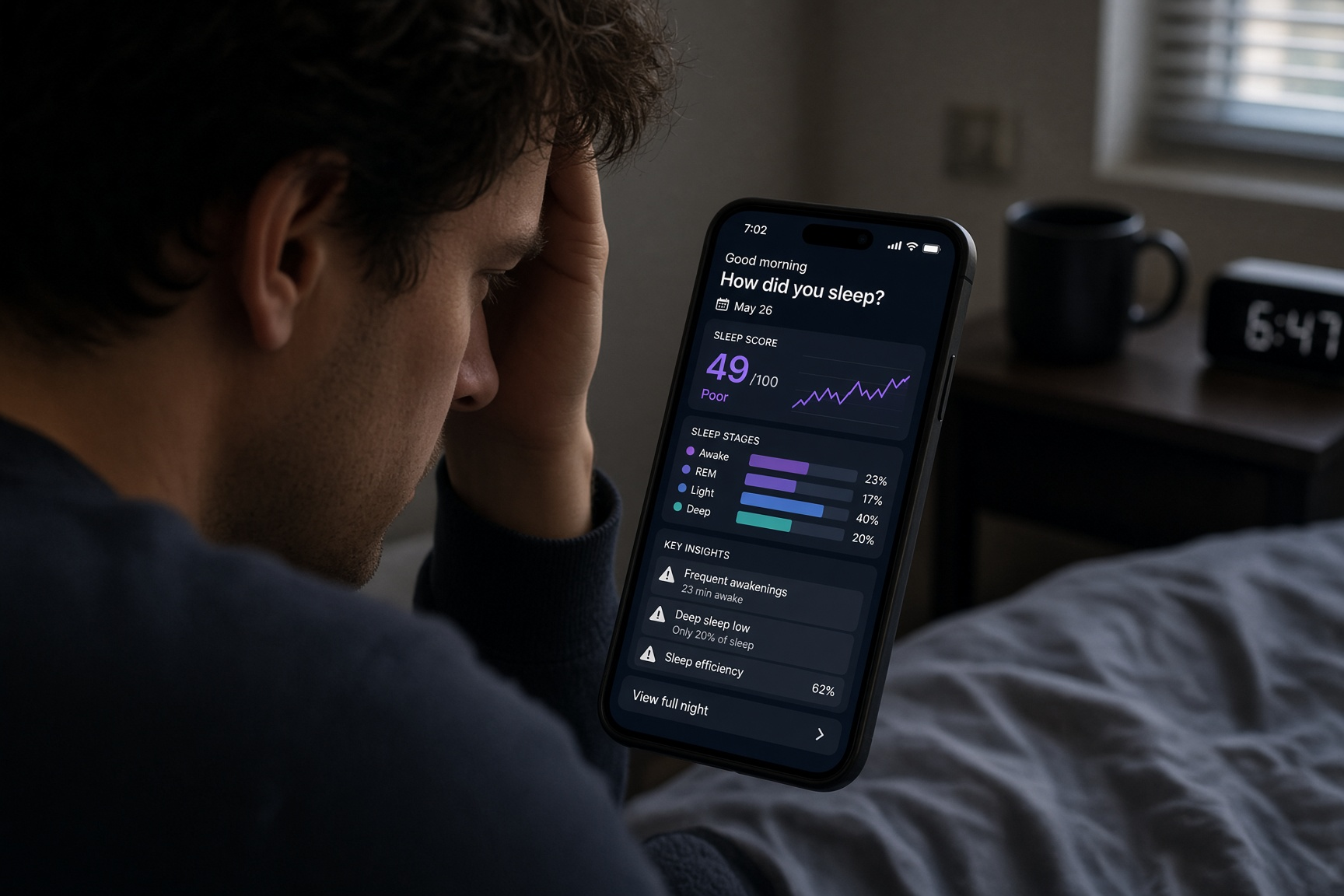
You wake up, check your ring or watch, and get a number: a sleep score, a readiness score, a breakdown of REM and deep sleep down to the minute. It feels like data. It looks like a lab report. For a lot of people, it's become the first, and sometimes only, way they think about their sleep.
Wearable sleep trackers are genuinely useful for some things and genuinely unreliable for others, and the line between those two categories isn't always obvious from the app itself. Understanding where that line falls matters, because the gap between what a consumer device measures and what a real sleep disorder requires to diagnose is bigger than most marketing suggests.
How Sleep Trackers Actually Work
Nearly all consumer sleep trackers, whether a ring, watch, or under-mattress sensor, rely primarily on accelerometer data (detecting movement) combined with heart rate and heart rate variability in more advanced devices. Some also estimate blood oxygen using pulse oximetry, though accuracy for this purpose varies considerably between devices.
From these signals, proprietary algorithms estimate when you fell asleep, when you woke up, how much you moved, and how your heart rate and HRV changed through the night. More sophisticated devices then attempt to classify that data into sleep stages: light, deep, and REM.
This is fundamentally different from how sleep is actually measured clinically. A real sleep study, polysomnography, records brain waves (EEG) directly, along with eye movements and muscle activity, the three signals that together allow a technologist to definitively identify which stage of sleep you're in during any given moment. Our guide to the four stages of sleep covers what those stages actually are and why the distinction matters.
A wearable isn't measuring your brain at all. It's inferring sleep stages from movement and cardiovascular patterns that merely correlate with them, which is a meaningfully different thing.
What Sleep Trackers Are Genuinely Good At
It's worth being fair to the technology, because some of what it does is legitimately useful.
Tracking consistency over time. Trends in your bedtime, wake time, and total sleep duration across weeks or months are generally reliable and genuinely informative. If your data shows you've been averaging 5.5 hours for the past month, that's a real and useful signal, even if the night-by-night stage breakdown isn't precise.
Flagging major behavioral patterns. Noticing that your sleep consistently gets worse after late-evening alcohol, or that weekends throw off your schedule enough to affect the following week, is a legitimate and actionable use of the data.
Motivating better habits. For a lot of people, simply having a number to look at creates accountability that improves sleep hygiene, going to bed a bit earlier, keeping a more consistent schedule, or cutting evening caffeine. The behavioral nudge effect is real even when the underlying number isn't lab-grade.
Rough estimates of total sleep time. Studies comparing wearables to polysomnography have generally found reasonable agreement on total sleep time and roughly when you fell asleep and woke up, particularly for people who are otherwise healthy sleepers without a disorder.
Where They Fall Short
Sleep staging accuracy is limited, and it's the headline metric of nearly every device. Because wearables infer stages from movement and heart rate rather than measuring brain activity directly, validation studies comparing consumer devices to polysomnography have consistently found meaningful disagreement, particularly in distinguishing REM from light sleep and in accurately identifying brief awakenings. The precise-looking pie chart in your app carries considerably more uncertainty than its clean presentation suggests.
They tend to overestimate sleep in poor sleepers. If you're lying still in bed but awake, most trackers interpret stillness as sleep, since movement is their primary signal. This means the people who might benefit most from accurate data, those with genuine insomnia or fragmented sleep, are often the ones getting the least reliable readings.
They generally cannot diagnose obstructive sleep apnea. This is the single most important limitation for a health-focused audience. Some newer devices offer oxygen-drop notifications or apnea "risk" flags based on blood oxygen estimates, and these can occasionally prompt someone to seek evaluation who otherwise wouldn't have. But device-based oxygen sensing is not validated to the standard required for diagnosis, and it cannot calculate an actual AHI (apnea-hypopnea index) the way a real sleep study can. A normal-looking tracker night does not rule out apnea, and an alarming one does not confirm it. Our guide on home tests versus in-lab studies explains what an actual diagnostic sleep study measures and why it's a fundamentally different tool.
They can't detect the disorders that depend on brain wave data. Periodic limb movement disorder, REM sleep behavior disorder, and the fine-grained arousals that fragment sleep in insomnia and apnea alike, all of these require EEG to identify with confidence. A wearable can hint that something's off through disrupted duration or elevated heart rate, but it can't tell you what that something is.
Narcolepsy and idiopathic hypersomnia require an MSLT, which no wearable replicates. Diagnosing these conditions requires a structured, same-day series of monitored nap opportunities following an overnight study, measuring precisely how fast you fall asleep and whether you enter REM abnormally quickly. There's no consumer equivalent. Our guide on narcolepsy covers why this specific testing matters and why the condition is so often missed for years without it.
Sleep scores are proprietary and inconsistent across brands. A "sleep score" of 75 means something different depending on which company designed the algorithm, and none of these scoring systems have been validated against clinical outcomes the way medical diagnostic criteria have. Comparing your score to a friend's, or even to published population averages, is comparing numbers that aren't measuring the same thing the same way.
Orthosomnia: When Tracking Itself Becomes the Problem
There's a specific, well-documented phenomenon worth knowing about: orthosomnia, a term coined by sleep researchers to describe a preoccupation with achieving perfect sleep tracker data that itself worsens sleep.
The mechanism is almost circular. Someone becomes anxious about a low sleep score, that anxiety activates the same hyperarousal that drives insomnia, and their actual sleep gets worse, sometimes despite feeling generally rested before they started tracking closely. Clinicians have reported patients presenting with new insomnia symptoms that trace directly back to nightly obsession over tracker data rather than any underlying physiological problem.
If checking your sleep score has started to feel like a source of anxiety rather than useful information, that's worth recognizing as a genuine pattern, not a personal failing. Sometimes the most useful intervention is putting the tracker away for a while.
When Your Tracker Data Is Actually Worth Bringing to a Doctor
Despite its limitations, tracker data isn't worthless in a clinical conversation, it's just supplementary rather than diagnostic. It's genuinely useful to share with a doctor when it shows:
- Consistently short total sleep time over weeks, even if the stage breakdown isn't precise, this supports a conversation about how much sleep you actually need
- A pattern of elevated overnight heart rate or resting heart rate creeping upward over time, which can reflect disrupted sleep quality worth investigating
- Recurring blood oxygen dips flagged by a device with that feature, worth mentioning even though it can't substitute for an actual sleep study
- A long-term trend of poor scores despite genuinely good sleep habits, which is a reasonable prompt to ask whether something physiological, rather than behavioral, might be going on
What tracker data should not do is replace an actual evaluation when you have real symptoms. If you snore loudly, have witnessed breathing pauses, wake with headaches, or feel excessively sleepy during the day, a normal-looking tracker report is not a reason to skip a sleep study. Our guides on sleep apnea symptoms and excessive daytime sleepiness cover the actual clinical red flags worth acting on regardless of what your app says.
The Practical Takeaway
Think of a sleep tracker the way you'd think of a home bathroom scale: useful for spotting trends over time, not precise enough to replace an actual medical test, and potentially misleading if you treat a single night's number as gospel.
Use it for what it's good at: noticing patterns, building better habits, and tracking your own consistency over weeks and months. Don't use it to rule out a real disorder, and don't let it become a nightly source of anxiety in its own right.
Actual symptoms deserve an actual evaluation. If your sleep concerns go beyond curiosity, snoring, gasping, daytime sleepiness, or sleep that doesn't feel restorative no matter what your app says, that's worth a real sleep study, not another night of staring at a score.
Ready for a real answer instead of an estimate? Use our sleep clinic directory to find an accredited sleep center near you and get properly evaluated.
Written by
Daniel Marin
Sharing insights on sleep health and wellness to help you achieve better rest and improved quality of life.