You did everything right. You tracked your food, you trained consistently, you stayed disciplined through the week. And you were running on six hours of sleep a night the entire time, because sleep is the one variable that always gets sacrificed first when the schedule gets tight.
That last part may be undermining the rest more than you'd expect. Sleep isn't a passive recovery window that you can borrow from without cost. It actively regulates the hormones controlling hunger and fullness, and short sleep shifts them in a consistent, measurable, and unhelpful direction: hungrier, less satisfied, and specifically drawn toward the foods that are hardest to stop eating.
Here's what the research actually shows, and why this matters for anyone who's tired and struggling with weight at the same time.
The Two Hormones at the Center of It
Appetite regulation involves many signals, but two do most of the work in the sleep research.
Leptin is the satiety hormone. Produced primarily by fat cells, it signals to your brain that energy stores are adequate and you can stop eating. Higher leptin, less hunger.
Ghrelin is the hunger hormone. Produced mainly in the stomach, it rises before meals and signals your brain to seek food. Higher ghrelin, more hunger.
In a well-rested person these two operate in reasonable balance. Restrict sleep, and the balance shifts in both directions at once, which is what makes the effect so consistent.
What the Research Found
The foundational work here comes from controlled laboratory sleep restriction studies, where researchers restrict participants' sleep under carefully monitored conditions and measure hormone levels directly.
The classic finding, replicated in various forms since: restricting sleep to around four hours a night for a short period produced decreased leptin and increased ghrelin, alongside a significant increase in self-reported hunger and appetite. The appetite increase was disproportionately directed toward calorie-dense, carbohydrate-rich foods.
Population data points the same way. Large epidemiological studies have repeatedly found associations between short habitual sleep duration and higher body mass index, with the relationship holding across age groups and persisting after adjustment for the obvious confounders.
Two important caveats worth stating plainly. First, laboratory studies typically use severe restriction (four to five hours) over short periods, which is more extreme than most people's habitual pattern. Second, epidemiological associations don't establish causation on their own. But the combination, controlled experiments showing a plausible hormonal mechanism plus population data showing the expected real-world pattern, makes this one of the better-supported relationships in sleep science.
It's Not Just Hormones: What Happens in the Brain
The hormone story is the most cited, but it's incomplete. Sleep restriction also changes how the brain responds to food.
Neuroimaging studies have found that after sleep restriction, brain regions associated with reward and motivation show heightened responses to images of high-calorie food, while activity in regions involved in evaluative judgment and impulse control is reduced.
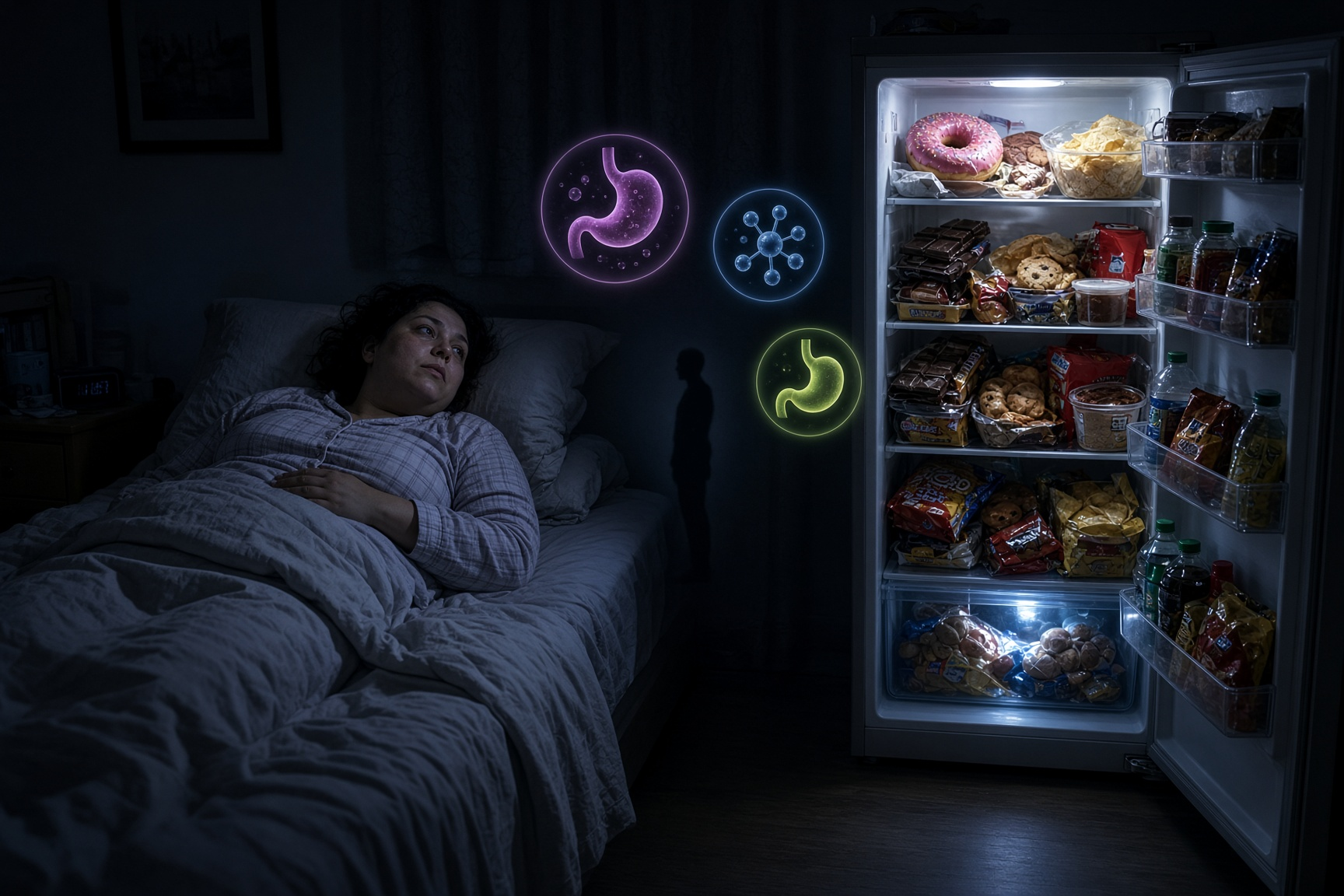
The practical translation: sleep deprivation doesn't just make you hungrier in a general sense. It makes high-calorie food look more appealing while simultaneously weakening the machinery you'd normally use to decline it. Anyone who has stood in front of an open refrigerator at 11 PM after a bad week has direct experience of this.
Research has also found that sleep-restricted people tend to consume more calories, particularly in the form of evening snacking, and that the extra intake typically exceeds the modest additional energy expenditure of being awake longer.
The Other Mechanisms
Several other pathways contribute:
Insulin sensitivity declines. Even short periods of sleep restriction have been shown to reduce insulin sensitivity in healthy adults, meaning the body handles glucose less efficiently. This is relevant both to weight and to diabetes risk.
Cortisol patterns shift. Sleep loss is associated with elevated evening cortisol, which influences appetite and promotes fat storage, particularly abdominal.
More waking hours means more eating opportunity. Straightforward, and it lands disproportionately in the late evening when food choices tend to be worst.
Fatigue reduces physical activity. Not just formal exercise, but spontaneous movement throughout the day, which is a meaningful component of daily energy expenditure.
Circadian misalignment matters independently. Eating at times misaligned with your body clock (late-night eating, shift work patterns) appears to affect metabolism beyond calorie count alone.
The Part Most Articles Miss: It Runs Both Ways
Nearly every article on this topic treats it as one-directional: poor sleep causes weight gain. That's half the picture, and the missing half is the more clinically important one.
Excess weight is the strongest risk factor for obstructive sleep apnea. Fat deposition around the neck and throat narrows the upper airway, abdominal fat reduces lung volume and makes the airway more collapsible, and fat infiltration into the tongue increases its size. This is why apnea prevalence rises substantially with BMI.
And sleep apnea, in turn, produces exactly the sleep disruption that drives the hormonal changes described above. It fragments sleep architecture dozens or hundreds of times a night, strips out deep and REM sleep, and produces the metabolic consequences of severe sleep loss even when the person spent eight hours in bed.
That's a self-reinforcing cycle:
Weight gain narrows the airway, which worsens or causes sleep apnea, which fragments sleep and disrupts appetite hormones and insulin sensitivity, which promotes further weight gain, which further narrows the airway.
The reason this matters practically: if you're in this cycle, sleep hygiene advice won't break it. Going to bed earlier does not fix a collapsing airway. Someone with untreated moderate apnea can execute perfect sleep habits, spend a disciplined eight hours in bed, and still wake with the hormonal profile of someone who barely slept.
Signs the Problem Might Be Sleep Apnea Rather Than Sleep Habits
This distinction is worth taking seriously, because it changes what you should do next. Consider evaluation if you have:
- Loud snoring, especially irregular snoring with pauses
- Witnessed breathing pauses, gasping, or choking during sleep
- Waking unrefreshed despite adequate time in bed
- Excessive daytime sleepiness disproportionate to your sleep duration
- Morning headaches or dry mouth on waking (covered in our guide to morning headaches and sleep apnea)
- Waking to urinate more than once a night
- High blood pressure, particularly if difficult to control
- Difficulty losing weight despite genuine, sustained effort
That last one deserves emphasis. Persistent difficulty losing weight in someone who is genuinely adherent to a reasonable plan is worth investigating rather than attributing to willpower. Untreated sleep apnea is a plausible and testable contributor.
Our guides on sleep apnea symptoms and snoring versus sleep apnea cover the full picture, and why you might always be tired covers the other medical causes worth ruling out.
Does Treating Sleep Apnea Help With Weight?
Honestly: the evidence is mixed, and it's worth being straight about that rather than overselling it.
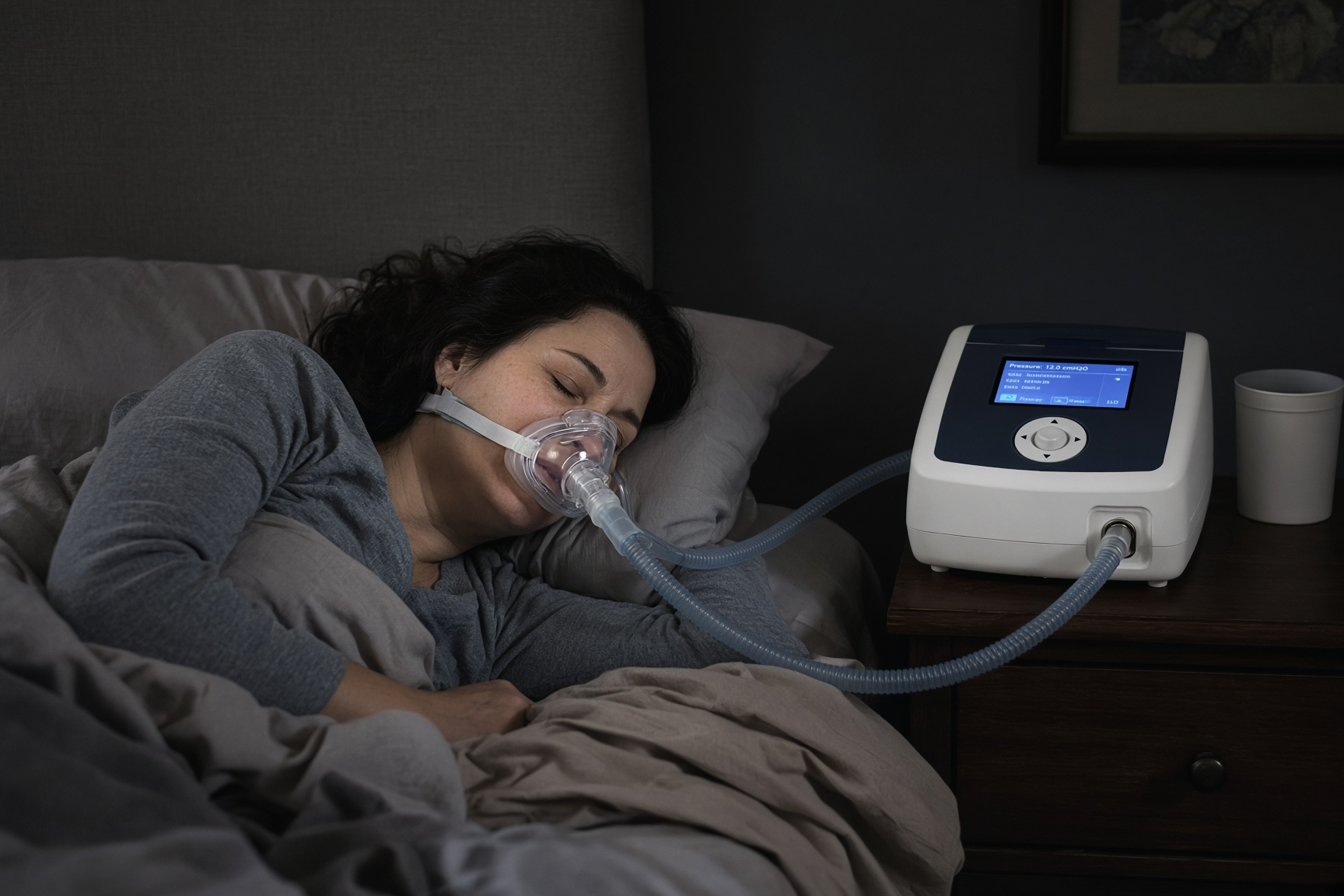
CPAP treatment reliably improves sleep quality, daytime alertness, and quality of life. Its direct effect on weight loss, however, has not been consistently demonstrated in trials, and some studies have found modest weight gain after starting treatment, possibly related to reduced work of breathing or other factors.
What treatment does do is remove a significant obstacle. Effective apnea treatment restores sleep architecture, which addresses the hormonal and metabolic disruption that was working against you. It also resolves the exhaustion that makes physical activity and food discipline genuinely harder to sustain.
The realistic framing: treating sleep apnea doesn't cause weight loss on its own, but it removes a physiological headwind and makes the deliberate work considerably more effective. Weight loss and apnea treatment work best pursued together rather than sequentially.
It's also worth knowing that weight loss meaningfully improves sleep apnea. Reductions in body weight are associated with reductions in apnea severity, and in some cases substantial weight loss resolves mild apnea entirely. The cycle runs in reverse too, which is the encouraging part.
What to Actually Do
Treat sleep as part of the plan, not the thing you sacrifice for it. If you're pursuing a weight goal on six hours a night, you're working against your own hormones. Protecting seven to nine hours is a legitimate component of the effort, not a luxury deferred until after. Our guide on how much sleep you actually need covers the evidence-based ranges.
Keep a consistent wake time. Circadian regularity supports both sleep quality and metabolic function, and a consistent wake time anchors the rhythm more effectively than a consistent bedtime.
Watch the late-evening eating window, which is where sleep-loss-driven overconsumption concentrates and where circadian misalignment compounds it.
Get evaluated if the apnea signs are present. This is the highest-leverage step for anyone in the cycle described above, because no amount of habit optimization compensates for an airway that closes.
For habits that hold up in research, see our guide to evidence-based sleep hygiene.
The Bottom Line
Short sleep lowers leptin, raises ghrelin, increases appetite, biases food preference toward calorie-dense options, weakens impulse control, and impairs insulin sensitivity. That's a consistent enough pattern that treating sleep as optional during a weight-loss effort is working against yourself.
But the more important point for many people is the two-way street. Excess weight drives sleep apnea, and sleep apnea produces the exact sleep disruption that drives weight gain. If you're tired despite adequate time in bed, snoring loudly, and finding weight loss unusually difficult, that combination is worth investigating properly. It's a testable, treatable condition, not a character flaw.
Tired, snoring, and struggling with weight? Use our sleep clinic directory to find an accredited sleep center near you and get evaluated for sleep apnea.
Is your weight affecting your sleep?
As this article covers, the relationship between weight and sleep runs in both directions, and excess weight is one of the most common risk factors for sleep apnea specifically. HealSend offers doctor-prescribed GLP-1 weight loss treatment, with clinician-led care delivered to your door. Talk to your sleep doctor about whether weight loss could be part of your treatment plan.
See if you qualifyAdvertising disclosure: this is a paid partnership. We may earn a commission if you sign up through this link, at no extra cost to you.
Written by
Daniel Marin
Sharing insights on sleep health and wellness to help you achieve better rest and improved quality of life.