You're on medication for high blood pressure. You take it as prescribed. And your numbers still won't fully cooperate, or your doctor keeps adding a second or third drug to the regimen. If that sounds familiar, there's a question worth asking that often gets skipped: has anyone checked you for sleep apnea?
The relationship between the two conditions is close enough that current hypertension guidelines specifically call for sleep apnea screening in certain patients, particularly those whose blood pressure resists standard treatment. This article focuses specifically on that blood pressure relationship, the mechanisms behind it, and what happens to your numbers when apnea gets treated. For the fuller picture of sleep apnea's cardiovascular effects, including heart attack, stroke, and atrial fibrillation risk, see our complete guide to sleep apnea and heart disease.
The Strength of the Link
Sleep apnea is now recognized as one of the most common identifiable causes of secondary hypertension, meaning high blood pressure with a specific, treatable underlying driver rather than the more general "essential" hypertension most people are diagnosed with. The association holds even after accounting for the two conditions' shared risk factors like age, weight, and alcohol use, which points to apnea affecting blood pressure through its own distinct mechanisms rather than simply riding alongside obesity.
The relationship is also dose-dependent: more severe apnea is associated with a greater likelihood of hypertension and typically higher blood pressure readings, which is the kind of pattern that strengthens the case for a genuine causal relationship rather than coincidence.
How Each Apnea Event Raises Your Blood Pressure
Unlike some of sleep apnea's other downstream effects, the blood pressure mechanism is fairly direct and observable within a single night.
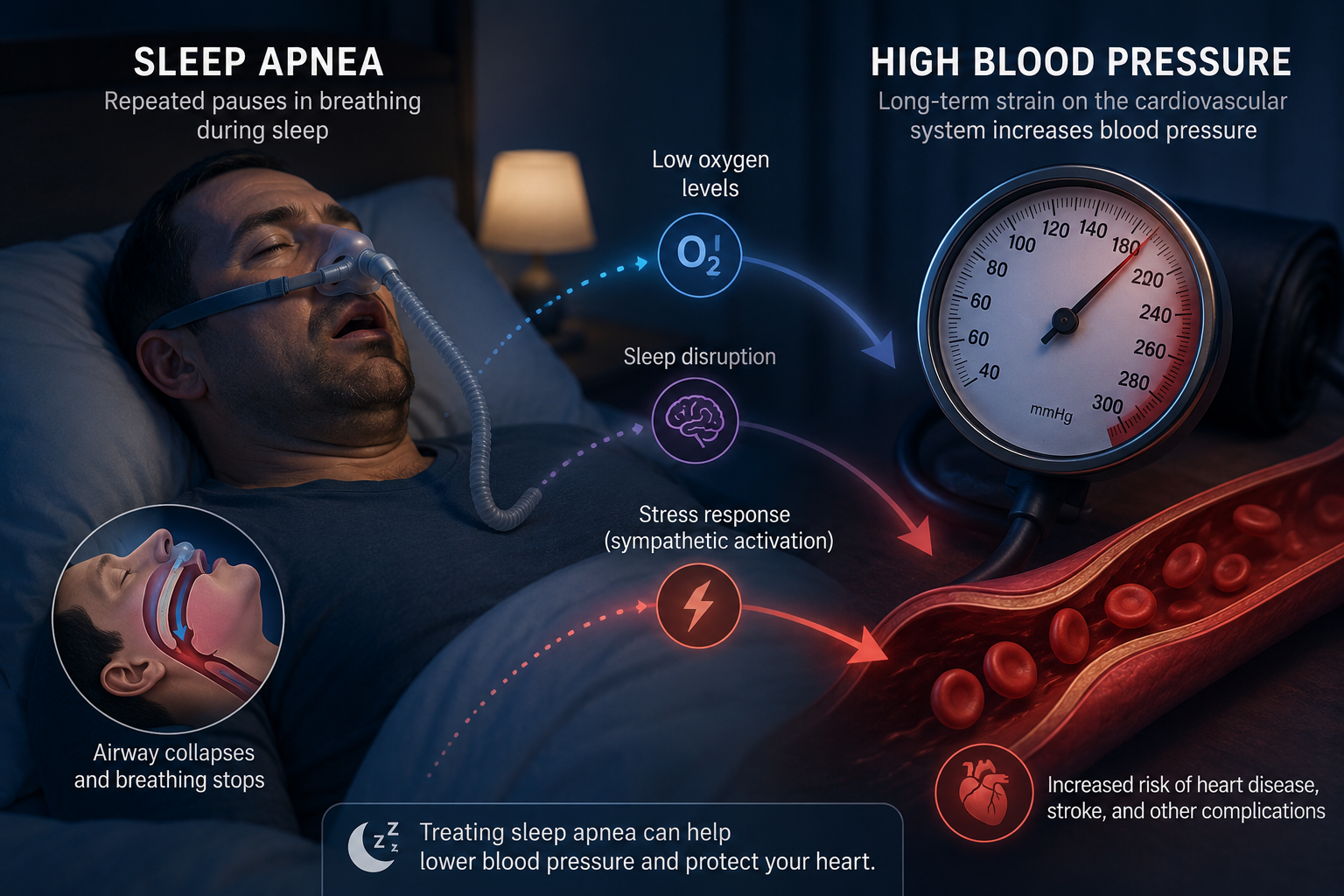
The event-by-event surge. When an apnea event occurs, oxygen levels fall and the brain triggers a stress response to restore breathing. That response includes a surge of sympathetic nervous system activity, adrenaline and noradrenaline release, and a sharp spike in blood pressure, sometimes by 20 mmHg or more within seconds around the end of an event. In someone with severe apnea, this happens dozens or hundreds of times a night. Each spike alone is transient, but their cumulative, repeated nature is what drives the sustained elevation over time.
Loss of the normal nighttime dip. In healthy sleep, blood pressure normally falls by 10 to 20 percent during the night compared to daytime levels, a pattern clinicians call "dipping." People with sleep apnea frequently lose this pattern, becoming "non-dippers," meaning blood pressure stays elevated through the night instead of resting. Non-dipping is itself an independent marker of higher cardiovascular risk, separate from the daytime blood pressure number alone.
The morning surge. Blood pressure and cortisol both rise sharply in the hour or so before and after waking, a normal phenomenon called the morning surge. In people with sleep apnea, this surge is frequently exaggerated, partly because apnea events tend to be longer and more frequent during the REM-dominant final stretch of the night, right when the morning surge is beginning to build. This is part of why hypertension-related events like heart attack and stroke cluster in the early morning hours.
Vascular damage over time. Beyond the acute surges, chronic intermittent oxygen drops damage the endothelium, the inner lining of blood vessels, impairing its ability to relax and regulate blood pressure normally. Repeated hypoxia also promotes oxidative stress and inflammation that stiffen arteries over months and years.
Fluid redistribution. Lying flat shifts fluid from the legs toward the neck and upper airway, which can worsen airway narrowing and apnea severity, particularly in people with fluid-retaining conditions like heart failure or kidney disease. That same fluid shift contributes to daytime blood pressure elevation, creating a feedback loop between fluid status, apnea, and hypertension.
Aldosterone. Several studies have found elevated aldosterone levels, a hormone that promotes sodium and fluid retention, in people with sleep apnea and resistant hypertension specifically. This overlap is one reason aldosterone-blocking medications sometimes work particularly well in this population, discussed further below.
Resistant Hypertension: Where the Overlap Is Largest
Resistant hypertension, blood pressure that remains above target despite three or more medications from different classes, including a diuretic, taken at appropriate doses, is where the sleep apnea connection is most pronounced. Studies screening patients with resistant hypertension have consistently found sleep apnea in a large majority of those tested, frequently moderate to severe, and frequently previously undiagnosed.
This pattern is significant enough that current hypertension management guidelines from major cardiology and hypertension societies recommend screening for sleep apnea specifically in patients with resistant hypertension. If your blood pressure has required a third or fourth medication and hasn't been adequately explained, apnea screening belongs in that workup, not as an afterthought.
Does Treating Sleep Apnea Actually Lower Blood Pressure?
Here the evidence is genuinely solid, though the size of the effect depends heavily on who's being treated and how consistently.
The average effect is real but modest. Meta-analyses of randomized trials have found that CPAP therapy produces an average reduction in blood pressure of roughly 2 to 3 mmHg systolic. On its own, that sounds unimpressive next to a typical antihypertensive medication.
But averages hide the patients who benefit most. The effect is considerably larger in specific groups: people with resistant hypertension, those with more severe apnea and greater oxygen desaturation, and those who use CPAP consistently for more than 4 hours a night. In these subgroups, reductions of 7 to 10 mmHg or more have been reported in some trials, a magnitude comparable to adding an additional blood pressure medication.
Adherence is the deciding factor. This is the theme that recurs across nearly every study of CPAP's cardiovascular effects. Trials with poor average CPAP usage tend to show minimal blood pressure benefit; trials or subgroups with strong adherence show meaningfully more. A machine sitting unused overnight cannot lower your blood pressure.
Population-level impact matters even at modest averages. A population-wide reduction of even 2 to 3 mmHg translates to a meaningful decrease in heart attack and stroke rates across large groups of people, even though it may feel unremarkable to any one individual watching their home cuff readings.
It's a complement to medication, not a replacement. Nobody should stop antihypertensive medication because they've started CPAP. The right framing is that treating apnea removes a driver working against your medications, potentially making them more effective and, for some patients, eventually allowing dose reduction under a doctor's supervision.
Why This Might Explain Medication-Resistant Numbers
If you're already on multiple blood pressure medications and your numbers still won't move the way they should, untreated sleep apnea is one of the more common, correctable explanations. The mechanism is straightforward: standard antihypertensives work by relaxing blood vessels, reducing fluid volume, or blunting the nervous system's blood-pressure-raising signals. Sleep apnea generates a nightly, repeated trigger for exactly those same nervous system and fluid mechanisms. Medication can dampen the response, but if the trigger fires hundreds of times every night, it can outpace what the drugs are managing.
This is also why some research has found that aldosterone-blocking medications like spironolactone work particularly well as an add-on in resistant hypertension, since they target a hormonal pathway that overlaps meaningfully with the sleep apnea mechanism described above. That's a conversation to have with your prescribing physician, not a reason to start or adjust medication independently.
Signs Worth Raising With Your Doctor
If you have high blood pressure, consider asking specifically about sleep apnea screening if you also have:
- Blood pressure that remains elevated despite three or more medications
- Loud snoring, or witnessed breathing pauses or gasping during sleep
- Morning headaches, discussed further in our guide to morning headaches and sleep apnea
- Excessive daytime sleepiness or unrefreshing sleep
- Waking to urinate more than once a night
- A home blood pressure reading that stays high in the morning specifically, even when daytime and evening readings look better
- Excess weight, a larger neck circumference, or a family history of sleep apnea
Our guides on sleep apnea symptoms and snoring versus sleep apnea cover the fuller symptom picture. Sleep apnea in women is also commonly missed, so don't rule it out based on not fitting the classic profile.
A Useful Home Monitoring Clue
If you already track your blood pressure at home, morning readings that run notably higher than evening ones, or blood pressure that doesn't fall as expected during a 24-hour ambulatory monitor (the "non-dipping" pattern mentioned above), can be a clue worth flagging to your doctor as a reason to consider apnea screening, alongside any of the symptoms above.
Getting Evaluated
Sleep apnea cannot be diagnosed from blood pressure patterns or symptoms alone, it requires an actual sleep study. Depending on your overall health and the complexity of your case, that may be a home sleep apnea test or an in-lab study; our guide on home tests versus in-lab studies explains how that decision typically gets made. People with significant cardiovascular disease or other complicating conditions are more likely to be directed toward in-lab testing.
If sleep apnea is confirmed, treatment (most commonly CPAP, though alternatives exist for people who can't tolerate it) should be pursued alongside, not instead of, your existing blood pressure management plan.
The Bottom Line
Sleep apnea raises blood pressure through a specific, repeatable mechanism: hundreds of nightly sympathetic surges, loss of the normal protective nighttime dip, an exaggerated morning surge, and cumulative vascular damage from intermittent oxygen drops. The overlap is largest, and most clinically actionable, in people whose hypertension resists standard treatment.
Treating apnea won't replace blood pressure medication, but for the right patient, especially someone with resistant hypertension and consistent CPAP use, it can meaningfully improve numbers that medication alone hasn't been able to control. If your blood pressure has been stubborn despite real effort, sleep apnea is a reasonable, testable, and treatable possibility worth raising with your doctor.
Blood pressure not responding the way it should? Use our sleep clinic directory to find an accredited sleep center near you and ask about screening for sleep apnea.
Is your weight affecting your sleep?
As this article covers, the relationship between weight and sleep runs in both directions, and excess weight is one of the most common risk factors for sleep apnea specifically. HealSend offers doctor-prescribed GLP-1 weight loss treatment, with clinician-led care delivered to your door. Talk to your sleep doctor about whether weight loss could be part of your treatment plan.
See if you qualifyAdvertising disclosure: this is a paid partnership. We may earn a commission if you sign up through this link, at no extra cost to you.
Written by
Daniel Marin
Sharing insights on sleep health and wellness to help you achieve better rest and improved quality of life.