If you have type 2 diabetes, there's a meaningful chance you also have obstructive sleep apnea, and a good chance nobody has checked. If you have sleep apnea, your risk of developing type 2 diabetes is higher than it would otherwise be, independent of your weight.
These two conditions travel together closely enough that major diabetes care guidelines now recommend screening for sleep apnea in people with type 2 diabetes. They share risk factors, particularly excess weight, but the relationship goes beyond shared causes: each condition appears to worsen the other through specific biological mechanisms.
For anyone managing diabetes and struggling with glucose control despite doing the right things, this is worth understanding properly.
How Often Do They Occur Together?
Studies of people with type 2 diabetes have consistently found high rates of obstructive sleep apnea, with many reporting that a majority of patients screened have at least mild apnea and a substantial proportion have moderate to severe disease. Prevalence figures vary widely across studies depending on the population, the severity threshold used, and the testing method, but the direction is consistent: rates are far above what you'd see in the general population.
The reverse holds as well. People with obstructive sleep apnea show higher rates of insulin resistance, prediabetes, and type 2 diabetes than comparable people without apnea.
The critical practical point: a large share of that apnea is undiagnosed. Sleep apnea is underdiagnosed generally, and in people with diabetes the classic symptoms (fatigue, poor concentration, feeling unrefreshed) are easily attributed to blood sugar fluctuations or to diabetes itself. The sleep question never gets asked.
Why Sleep Apnea Worsens Blood Sugar Control
Excess weight contributes to both conditions, which explains part of the overlap. But research has found associations between sleep apnea and impaired glucose metabolism that persist after adjusting for BMI, pointing to mechanisms specific to the breathing disorder itself.
Intermittent Hypoxia
This appears to be the central mechanism. Each apnea event causes oxygen levels to fall and then recover, and repeating that cycle hundreds of times a night produces effects that sustained low oxygen does not.
Intermittent hypoxia has been shown to impair insulin sensitivity, disrupt normal insulin secretion from pancreatic beta cells, and increase hepatic glucose production. It also drives oxidative stress and systemic inflammation, both of which independently interfere with insulin signaling.
Sympathetic Nervous System Activation
Every apnea event ends in an arousal accompanied by a surge of sympathetic activity, essentially a fight-or-flight response, dozens or hundreds of times a night. Catecholamines released during these surges promote glucose release from the liver and directly oppose insulin's action.
The result is a person whose stress-response system is being activated all night, every night, with metabolic consequences that carry into the following day.
Cortisol and HPA Axis Disruption
Repeated nighttime arousals disturb normal cortisol rhythms. Cortisol raises blood glucose by design, and chronic dysregulation of that rhythm contributes to insulin resistance and to the dawn phenomenon, the early-morning glucose rise many people with diabetes contend with.
Sleep Fragmentation and Loss of Deep Sleep
Slow-wave sleep appears to matter specifically for glucose regulation. Studies that selectively suppressed deep sleep in healthy adults, without reducing total sleep time, found measurable decreases in insulin sensitivity.
Sleep apnea does exactly this: it fragments architecture and strips out deep sleep, as covered in our guide to the four stages of sleep. Someone with untreated apnea can spend eight hours in bed while getting very little of the sleep stage that supports glucose handling.
Appetite and Behavior
Poor sleep raises ghrelin, lowers leptin, biases food preference toward calorie-dense options, and reduces the energy available for physical activity, all covered in our guide on sleep and appetite hormones. For someone managing diabetes through diet and exercise, that's a meaningful headwind.
Why Diabetes Worsens Sleep Apnea
The relationship runs the other way too, through several routes.
Weight gain. Type 2 diabetes and weight gain frequently accompany one another, and excess weight is the strongest modifiable risk factor for obstructive sleep apnea. Fat deposition around the neck narrows the airway, and abdominal fat reduces lung volume in a way that makes the airway more collapsible.
Autonomic neuropathy. Longstanding diabetes can damage the autonomic nerves that regulate breathing and upper airway muscle tone. Impaired autonomic control of ventilation is associated with sleep-disordered breathing, including central sleep apnea, and may reduce the arousal response that normally terminates an apnea event.
Fluid redistribution. Diabetic nephropathy and associated fluid retention can lead to overnight rostral fluid shift, where fluid pooled in the legs during the day moves toward the neck when lying down, narrowing the upper airway.
Nocturia. High blood glucose causes osmotic diuresis and frequent nighttime urination, fragmenting sleep independently of apnea. Nocturia is also a symptom of sleep apnea itself, so the two compound each other.
The Cycle
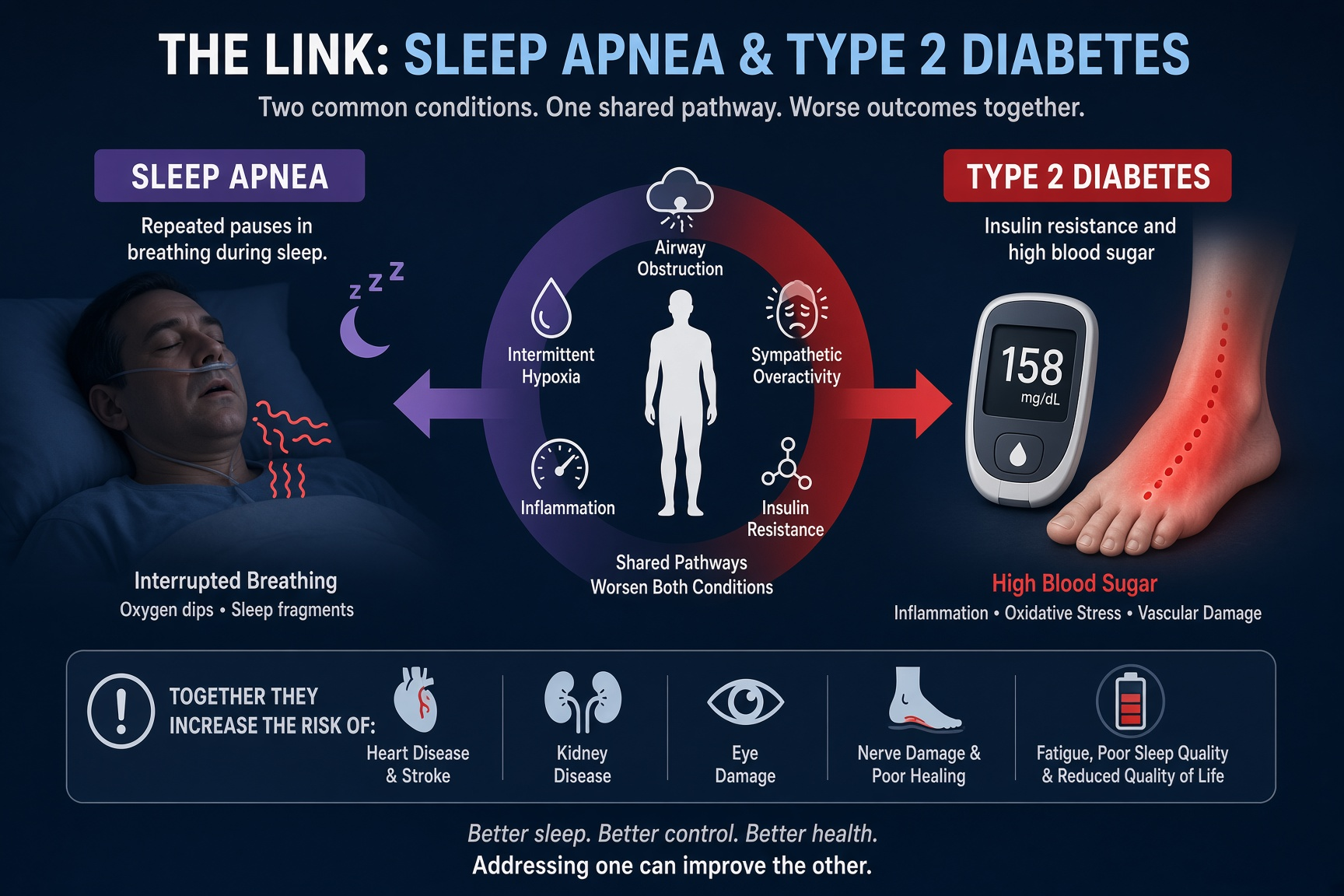
Put together, the two conditions form a reinforcing loop:
Sleep apnea causes intermittent hypoxia and sympathetic activation, which worsen insulin resistance and glucose control. Worsening diabetes contributes to weight gain, fluid retention, and autonomic dysfunction, which worsen the apnea. Worse apnea further degrades sleep quality and glucose regulation.
For someone in this cycle, intensifying diabetes management alone can produce disappointing results, because a significant driver of the problem is happening overnight and isn't being addressed.
Why This Matters Beyond Glucose Numbers
Both conditions independently raise cardiovascular risk, and together the effect is compounded. Sleep apnea is strongly associated with hypertension, and the combination of apnea and diabetes is associated with worse cardiovascular outcomes than either alone.
There's also evidence linking sleep apnea to diabetic complications, including diabetic retinopathy and neuropathy, plausibly through the same hypoxia and vascular stress pathways. Our guide on what untreated sleep apnea does to your brain, heart, and metabolism covers the broader consequence picture, and sleep apnea and heart disease covers the cardiovascular evidence in depth.
Does Treating Sleep Apnea Improve Diabetes?
This is where honesty matters more than a clean story.
What the evidence supports well: CPAP treatment reliably improves sleep quality, daytime sleepiness, blood pressure in many patients, and quality of life. Studies have also found improvements in insulin sensitivity and in overnight and post-meal glucose patterns with effective treatment.
Where the evidence is more mixed: randomized trials examining CPAP's effect on HbA1c, the standard three-month measure of glucose control, have produced inconsistent results. Some show modest improvement, others show little change. Trials with better adherence and longer duration tend to show more benefit, which suggests the mixed findings partly reflect the well-documented challenge of CPAP adherence rather than absence of a real effect.
The reasonable conclusion: treating sleep apnea should be understood as removing a significant obstacle to diabetes management rather than as a diabetes treatment in itself. It addresses a physiological driver working against you, improves the exhaustion that makes diet and exercise harder to sustain, and reduces cardiovascular risk that both conditions elevate. Expecting it to normalize HbA1c on its own would be overstating what the data show.
Adherence is the recurring theme. Benefits track closely with actually using the treatment consistently.
Screening: Who Should Ask About What
If you have type 2 diabetes, consider asking your doctor about sleep apnea screening, particularly if you have:
- Loud snoring, or witnessed breathing pauses or gasping
- Persistent fatigue or unrefreshing sleep despite adequate time in bed
- Excessive daytime sleepiness
- Blood pressure that's difficult to control
- Glucose control that's harder to achieve than your effort would predict
- Frequent nighttime urination beyond what your glucose levels explain
- Morning headaches (see our guide to morning headaches and sleep apnea)
- Excess weight or a larger neck circumference
If you have sleep apnea, ask whether you've been screened for diabetes and prediabetes, particularly if you have other risk factors. Prediabetes is common, largely asymptomatic, and a point at which intervention is especially effective.
Neither condition can be diagnosed from symptoms alone. Sleep apnea requires a sleep study, and our guide on home tests versus in-lab studies explains how that choice is made. Note that people with significant comorbidities sometimes need in-lab testing rather than a home test, so this is a decision to make with a physician.
Practical Takeaways
Treat sleep as part of diabetes management. Sleep duration and quality affect glucose control measurably. It belongs in the plan alongside diet, activity, and medication rather than being the thing that gets sacrificed for them.
Don't attribute all fatigue to diabetes. It's the easy explanation, and it's often incomplete. Persistent exhaustion alongside snoring is worth investigating separately. Our guide on why you might always be tired covers the broader differential.
If control is worse than your effort suggests it should be, look for hidden contributors. Untreated sleep apnea is a genuinely common one, and unlike many contributors, it's testable and treatable.
Weight loss helps both. It's the one intervention that directly improves apnea severity and glucose control simultaneously, and improvements in each tend to make the other easier.
The Bottom Line
Sleep apnea and type 2 diabetes are linked through more than shared risk factors. Intermittent hypoxia, sympathetic surges, cortisol disruption, and loss of deep sleep all impair glucose regulation directly, while diabetes-related weight gain, fluid retention, and autonomic changes worsen the breathing disorder in return.
The most actionable consequence is simple: if you have type 2 diabetes and you snore, wake unrefreshed, or feel exhausted during the day, ask about sleep apnea screening. It's frequently present, frequently missed, and treating it removes a real obstacle to everything else you're doing.
Managing diabetes and always exhausted? Use our sleep clinic directory to find an accredited sleep center near you and ask about screening for sleep apnea.
Is your weight affecting your sleep?
As this article covers, the relationship between weight and sleep runs in both directions, and excess weight is one of the most common risk factors for sleep apnea specifically. HealSend offers doctor-prescribed GLP-1 weight loss treatment, with clinician-led care delivered to your door. Talk to your sleep doctor about whether weight loss could be part of your treatment plan.
See if you qualifyAdvertising disclosure: this is a paid partnership. We may earn a commission if you sign up through this link, at no extra cost to you.
Written by
Daniel Marin
Sharing insights on sleep health and wellness to help you achieve better rest and improved quality of life.