There's a particular kind of patient that sleep medicine has long struggled to explain. They're exhausted, sometimes profoundly so. Their sleep doesn't feel restorative no matter how long they spend in bed. They may have trouble concentrating, cold hands and feet, headaches, or lightheadedness when standing. They get a sleep study, and it comes back normal, or borderline: an AHI under 5, no significant oxygen drops, nothing flagged as sleep apnea.
They're told there's nothing wrong. They know that isn't true.
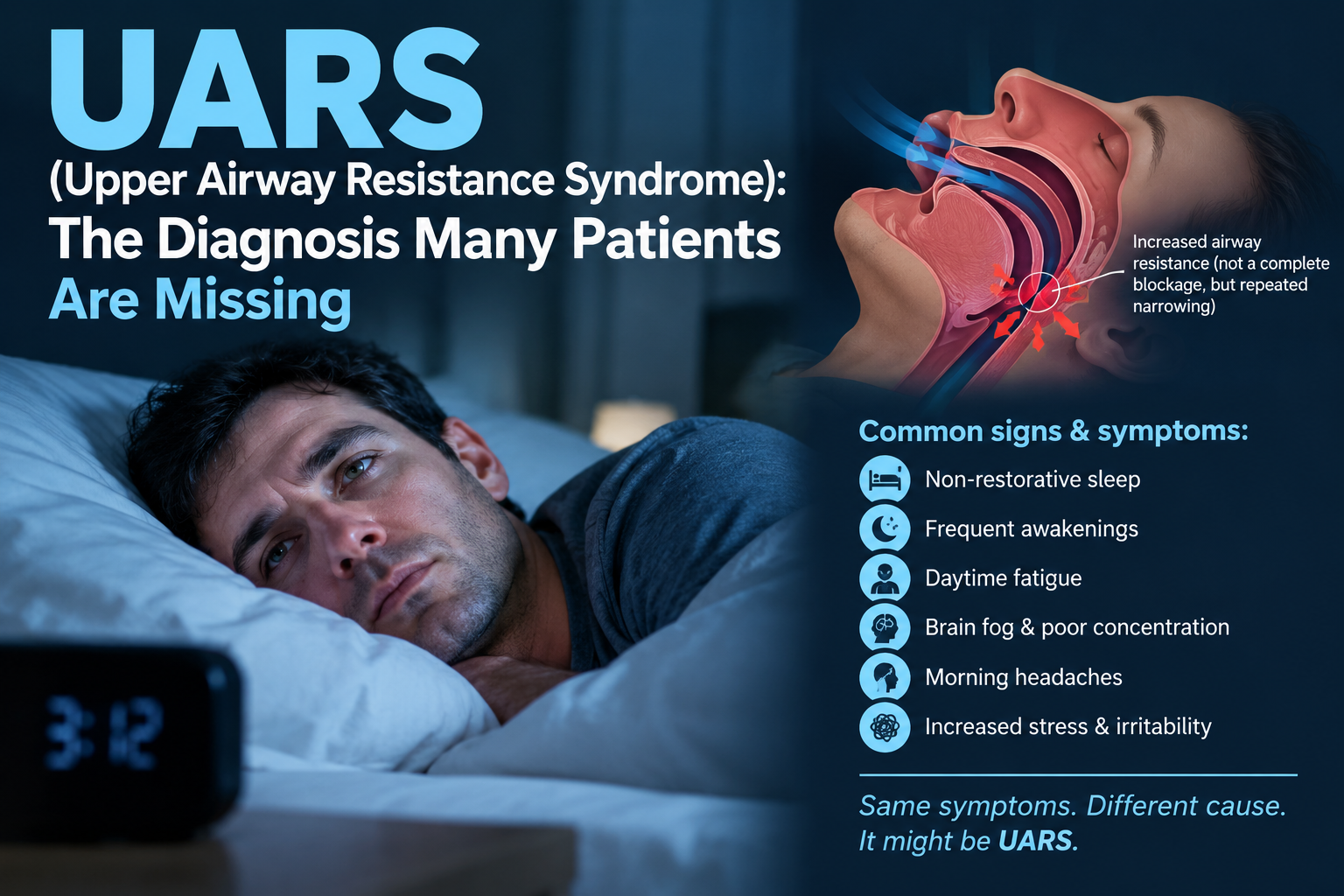
For a subset of these patients, the missing explanation is Upper Airway Resistance Syndrome (UARS), a form of sleep-disordered breathing that fragments sleep through repeated airway narrowing without the complete or near-complete breathing pauses that define sleep apnea. It's a real, recognized condition, but it's frequently missed, because the standard metric used to diagnose sleep apnea is largely blind to it.
What UARS Is
In obstructive sleep apnea, the airway collapses fully (apnea) or partially enough to reduce airflow substantially (hypopnea), and the standard measure of severity, the AHI (apnea-hypopnea index), counts these events per hour of sleep. A few of the AHI's requirements are specific: an apnea is a near-complete cessation of airflow, and a hypopnea generally requires a meaningful drop in airflow accompanied by an oxygen desaturation or a documented arousal.
UARS sits in the gap. The airway narrows enough that breathing becomes effortful, the brain has to work progressively harder to pull air through, and eventually that effort triggers a brief arousal that partially wakes the sleeper and restores airway tone. But airflow never drops enough to be scored as an apnea or a hypopnea, and oxygen levels typically stay normal. There's no dramatic breathing pause. There's just repeated, subtle effort followed by repeated micro-awakenings.
The result: sleep is fragmented, sometimes as heavily as in moderate sleep apnea, yet the AHI can be entirely normal. These arousal-terminating events are called respiratory effort-related arousals (RERAs), and the number of them per hour is combined with apneas and hypopneas into a related metric called the RDI (respiratory disturbance index).
Who Gets It: A Different Profile Than Classic Sleep Apnea
Part of why UARS gets missed is that the typical patient doesn't look like the textbook sleep apnea patient. Clinicians, and patients themselves, often carry a mental picture of sleep apnea as an overweight, middle-aged man who snores loudly. UARS tends to present differently.
Commonly seen in:
- Younger, leaner, and often female patients, often with normal or low BMI
- People with narrow facial anatomy: a high, narrow palate, a recessed or small jaw, a narrow dental arch, or a history of needing orthodontic expansion or extractions
- People with limited snoring, or none at all, since airway narrowing without full collapse can be quieter
- Patients who have been diagnosed elsewhere, sometimes for years, with insomnia, chronic fatigue, anxiety, or depression, and who never responded fully to treatment for any of them
Our guide on sleep apnea in women covers a closely related pattern: the classic symptom profile clinicians look for misses many women, and the same underlying issue, a screening framework built around one presentation, applies to UARS.
Symptoms
UARS symptoms overlap heavily with sleep apnea and with several other conditions, which is part of the diagnostic difficulty.
Common:
- Persistent, unrefreshing sleep and daytime fatigue despite adequate time in bed
- Insomnia, particularly sleep-maintenance insomnia, waking repeatedly through the night
- Morning headaches (see our guide on morning headaches and sleep apnea, which applies here too)
- Difficulty concentrating and "brain fog"
- Nighttime urination
- Teeth grinding (bruxism)
More characteristic of UARS than classic sleep apnea:
- Cold hands and feet, associated with autonomic nervous system dysregulation
- Low blood pressure, or lightheadedness or fainting on standing (orthostatic symptoms), in contrast to the high blood pressure more typical of sleep apnea
- Prominent anxiety and a sense of being "wired but tired"
- Functional gastrointestinal symptoms, such as irritable bowel syndrome, and reflux
- A history of migraines
Many of these symptoms reflect chronic sympathetic nervous system activation from repeated arousals through the night, which helps explain why UARS is so often mistaken for anxiety, chronic fatigue syndrome, or a functional disorder.
Why a Standard Sleep Study Often Misses It
This is the crux of the diagnostic problem, and it comes down to how sleep studies are typically scored and how insurance and clinical criteria are commonly applied.
The AHI doesn't capture RERAs. A patient with a normal AHI can still be having dozens of RERAs per hour, each one a genuine sleep disruption, and none of them show up in the number most commonly used to decide whether someone "has sleep apnea."
RERA scoring requires additional measurements. Detecting them reliably requires either an esophageal pressure monitor (the gold standard, but uncomfortable and rarely used routinely) or, more commonly, careful analysis of the nasal pressure airflow signal for characteristic flattening patterns, combined with EEG evidence of arousal. Home sleep apnea tests, which don't record brain waves, cannot identify arousals at all, which is one reason they are poorly suited to detecting this condition. Our guide on home tests versus in-lab studies covers what each test does and doesn't measure.
Scoring rules and reporting vary. Whether RERAs are scored at all, and whether the RDI is reported alongside the AHI, depends on the lab and the scoring rules in use. Some labs don't routinely score RERAs unless specifically requested, meaning the raw data may contain evidence of UARS that never makes it into the final report.
Insurance coverage often hinges on AHI. Many insurance policies use an AHI threshold to determine whether treatment is covered, which means a patient with a low AHI but a meaningful RDI can face barriers to care even after being correctly identified.
If your symptoms strongly suggest disordered sleep but your report shows an AHI in the normal range, it's worth asking your sleep specialist directly whether RERAs were scored and what your RDI was.
Getting Evaluated
If UARS is a possibility, the most useful steps are:
See a board-certified sleep specialist, ideally one familiar with UARS and comfortable looking beyond the AHI. Our guide on board-certified sleep physicians explains why that credential matters most for conditions like this, where the diagnosis isn't found by following a standard checklist.
Request an in-lab polysomnogram with RERA scoring. An in-lab study records EEG and can identify arousals, and asking that RERAs be scored and the RDI reported gives your physician the information a home test cannot.
Ask for a review of the raw data if a prior study was reported as normal. Some clinicians will re-score an existing study for RERAs on request.
Consider a dental or craniofacial evaluation if you have the narrow-airway anatomy associated with UARS, since structural contributors influence which treatments are likely to help.
Treatment
Because UARS exists on a spectrum with sleep apnea, similar treatment approaches apply, tailored to the individual.
CPAP or APAP. Positive airway pressure can be effective for UARS, holding the airway open enough to eliminate the effort and the arousals it triggers. Some UARS patients are sensitive to pressure and do better at lower settings or with a device offering pressure relief features, so titration matters.
Oral appliance therapy. For patients whose narrowing is tied to jaw position or a recessed mandible, a custom oral appliance that advances the lower jaw can be a good fit. See our guide on oral appliance therapy versus CPAP for who tends to benefit.
Orthodontic and craniofacial approaches. For patients with a narrow palate or dental arch, expansion of the palate (which is well established in children and increasingly used in selected adults) can enlarge the airway. This is a specialist decision made with a dentist or orthodontist experienced in airway.
Positional therapy and weight management where relevant, although UARS patients are often lean, so weight is less commonly the driver than in classic apnea.
Nasal treatment. Correcting nasal obstruction, whether through medical management of allergies or a structural fix, can reduce airway resistance, particularly since nasal breathing problems contribute to the pattern.
Surgical options are considered for specific anatomical findings, and outcomes vary, so this is a decision to make carefully with an experienced sleep surgeon. Our guide on CPAP alternatives covers the range of options.
Treating coexisting conditions. Insomnia, anxiety, and other issues that developed alongside chronic sleep fragmentation may need their own attention, but often improve substantially once the underlying breathing-related arousals are addressed.
A Note on Controversy
It's worth being honest that UARS occupies contested ground in sleep medicine. It isn't a separate diagnosis in the current formal classification system, which folds it into the broader category of obstructive sleep apnea when the RDI meets criteria, and some clinicians question whether it should be treated as a distinct entity at all. Others, particularly those working with patients who fall through the diagnostic cracks, consider it a clinically meaningful and underrecognized part of the sleep-disordered breathing spectrum.
That disagreement matters practically: how your provider views UARS will influence whether they look for it, how they interpret an AHI in the normal range, and whether they recommend treatment. If your symptoms are significant and a "normal" study doesn't fit your experience, seeking a second opinion from a specialist with experience in this area is reasonable, not doctor-shopping.
The Bottom Line
UARS is a form of sleep-disordered breathing where the airway narrows enough to fragment sleep through repeated effort-related arousals, without the pauses and oxygen drops that a standard AHI is designed to count. It tends to affect leaner, younger patients, often women, often those with narrow facial anatomy, and it's frequently misattributed to insomnia, anxiety, or chronic fatigue for years.
If you're profoundly tired despite a "normal" sleep study, and your symptoms don't match the textbook sleep apnea profile, it's worth asking whether RERAs were scored and what your RDI was. The condition is treatable, and the right evaluation can turn years of unexplained fatigue into an answer.
Told your sleep study was normal but still exhausted? Use our sleep clinic directory to find an accredited sleep center near you and ask about a comprehensive evaluation that looks beyond the AHI.
Written by
Daniel Marin
Sharing insights on sleep health and wellness to help you achieve better rest and improved quality of life.