It's oddly specific, and oddly universal. You fall asleep without much trouble, then somewhere around 3 AM you're awake. Not groggy-awake, but fully, uselessly alert, staring at the ceiling while your brain produces a highlights reel of everything you've ever worried about. Eventually you drift off again, twenty minutes before the alarm.
The good news is that the waking itself is usually normal, and more common than most people realize. The bad news is that the part where you can't get back to sleep, and the fact that it happens every night, are worth understanding properly, because the causes range from a fixable habit to a medical condition that needs evaluation.
Here's what's actually going on.
First: Waking Up at Night Is Normal
The single most useful thing to know is that brief awakenings during the night are a standard feature of human sleep, not a malfunction.
Healthy sleepers surface briefly many times a night, often without any memory of it. As covered in our guide to the four stages of sleep, you cycle through the stages roughly every 90 minutes, and the transition points between cycles are natural moments of lighter sleep where a brief arousal easily occurs. Most of the time you roll over and drop straight back down without ever registering that it happened.
So the question is rarely "why am I waking up?" It's "why am I staying awake, and why do I remember it?"
That reframing matters, because it points at a different set of causes.
Why 3 AM Specifically
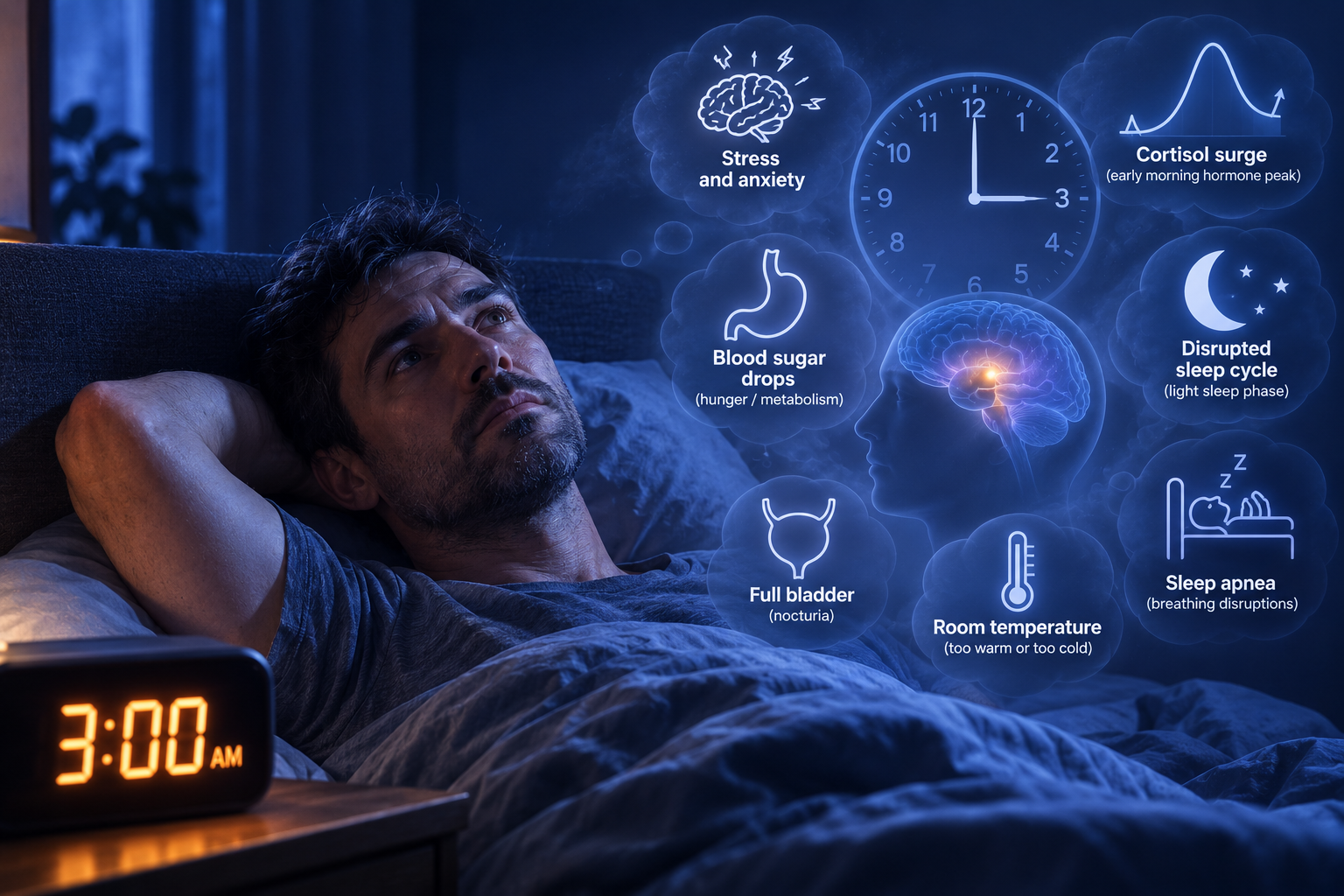
Several things converge in the small hours to make an awakening at that time both more likely and more memorable.
Your Deep Sleep Is Already Spent
Deep sleep (N3) is heavily front-loaded. The large majority of it occurs in the first third of the night, which for a typical bedtime means it's mostly finished by around 2 or 3 AM. After that, your cycles shift toward lighter N2 and progressively longer REM periods.
Lighter sleep is easier to wake from and easier to remember waking from. The same noise, full bladder, or stray thought that wouldn't have touched you at 11 PM can surface you completely at 3 AM. Nothing has gone wrong, you've simply spent the deepest, most protected portion of the night.
Your Core Body Temperature Bottoms Out
Body temperature follows a circadian curve, dropping through the night and reaching its minimum in the early morning hours, typically somewhere around 3 to 5 AM. That trough is a period of significant physiological transition, and the surrounding window is associated with lighter, more fragile sleep for many people.
Cortisol Starts Climbing
Cortisol, the primary alertness and stress hormone, follows a daily rhythm: lowest around midnight, then rising through the second half of the night to peak shortly after you wake. That rise begins in the small hours.
For most people this is a smooth, unnoticed ramp. But if your baseline stress is elevated, the rising cortisol arrives on top of an already activated nervous system. You wake during a naturally light phase of sleep, cortisol is climbing, and your brain interprets the combination as a reason to be alert. This is a large part of why 3 AM awakenings so reliably come with racing, catastrophic thinking. Problems genuinely do feel worse at 3 AM, partly because of the hormonal context you're evaluating them in.
The Common, Fixable Causes
Alcohol
This is one of the most frequent culprits and one of the most misunderstood. Alcohol is sedating, so it speeds sleep onset and feels like it helps. But as your body metabolizes it over the following hours, it produces a rebound effect: suppressed REM sleep in the first half of the night returns with a vengeance in the second half, alongside sympathetic nervous system activation.
The classic pattern is falling asleep quickly after drinking, then waking around 2 to 4 AM feeling alert, warm, and unable to settle. If your 3 AM waking correlates with evenings you've had a drink, you've likely found your answer.
Anxiety and Chronic Hyperarousal
Insomnia is fundamentally a disorder of hyperarousal, a nervous system that won't downshift. When baseline arousal is elevated, normal end-of-cycle awakenings that should pass unnoticed instead tip you into full wakefulness, and the rising cortisol gives your brain something to attach to.
This is also where a self-reinforcing loop forms. You wake, immediately think "not again," start calculating how much sleep you have left, and that frustration produces exactly the arousal that keeps you awake. The worry about not sleeping becomes the mechanism preventing sleep.
Too Much Time in Bed
Counterintuitively, spending longer in bed often makes middle-of-the-night waking worse. Sleep drive is finite. If you need seven hours and spend nine in bed, roughly two hours of wakefulness has to go somewhere, and it frequently lands in the middle of the night.
This is why sleep restriction therapy, one of the core components of CBT-I, works so well for middle-of-the-night insomnia despite sounding backwards. Consolidating your time in bed to match your actual sleep need produces deeper, more continuous sleep.
Irregular Sleep Timing
Going to bed at wildly different times, or shifting substantially on weekends, leaves your circadian rhythm poorly anchored. Sleep becomes lighter and more fragmented when your body isn't confident about when the night is supposed to be. Our guide to evidence-based sleep hygiene covers which timing habits actually hold up in research.
Room Temperature, Light, and Noise
Basic, but genuinely common. A room that's too warm interferes with the core temperature drop sleep depends on. Light exposure in the small hours (including from checking your phone when you wake) suppresses melatonin and signals your circadian system that morning has arrived.
Caffeine Later Than You Think
Caffeine has a half-life of roughly five to six hours, meaning a 3 PM coffee can still have a meaningful amount active in your system at bedtime. It doesn't always prevent sleep onset, but it lightens sleep and makes middle-of-the-night awakenings more likely.
The Medical Causes Worth Ruling Out
If your 3 AM waking is nightly, longstanding, and unresponsive to the fixes above, it's worth considering causes that aren't about habits at all.
Obstructive Sleep Apnea
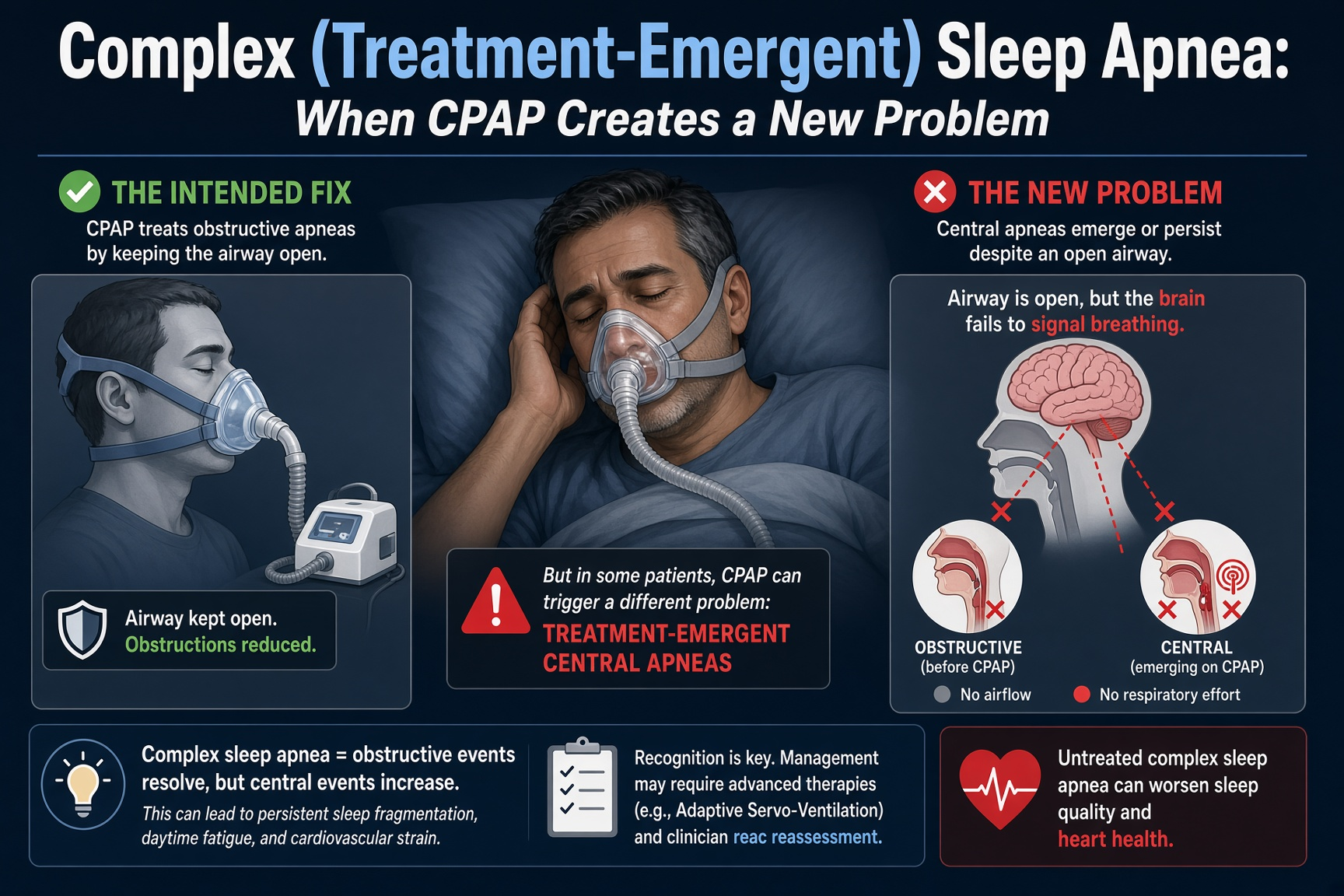
This one is frequently missed, because people assume apnea presents as snoring and daytime sleepiness rather than as insomnia. In reality, repeated breathing interruptions cause repeated arousals, and some people experience those arousals as waking up rather than as unremembered fragmentation.
Suspect this if the waking comes with: gasping or choking, a racing heart, needing to urinate (apnea genuinely drives nighttime urination through a hormonal mechanism), a dry mouth or sore throat, morning headaches, or a partner reporting loud snoring and breathing pauses. Our guides on snoring versus sleep apnea and sleep apnea symptoms cover the full picture.
The important detail: apnea-driven awakenings will not resolve with better sleep hygiene. They need diagnosis and treatment.
Nocturia
Waking to urinate more than once a night isn't simply an aging inevitability. It can reflect sleep apnea, poorly controlled blood sugar, prostate issues, medication timing (particularly diuretics), or heart failure. If this is the reliable trigger for your 3 AM waking, it's worth investigating the cause rather than just restricting evening fluids.
Restless Legs and Periodic Limb Movements
Restless legs syndrome can make returning to sleep genuinely difficult, since the urge to move intensifies with rest. Periodic limb movement disorder causes repeated leg jerks that fragment sleep, often without the person's awareness, though a bed partner may have noticed. See our guide to restless legs syndrome.
Depression
Early-morning awakening, waking hours before intended and being unable to return to sleep, is a recognized and relatively characteristic feature of depression, distinct from difficulty falling asleep. If the 3 AM waking comes alongside persistent low mood, loss of interest, or appetite changes, that pattern is clinically meaningful.
Hormonal Transitions
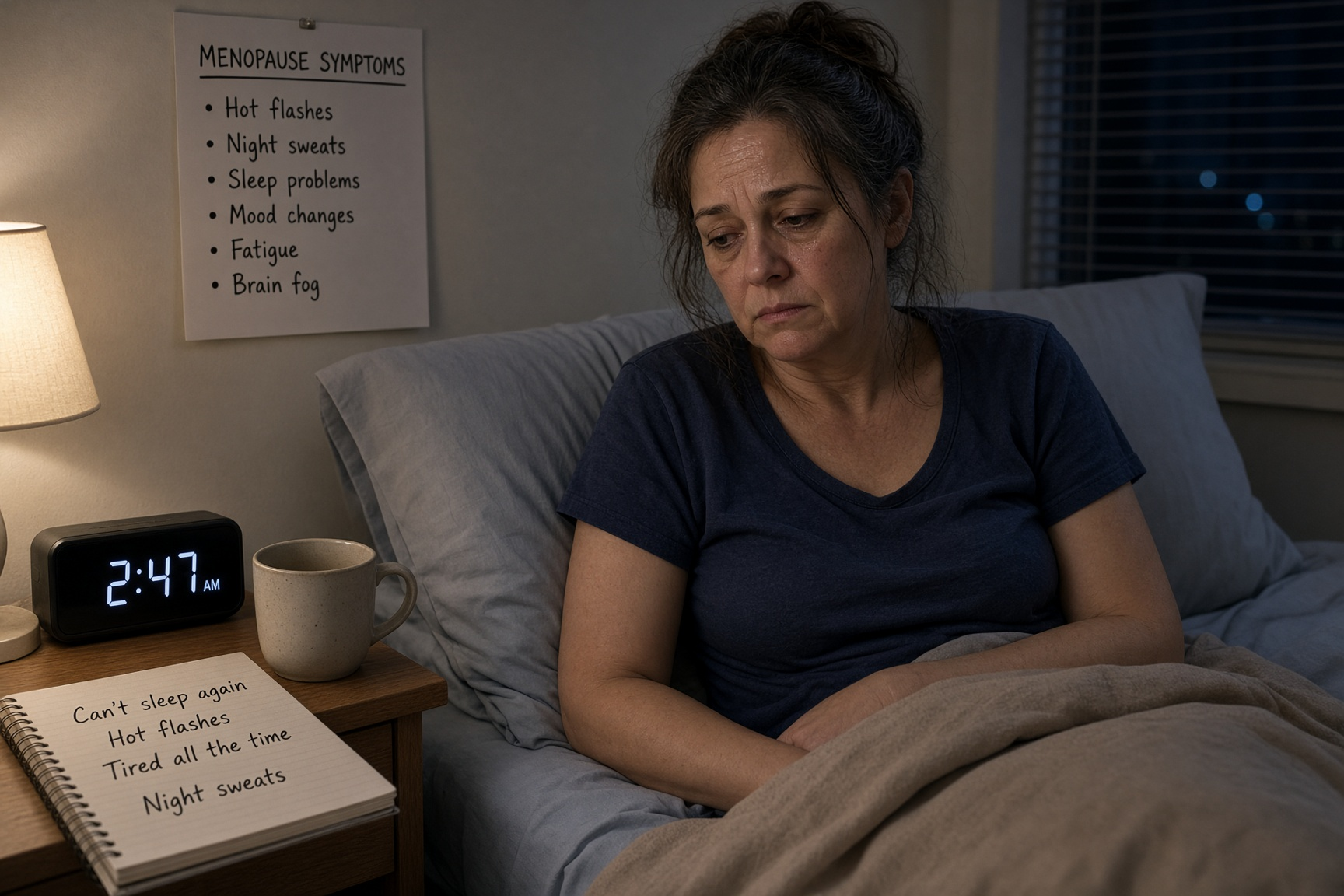
Perimenopause and menopause are strongly associated with middle-of-the-night waking, both through night sweats and vasomotor symptoms and through independent effects on sleep architecture. This is one of the most common causes in women in their forties and fifties and is often under-discussed.
Reflux, Pain, and Thyroid Issues
Nighttime acid reflux frequently wakes people without producing obvious heartburn. Chronic pain conditions surface during lighter sleep phases. An overactive thyroid can produce nighttime alertness and palpitations. All are worth mentioning to a doctor if they fit.
What to Actually Do When You Wake at 3 AM
The instinct is to lie there and try harder to sleep, which is close to the worst available option. It builds frustration and, over time, teaches your brain to associate the bed with lying awake.
Don't check the clock. Calculating remaining sleep time serves no purpose and reliably raises arousal. Turn it away from you.
Stay off your phone. The light is a direct circadian signal, and the content is stimulating.
If you're awake more than about 20 minutes, get up. This is the stimulus control principle from CBT-I, and it's counterintuitive but well supported. Leave the bedroom, sit somewhere else in dim light, do something calm and unstimulating (reading something undemanding works well), and return to bed when you feel genuinely sleepy again. Repeat as needed. The goal is protecting the association between your bed and sleep.
Don't try to force it. Effortful trying is arousing by nature. Aim for restful, low-demand wakefulness rather than sleep, which paradoxically makes sleep more likely to arrive.
Address it during the day, not at 3 AM. Middle-of-the-night worry is not a productive planning session. If a specific concern keeps surfacing, writing it down earlier in the evening ("worry time" scheduled well before bed) meaningfully reduces its tendency to show up later.
When to See a Specialist
Consider a proper evaluation if:
- It happens most nights and has persisted for three months or more
- You're awake for extended periods and it's affecting your daytime function
- You have any signs of sleep apnea: snoring, witnessed pauses, gasping, morning headaches, nighttime urination
- You're exhausted during the day despite spending adequate time in bed
- Basic changes to alcohol, caffeine, timing, and bedroom environment haven't helped
- It comes with persistent low mood or anxiety that's affecting your life more broadly
Chronic insomnia is defined as difficulty falling or staying asleep at least three nights a week for at least three months, and it responds well to treatment. CBT-I is the recommended first-line approach, more effective long-term than sleep medication, and it directly targets exactly this pattern. If the underlying cause turns out to be apnea or a movement disorder instead, that requires a different path, which is precisely why evaluation is worth it rather than guessing.
Our guide on insomnia versus sleep apnea covers how to tell which one you're likely dealing with.
The Bottom Line
Waking at 3 AM is not, by itself, a sign that something is broken. Brief awakenings are a normal feature of sleep, and the small hours are when your sleep is naturally lightest, your body temperature is at its lowest, and cortisol has begun its climb. That combination makes an awakening both likelier and more memorable.
What isn't normal is lying awake for an hour every night, or waking with gasping, a pounding heart, or a need to urinate. Those point at causes that habits won't fix.
Start with the straightforward things: alcohol, caffeine timing, room temperature, consistent schedule, and getting out of bed rather than lying there frustrated. If the pattern persists past those, it's a medical question worth answering.
Waking every night and can't get back to sleep? Use our sleep clinic directory to find an accredited sleep center near you and get properly evaluated.
Written by
Daniel Marin
Sharing insights on sleep health and wellness to help you achieve better rest and improved quality of life.