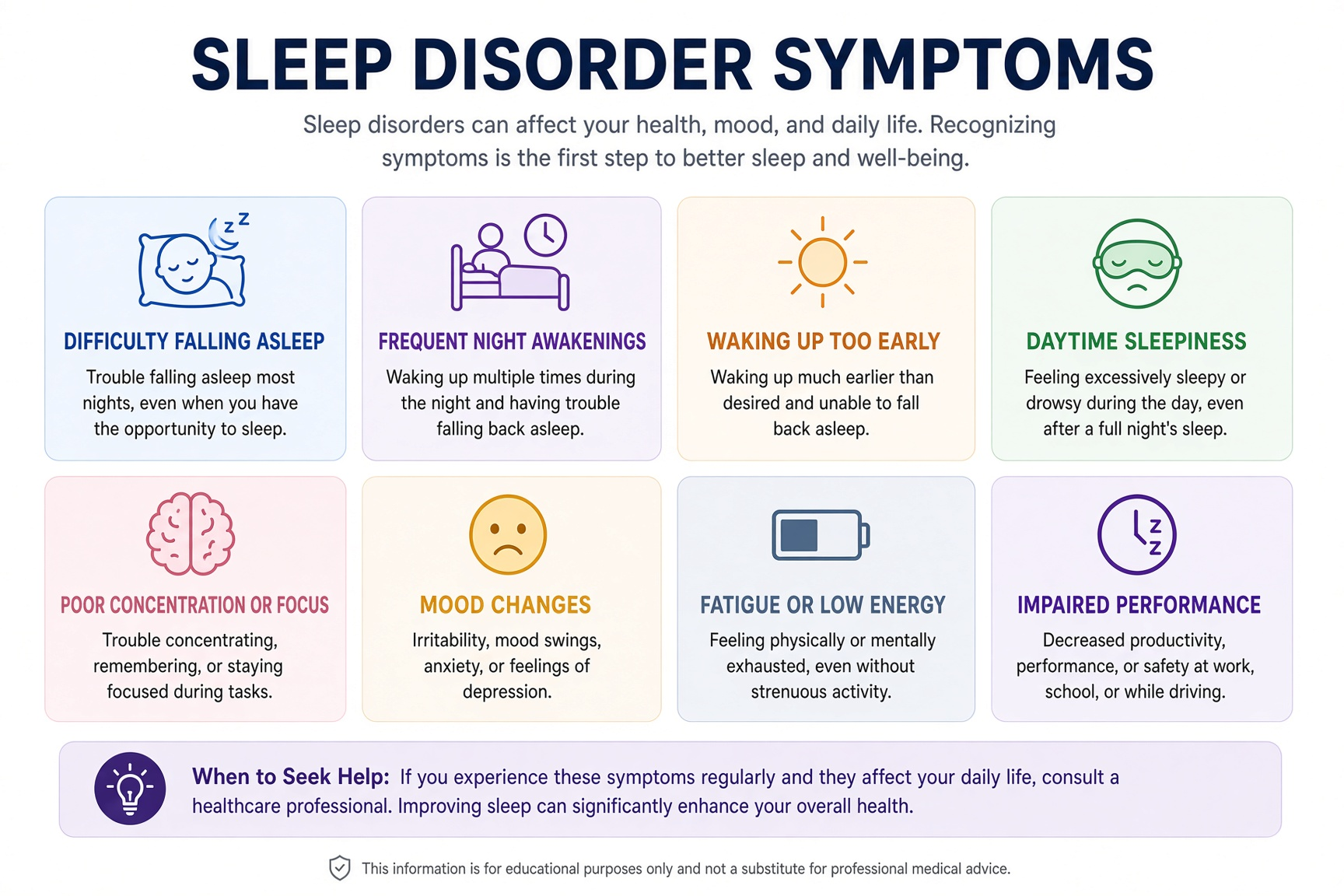
Most people arrive at "something is wrong with my sleep" long before they arrive at which specific thing is wrong. That gap matters, because sleep disorders fall into a handful of distinct categories, breathing disorders, insomnia, movement disorders, hypersomnia, circadian rhythm disorders, and parasomnias, and each one has its own symptom pattern, its own diagnostic path, and its own treatment. Treating one when you actually have another rarely works.
This checklist is organized by category rather than as one long undifferentiated list, so you can find where your symptoms cluster and jump straight to the guide that goes deeper. Check off what applies to you in each section. A cluster of checks in one category is a stronger signal than a scattering across several, though overlapping conditions are common and worth knowing about too.
This isn't a diagnostic tool, only a sleep study or clinical evaluation can actually diagnose these conditions, but it's a genuinely useful way to organize what you're experiencing before that conversation.
Category 1: Sleep-Disordered Breathing
- Loud or irregular snoring
- Snoring that stops and starts, sometimes with a gasp or snort
- Witnessed pauses in breathing during sleep
- Waking up gasping or choking
- Waking with a dry mouth or sore throat
- Morning headaches
- Waking to urinate more than once a night
- Excessive daytime sleepiness despite adequate time in bed
- Difficulty concentrating or memory problems
- High blood pressure, especially if hard to control with medication
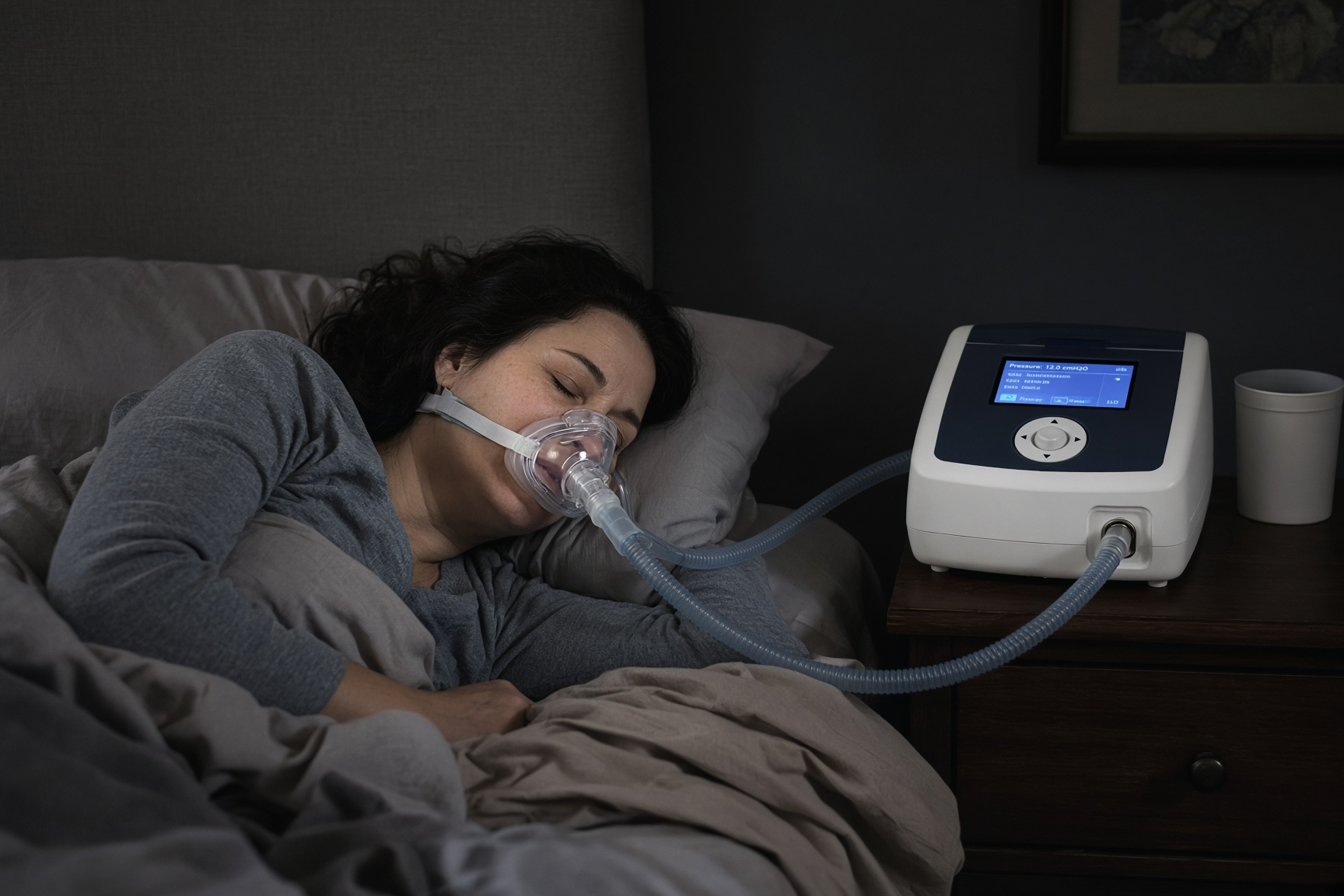
If several of these apply: this points toward obstructive sleep apnea, one of the most common and most underdiagnosed sleep disorders. Start with our guides on sleep apnea symptoms and snoring versus sleep apnea. If you don't fit the classic loud-snoring profile, know that apnea in women is frequently missed because symptoms often look different.
Category 2: Insomnia
- Difficulty falling asleep, often lying awake for 30 minutes or more
- Waking during the night and struggling to fall back asleep
- Waking too early and being unable to return to sleep
- A racing or overactive mind at bedtime
- Dreading bedtime because you anticipate another bad night
- Symptoms occurring at least three nights a week for three months or more
- Daytime impairment as a result: fatigue, irritability, poor concentration
If several of these apply: this points toward chronic insomnia. The key distinguishing feature from sleep apnea is awareness, people with insomnia are conscious of not sleeping, while people with apnea often have no idea their sleep is disrupted. Our guide on insomnia versus sleep apnea helps sort out which applies, and CBT-I is the recommended first-line treatment. If your problem is specifically waking in the middle of the night, see our guide on waking at 3 AM.
Category 3: Movement Disorders
- An uncomfortable, hard-to-describe urge to move your legs, especially in the evening
- The urge is worse when resting and relieved by movement
- Crawling, itching, or pulling sensations deep in the legs
- A bed partner has noticed you kicking or jerking during sleep
- Symptoms significantly delay falling asleep
If several of these apply: this points toward restless legs syndrome or periodic limb movement disorder. Both are strongly, and often correctably, linked to iron deficiency. Our complete guide to restless legs syndrome covers the full picture and when to see a specialist.
Category 4: Hypersomnia (Excessive Sleep Attacks)
- Overwhelming, sometimes irresistible urges to sleep during the day, regardless of how much you slept the night before
- Brief naps that feel refreshing, at least temporarily
- Sudden, brief muscle weakness triggered by laughing, surprise, or strong emotion
- Vivid, dreamlike hallucinations as you're falling asleep or waking up
- Waking up unable to move or speak for a short time
- Long, unrefreshing naps and significant difficulty waking up ("sleep drunkenness")
If several of these apply, especially the sudden muscle weakness: this points toward narcolepsy or idiopathic hypersomnia, conditions frequently misdiagnosed for a decade or more because they're mistaken for depression, laziness, or simple tiredness. Our complete guide to narcolepsy covers the full symptom picture and the specific testing required. For a broader look at what qualifies as true excessive daytime sleepiness versus ordinary tiredness, see our guide on excessive daytime sleepiness.
Category 5: Circadian Rhythm Issues
- You feel most alert and functional at times that don't match a standard schedule (very late at night, or very early in the morning)
- You struggle to fall asleep at a socially normal bedtime despite feeling tired the next day
- Your sleep timing shifts dramatically between work days and days off
- Shift work regularly disrupts your sleep-wake schedule
- Your natural sleep pattern feels fundamentally out of sync with the world around you, rather than disrupted or broken
If several of these apply: this points toward a circadian rhythm disorder rather than a primary sleep disorder, meaning the sleep itself may be fine once it happens, but the timing is misaligned. This is common in teenagers, night-shift workers, and people with a strong natural tendency toward very late or very early schedules.
Category 6: Parasomnias and Unusual Nighttime Behaviors
- Physically acting out dreams: talking, shouting, punching, or kicking while asleep
- A bed partner has been injured, or you've been injured, during sleep
- Walking, eating, or performing other complex behaviors while asleep, with no memory afterward
- Intense fear or screaming episodes early in the night, with no memory the next day
- Frequent, distinct nightmares that wake you and that you remember vividly
If several of these apply: this points toward a parasomnia. Sleepwalking and night terrors typically arise from deep sleep, occur in the first third of the night, and are followed by no memory of the event, as explained in our guide to the four stages of sleep. Acting out dreams with vivid recall afterward is a different and distinct pattern (REM sleep behavior disorder) that's worth mentioning specifically to a doctor, since it's clinically significant beyond the injury risk. If this describes a child in your home rather than yourself, our guide on signs your child may have a sleep disorder covers the pediatric picture.
What If You Checked Boxes in Multiple Categories?
This is common, and it's worth knowing before it causes confusion. Several combinations occur together often enough that they have their own clinical significance:
- Insomnia and sleep apnea together is common enough to have its own name, COMISA, and it usually requires addressing both conditions rather than just one.
- Restless legs syndrome frequently accompanies insomnia, since the leg symptoms are often what's actually preventing sleep onset in the first place.
- Sleep apnea can produce symptoms that look like several other categories at once, disrupted sleep architecture from apnea can cause daytime sleepiness that resembles hypersomnia, movement-like arousals, and even contribute to mood-related sleep disruption.
If your checks span categories, don't try to self-diagnose the combination. That's exactly the situation a proper evaluation is built for.
What to Do With This
A cluster of checks in one category is a reasonable basis for bringing a specific concern to a doctor, referencing the relevant condition by name rather than a vague "I'm not sleeping well."
Checks across several categories is a reason to seek a comprehensive evaluation rather than guessing at a single cause yourself.
Any red-flag items (falling asleep while driving, witnessed breathing pauses, sudden muscle weakness, injuring yourself or a partner during sleep) warrant prompt evaluation regardless of how the rest of the checklist looks.
None of these conditions can be definitively diagnosed from a checklist. Insomnia and restless legs syndrome are typically diagnosed clinically, through history and symptoms. Sleep apnea, narcolepsy, idiopathic hypersomnia, and periodic limb movement disorder require an actual sleep study to confirm. Our guide on home tests versus in-lab studies explains how that decision gets made, and what to expect during a sleep study walks through the process for anyone nervous about the night itself.
The Bottom Line
Sleep problems aren't one thing. They're a set of distinct categories, breathing disorders, insomnia, movement disorders, hypersomnia, circadian misalignment, and parasomnias, each with a different symptom signature and a different fix. Working out which category your symptoms cluster in is the single most useful step you can take before an appointment, and it's often the difference between a productive conversation with a doctor and a frustrating one.
Ready to get properly evaluated? Use our sleep clinic directory to find an accredited sleep center near you and get an evaluation that actually matches your symptoms.
Written by
Daniel Marin
Sharing insights on sleep health and wellness to help you achieve better rest and improved quality of life.