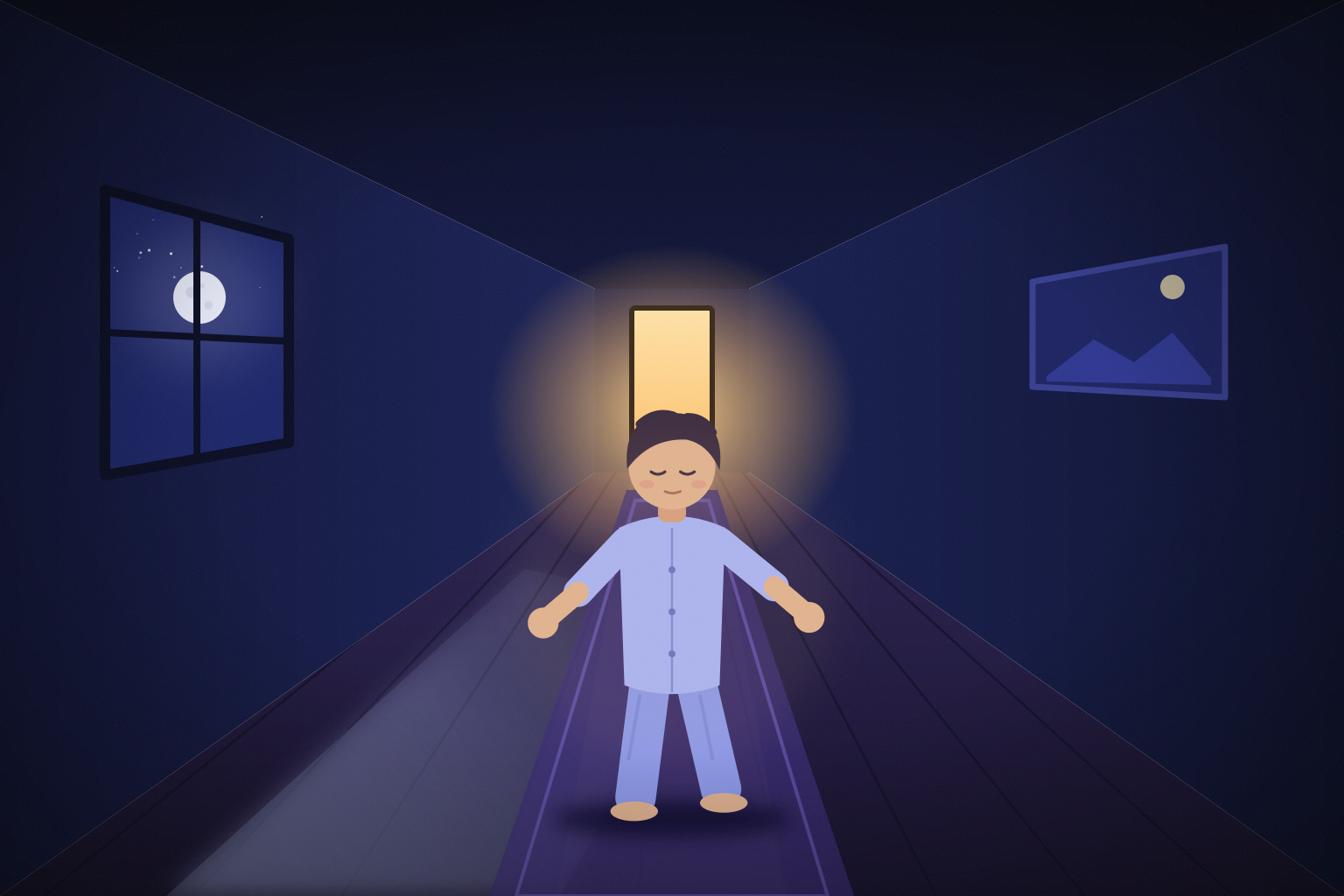
You find the front door unlocked, or a plate of food on the counter you don't remember making. A partner tells you that you sat up in bed, walked down the hallway with your eyes open, and answered a question with something that made no sense. You woke up in a different room with no memory of getting there.
For many adults, discovering that they sleepwalk is both startling and embarrassing. Most people assume sleepwalking is something children grow out of, so when it happens in adulthood it can feel like a sign that something is wrong. Sometimes it is, and sometimes it's a long-standing tendency that has resurfaced. Either way, adult sleepwalking is worth understanding properly, because the causes are often identifiable and treatable, and the safety risks are real.
What Sleepwalking Actually Is
Sleepwalking, or somnambulism, is a disorder of arousal: a partial awakening from deep sleep in which part of the brain is awake enough to move and perform complex behavior while the rest remains asleep. The person is neither fully asleep nor awake.
It belongs to a family of conditions called NREM parasomnias, which also includes sleep terrors and confusional arousals. All of them arise from the deepest stage of non-REM sleep. Our guide to the four stages of sleep explains that stage (N3, or slow-wave sleep) and why it is concentrated in the first third of the night, which is exactly when these episodes tend to occur.
What a typical episode looks like:
- It happens in the first few hours after falling asleep, not in the early morning
- The person sits up, gets out of bed, and may walk, sometimes with open, glassy eyes
- They may perform routine or even complex tasks: dressing, moving objects, opening doors, preparing food, or leaving the house
- They're difficult to wake, and if woken are confused and disoriented
- Speech, if any, is usually mumbled or doesn't make sense
- They typically return to bed on their own, or can be gently guided there
- There is little or no memory of the episode the next morning
- Episodes usually last from a few minutes to around half an hour
How Common Is It in Adults?
Sleepwalking is most common in childhood, but it doesn't always stop. Estimates of past-year sleepwalking among adults range from roughly 1.5 to 3.6 percent depending on the study, and a larger share of adults report having sleepwalked at some point in their lives. Many adults who sleepwalk were also sleepwalkers as children, and a family history is common, since there is a strong genetic component.
Two patterns are worth distinguishing, because they point toward different explanations:
Persistent sleepwalking continues from childhood into adulthood. This usually reflects an inherited tendency toward partial arousals from deep sleep.
Adult-onset sleepwalking begins for the first time in adulthood, or returns after a long absence. This pattern deserves closer attention, because it more often has an identifiable trigger or underlying cause.
What Triggers Sleepwalking in Adults
Most sleepwalking involves a vulnerability to arousals from deep sleep combined with something that provokes them. The triggers are important to know because many can be addressed.
Sleep deprivation and irregular schedules. When you're short on sleep, your brain compensates with a rebound of deep sleep, which increases the opportunity for partial arousals. Our guide on sleep debt covers how this accumulates. Shift work and erratic sleep timing add to the risk.
Untreated sleep apnea. This is one of the most important and most frequently missed triggers in adults. Each breathing disruption causes an arousal, and in someone predisposed to sleepwalking, those arousals can set off an episode. Treating the apnea often reduces or resolves the sleepwalking. Our guide on sleep apnea symptoms covers the warning signs.
Other sleep disorders. Restless legs syndrome and periodic limb movement disorder, which fragment sleep with repeated movements, can also provoke episodes. See our guide on restless legs syndrome.
Medications. Sedative-hypnotic sleep medications, particularly zolpidem and related drugs (sometimes called "Z-drugs"), are well known for provoking complex sleep behaviors, including sleepwalking, sleep-eating, and even sleep-driving. The FDA requires a boxed warning on these medications for that reason. Other medications implicated include certain antipsychotics, some antidepressants, lithium, and some beta blockers. Never stop a prescribed medication on your own, but if sleepwalking began after starting one, tell your prescriber.
Alcohol. Alcohol fragments sleep and can trigger arousal-related episodes, particularly in the first half of the night.
Stress and emotional strain. Psychological stress is associated with increased episodes, though it is rarely the sole cause.
Medical triggers. Fever, nighttime reflux, pain, a full bladder, and noise or other disturbances can all provoke an arousal in someone with the underlying tendency.
Neurological and psychiatric conditions. In some cases, new sleepwalking-like behavior reflects another condition, which is why unexplained adult-onset episodes should be evaluated rather than dismissed.
Is It Really Sleepwalking? Conditions That Look Similar
Not every episode of nighttime wandering is a disorder of arousal. Telling them apart changes the treatment.
| Condition | Key differences |
|---|---|
| Sleepwalking | Early in the night, from deep sleep; hard to wake; confused; no memory |
| REM sleep behavior disorder | Later in the night, from REM sleep; acts out a vivid dream; wakes easily and recalls the dream. Mostly older adults. See our guide on REM sleep behavior disorder |
| Nocturnal seizures | Brief, stereotyped, repetitive episodes, often several a night, sometimes with jerking or stiffening |
| Sleep-related eating disorder | Eating, often unusual foods, during partial arousals; sometimes linked to sleep medications |
| Sleep terrors | Sudden screaming and intense fear with little movement from the bed |
| Confusional arousal | Confusion and disorientation on waking, without leaving the bed |
| Sleep apnea arousals | Gasping, choking, or movement tied to breathing pauses |
A bed partner's description, or a video recording of an episode, can be remarkably helpful to a sleep specialist.
The Real Risks
Sleepwalking is often portrayed humorously, but the consequences can be serious.
- Injuries from falls, collisions with furniture, and tumbles down stairs are the most common
- Leaving the home, sometimes in cold weather or without shoes, or wandering outside at night
- Cooking or using appliances, with the risk of burns or fires
- Driving, which is rare but documented
- Aggression is uncommon, but a person who is aroused or restrained during an episode may react defensively and can injure a partner or family member without any awareness of doing so
This is not a reason for panic. Most sleepwalking is benign. But it is a reason to take the safety measures below seriously, particularly if episodes are frequent or involve complex behavior.
Keeping Yourself and Others Safe
Make the home safe.
- Lock exterior doors and windows, and consider door chimes or alarms that alert others if a door opens
- Place a gate at the top of stairs, or sleep on the ground floor if possible
- Clear the floor and path of clutter, cords, and sharp objects
- Store knives, car keys, and other hazards out of reach or out of sight
- Make sure heating appliances and the stove can't be used easily
Handle an episode gently.
- Don't try to forcibly wake the person, which can cause confusion, fear, or a defensive reaction
- Quietly and calmly guide them back to bed
- If they seem unresponsive to direction, stay nearby and make sure they remain safe
Reduce the triggers.
- Keep a regular sleep schedule and get enough sleep
- Limit or avoid alcohol, especially in the evening
- Manage stress, and consider relaxation techniques before bed
- Treat sleep apnea or other sleep disorders if present
- Review your medications with your prescriber, particularly any sleep aids
Our guide to evidence-based sleep hygiene covers the habits that hold up in research, and our guide on how much sleep you need by age can help you set a realistic target.
When to Get Evaluated
Occasional, harmless sleepwalking that began in childhood and doesn't cause problems may not need medical attention. Consider seeing a sleep specialist if:
- Sleepwalking begins or returns in adulthood
- Episodes are frequent, or occurring several times a week
- You've been injured, or have put yourself or others at risk
- Episodes involve complex or dangerous behaviors: cooking, leaving the house, driving, or aggression
- You also have signs of sleep apnea, such as loud snoring, witnessed breathing pauses, or daytime sleepiness
- You have excessive daytime sleepiness
- Episodes began after starting a medication
- Behavior at night is stereotyped and repetitive, or involves jerking or stiffening, which could indicate seizures
- You're an older adult with vivid dream-linked behavior, which could be REM sleep behavior disorder
What evaluation involves. A sleep specialist will take a careful history, review your medications, and often recommend an in-lab polysomnogram, sometimes with video and extended recording, to look for sleep apnea, limb movements, seizure activity, and other contributors, and to characterize the events themselves. A home test can't evaluate parasomnias, because it doesn't record brain activity. Our guide on home tests versus in-lab studies explains the difference.
Treatment
Treatment depends on the cause and the risk.
Address triggers first. For many adults, treating sleep apnea, correcting sleep deprivation, stopping alcohol before bed, and adjusting a provoking medication substantially reduces or eliminates episodes.
Safety measures. These are essential regardless of other treatment.
Behavioral approaches. Stress management, relaxation training, and consistent sleep scheduling help many people. Some specialists use techniques such as hypnosis or scheduled awakenings, though the evidence is more limited in adults than in children.
Medication is generally reserved for frequent, dangerous, or injurious episodes that don't respond to other measures. Options a specialist might consider include a low-dose benzodiazepine such as clonazepam, or certain antidepressants, each with trade-offs that need careful discussion. These decisions should be made with a sleep specialist.
Sleepwalking in Children
If you're reading this because of a child's sleepwalking, the picture is different. Sleepwalking and sleep terrors are very common in children, usually benign, and typically outgrown by adolescence. Our guides on night terrors versus nightmares and signs your child may have a sleep disorder cover what parents should know.
The Bottom Line
Sleepwalking is a partial awakening from deep sleep, and while it's most familiar in children, it affects a minority of adults too. When it persists or appears for the first time in adulthood, it's worth looking for triggers, particularly untreated sleep apnea, sleep deprivation, alcohol, and certain medications, many of which can be addressed.
The most important steps are making the sleeping environment safe, handling episodes gently, and seeking evaluation if episodes are frequent, new, or risky.
Sleepwalking or unusual nighttime behavior? Use our sleep clinic directory to find an accredited sleep center near you for a full evaluation.
Written by
Daniel Marin
Sharing insights on sleep health and wellness to help you achieve better rest and improved quality of life.