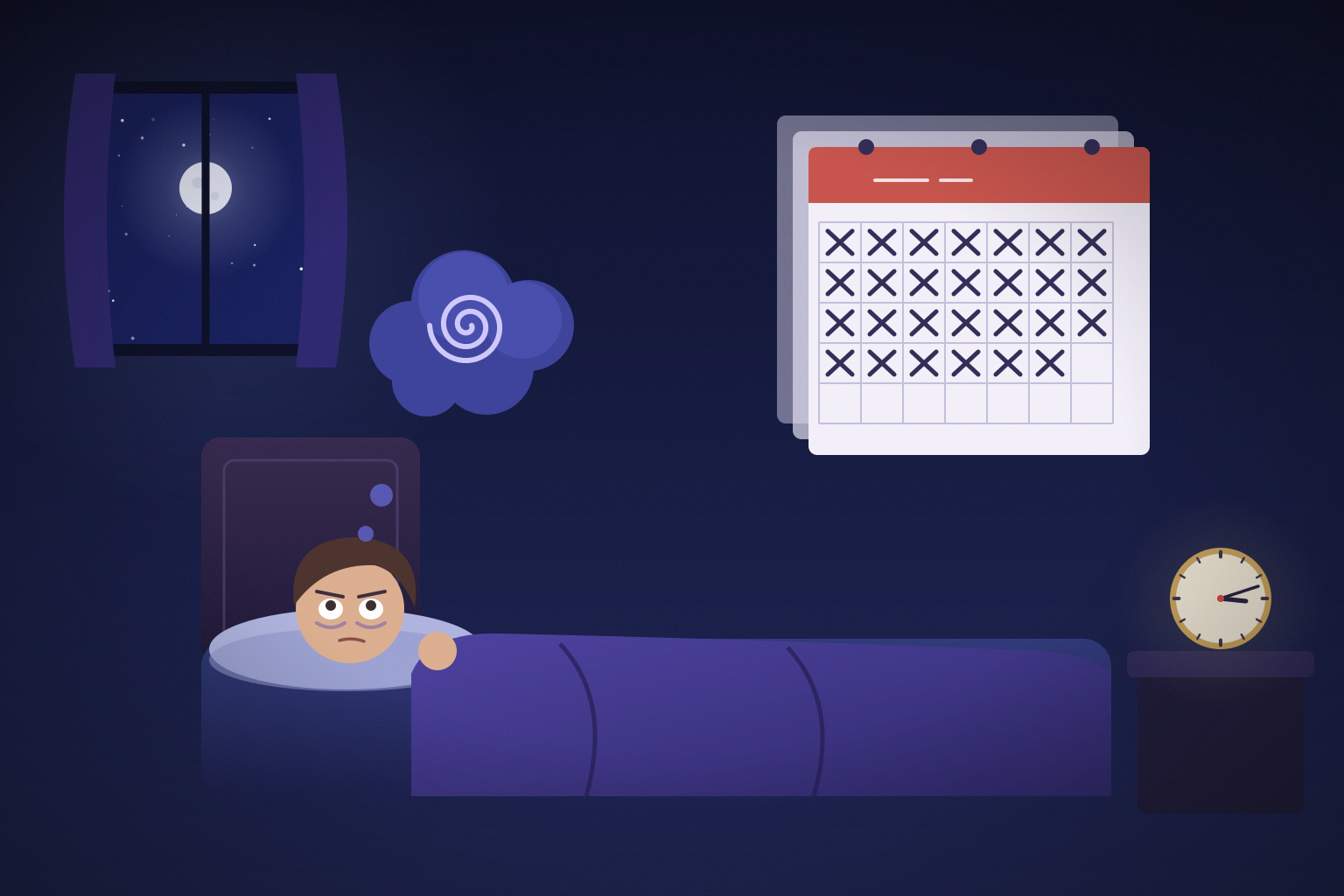
You've been sleeping badly for two weeks. A deadline, a family emergency, a breakup, a move: something made your nights difficult, and you're now lying awake, watching the clock. Is this just a rough patch, or the start of something that won't go away?
The honest answer is that it depends on how long it lasts, and on what keeps it going. Sleep medicine draws a firm line between acute insomnia, which is short-lived and usually tied to a trigger, and chronic insomnia, which persists and tends to take on a life of its own. The line matters because the two respond to different approaches, and treating chronic insomnia like an acute one is one of the most common reasons it never resolves.
The Definitions
The terms follow the same thresholds used across sleep medicine.
Chronic insomnia means difficulty falling asleep, staying asleep, or waking too early, occurring at least three nights a week for at least three months, despite adequate opportunity for sleep, and causing daytime problems such as fatigue, poor concentration, or irritability. It's the definition we use throughout this site, including in our guide on insomnia versus sleep apnea.
Acute (short-term) insomnia is the same set of sleep difficulties lasting less than three months. It often begins with an identifiable stressor and may last days or weeks.
Both involve real sleep difficulty and real daytime impact. The difference is mainly duration and, more importantly, what is sustaining the problem.
Acute Insomnia: Usually a Reaction
Acute insomnia is common and frequently understandable. Typical triggers include:
- Stressful events such as job changes, financial strain, or relationship problems
- Illness, pain, or a hospital stay
- Grief or loss
- Travel, time-zone changes, or a new sleep environment
- Medications, caffeine, or alcohol
- Major life transitions
In many people, acute insomnia resolves once the stressor passes or the person adapts. The nervous system is simply running hot for a while, and sleep follows when things settle. It isn't a sign that anything is permanently wrong.
Chronic Insomnia: A Self-Sustaining Pattern
Chronic insomnia often starts as acute insomnia, but by the time it has lasted months, the original trigger may be long gone. Researchers describe it with a model of three kinds of factors:
- Predisposing factors: the tendencies you bring, such as a tendency toward high arousal, a worrier's temperament, or a family history
- Precipitating factors: the trigger that starts it, such as the stressful event
- Perpetuating factors: the habits and beliefs that keep it going after the trigger has faded
It's the third category that turns a bad week into a bad year. Understandable responses to poor sleep, such as the following, end up locking it in:
- Spending more time in bed hoping to catch up, which weakens the sleep drive and fragments sleep further
- Napping or sleeping in, which erodes sleep pressure for the following night
- Irregular schedules, which blur the body clock
- Lying in bed awake, so the bed becomes a cue for frustration and wakefulness instead of sleep
- Watching the clock and calculating the hours left, which raises arousal
- Dreading bedtime, so that anticipatory anxiety is itself a trigger
- Relying on caffeine and alcohol to manage the day and the night
By then, the insomnia is sustained by learned behaviors and conditioned arousal, not by the original problem. This is exactly why chronic insomnia needs a different kind of treatment from the acute kind.
Side by Side
| Feature | Acute insomnia | Chronic insomnia |
|---|---|---|
| Duration | Less than 3 months | At least 3 nights a week for 3 months or more |
| Typical trigger | An identifiable stressor or change | May have started with one, but persists without it |
| What keeps it going | The trigger itself | Habits, conditioned arousal, and worry about sleep |
| Likely course | Often resolves as the trigger passes | Tends to persist without targeted treatment |
| First step | Address the cause, protect sleep habits, give it time | Structured treatment, with CBT-I as first line |
| Role of medication | Occasionally, for short periods | Not the default; used as an adjunct if at all |
| Evaluation for other causes | Often not needed | Important: sleep apnea, restless legs, mood, and medications |
Treatment of Acute Insomnia
The aim is to get through the difficult period without letting poor habits take hold.
Deal with the source, where you can. A problem you can address, such as a work issue or a stimulating routine, may need attention before sleep improves.
Protect your sleep habits. Keep regular sleep and wake times, get daylight in the morning, limit caffeine and alcohol, and build a calm wind-down routine. Our guide to evidence-based sleep hygiene covers the habits that hold up in research.
Resist the compensating behaviors. The urge to sleep in, nap for hours, or spend extra time in bed is understandable, and it's exactly what lets acute insomnia harden. Stay out of bed when you're not sleepy, and keep your wake time steady.
Don't let worry about sleep take over. A few poor nights are survivable, and catastrophizing about them generates the arousal that keeps you awake.
Medication is sometimes used briefly. A clinician may consider a short course when sleeplessness is badly affecting daytime function and safety, weighing the benefits against side effects. This is a decision for a physician, not something to improvise, and several sleep medications carry real risks. Sedatives can also worsen undiagnosed sleep apnea, a risk we cover in our guide on sleep apnea and mood.
Know when to act. If poor sleep persists after the stressor has passed, or you start to dread bedtime, don't wait for the three-month mark to ask for help.
Treatment of Chronic Insomnia
Chronic insomnia calls for structured treatment aimed at the perpetuating factors. Cognitive Behavioral Therapy for Insomnia (CBT-I) is the recommended first-line treatment, endorsed by major medical organizations, and it's more effective over the long term than sleeping pills because it targets the learned patterns that keep the problem alive.
CBT-I typically combines:
- Sleep restriction, which tightens the time you spend in bed to the time you actually sleep, rebuilding sleep drive
- Stimulus control, which retrains the bed as a cue for sleep
- Cognitive restructuring, which addresses unhelpful beliefs and worries about sleep
- Relaxation training, which reduces arousal
- Sleep hygiene education, as a supporting piece
Our full guide on CBT-I explains how it works, what a course looks like, and how to find a qualified provider. Digital programs and remote visits have expanded access considerably, as our guide on telemedicine for sleep disorders describes.
Medication plays a supporting role. Where medication is used for chronic insomnia, it's generally as an adjunct, with attention to side effects, dependence, and interactions, and not as a long-term default. Several commonly prescribed sleep drugs carry real risks, including complex sleep behaviors, which we describe in our guide on sleepwalking in adults.
Chronic Insomnia Deserves a Wider Look
One reason the distinction matters is that chronic insomnia is rarely just insomnia. A thorough evaluation looks for contributors that CBT-I alone won't fix:
- Sleep apnea. Insomnia and sleep apnea often occur together, and apnea-related awakenings can look like insomnia. Treating only one leaves the other. Our guide on telling insomnia and sleep apnea apart explains how to sort them out
- Restless legs syndrome and periodic limb movements, which delay and fragment sleep. See our guide on restless legs syndrome
- Depression and anxiety, which can cause insomnia and be worsened by it
- Circadian rhythm disorders, in which sleep is normal but mistimed. See our guide on circadian rhythm disorders
- Medications, caffeine, alcohol, and pain
- Hormonal changes, particularly around menopause. See our guide on menopause and sleep
If your problem is mainly waking in the small hours, our guide on waking at 3 AM covers the common causes.
How to Tell Whether Acute Is Turning Chronic
Watch for these signs, which suggest that perpetuating factors have taken over:
- Sleep is still poor weeks after the trigger has passed
- You've started spending more time in bed, napping, or sleeping in to compensate
- You dread bedtime or feel anxious as night approaches
- You watch the clock and calculate remaining sleep
- Your sleep is worse in your own bed than elsewhere
- You're relying on caffeine, alcohol, or sleep aids more and more
- It's happening three or more nights a week and approaching the three-month mark
A sleep diary kept for two weeks, noting bedtime, wake time, how long it takes to fall asleep, and nighttime awakenings, gives you and your clinician useful evidence.
When to Seek Help
- Insomnia has lasted several weeks without improving
- It's affecting your work, mood, relationships, or safety
- You suspect sleep apnea (loud snoring, witnessed breathing pauses, daytime sleepiness)
- You've been using sleep medications regularly
- You're considering stopping or changing a sleep medication
- You'd like a medication-free approach
A physician or a behavioral sleep medicine specialist can evaluate the whole picture and start the right treatment. Our guides on choosing a sleep clinic and board-certified sleep physicians explain what to look for.
The Bottom Line
Acute insomnia is a reaction, usually to a trigger, and it often passes with time and good habits. Chronic insomnia is a pattern, sustained long after the trigger is gone by the very things people do to cope with poor sleep. That's why the first calls for patience and protecting your routine, and the second calls for structured treatment, with CBT-I as the first-line choice and a wider look for other sleep disorders underneath.
The sooner chronic insomnia is recognized as chronic, the sooner it can be treated as what it is.
Struggling with sleep for weeks or months? Find insomnia treatment near you, or use our sleep clinic directory to find an accredited sleep center.
Written by
Daniel Marin
Sharing insights on sleep health and wellness to help you achieve better rest and improved quality of life.