Your partner says you kick all night. Or you wake feeling unrefreshed even though you sleep a full eight hours, and your sleep apnea test came back clear. Or your sleep report arrives with a line that says "PLMS index: 24 per hour" and no explanation of what that means.
Periodic limb movements are one of the most common findings in sleep medicine, and one of the most misunderstood. They show up in many people who have no symptoms at all, and they're associated with several other conditions, so having them is not the same as having a disorder. Understanding how they're measured, and how doctors decide whether they matter, makes sense of what a sleep study is really telling you.
Two Terms That Get Mixed Up
Much of the confusion comes from two similar terms that mean different things.
Periodic limb movements of sleep (PLMS) are a finding: repeated, stereotyped movements of the limbs during sleep, most often the legs, that are recorded during a sleep study. A typical movement involves the big toe extending upward, often with the ankle, knee, and sometimes the hip bending. You usually don't notice them.
Periodic limb movement disorder (PLMD) is a diagnosis: it requires PLMS above a certain frequency and a sleep problem or daytime impairment that the movements are judged to explain, with other causes ruled out.
PLMS are common and often harmless. PLMD is much less common. Online, and sometimes even in clinical conversation, the two get used interchangeably, which is part of why a line on a sleep report can alarm people unnecessarily.
What the Movements Look Like
During a sleep study, PLMS appear as a regular series of leg twitches, often every 20 to 40 seconds, usually in the legs, and most prominent in the lighter stages of non-REM sleep. Many are small, and many don't wake you. Some, however, are accompanied by brief arousals, the short surges of brain activity that fragment sleep without fully waking you. Our guide to the four stages of sleep explains why that fragmentation matters.
Bed partners are often the first to notice, through kicking, twitching, or a restless bed.
How Leg Movements Are Measured
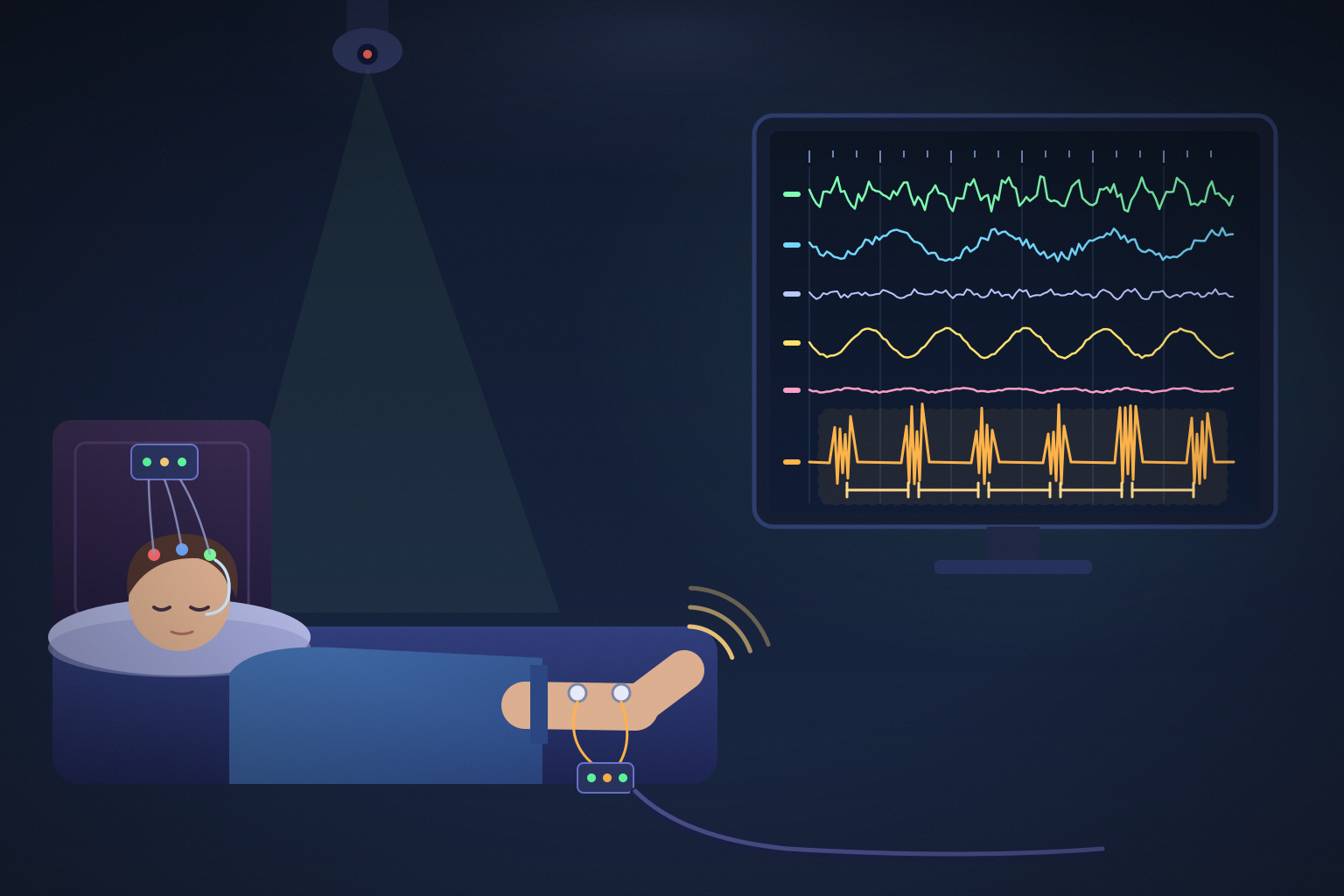
Where they're recorded. In an in-lab polysomnogram, small sensors are taped over the tibialis anterior, the muscle along the front of each shin, to record electrical muscle activity (EMG). Brain waves, eye movements, breathing, oxygen levels, and heart rhythm are recorded at the same time. Our guide on what to expect during a sleep study walks through how the sensors are placed and what the night is like.
How they're scored. A technologist reviews the study and marks leg movements using standardized rules from the American Academy of Sleep Medicine. Under the current scoring approach, a series counts as periodic when it includes at least four consecutive leg movements, each lasting roughly half a second to ten seconds, with intervals of more than 5 and up to 90 seconds between them. The rules have been revised over time, and details differ between versions of the manual.
What the report shows. The key numbers are typically:
- The PLMS index: the number of PLMS per hour of sleep
- The PLM-arousal index: how many of those movements are associated with an arousal from sleep, which is a closer indicator of whether they're actually disrupting sleep
- When they occur, including during which sleep stages
One important adjustment. Leg movements that happen right alongside breathing events can be a reflex to apneas, and are generally not scored as PLMS when better explained by sleep apnea. That's why your sleep apnea status matters so much in interpreting leg movement findings.
What Counts as a Diagnosis
Under the current international classification of sleep disorders, PLMD is diagnosed when all of the following hold:
- PLMS are documented on a polysomnogram
- The frequency is above the threshold: more than 15 per hour in adults (more than 5 per hour in children)
- There is clinically significant sleep disturbance or daytime impairment such as unrefreshing sleep, sleepiness, or fatigue
- The movements and symptoms aren't better explained by another disorder
That last requirement does a lot of work. PLMD is a diagnosis of exclusion, and it generally cannot be diagnosed when restless legs syndrome, narcolepsy, REM sleep behavior disorder, or untreated obstructive sleep apnea is present, since those conditions can account for leg movements on their own. When restless legs syndrome and PLMS coexist, restless legs syndrome takes precedence.
A few other cautions:
- The numerical cutoff is debated. The threshold of 15 per hour in adults has been questioned as somewhat arbitrary, and clinicians weigh the number alongside the person's symptoms
- PLMS increase with age, and a high index in an older adult with no sleep complaints may mean very little
- PLMS are common in people without symptoms. A finding on a report doesn't, by itself, call for treatment
Conditions and Factors Linked to Leg Movements
If leg movements show up on your study, your doctor will look for an explanation. Common associations include:
- Restless legs syndrome. Most people with restless legs syndrome also show PLMS on a sleep study. RLS is diagnosed from symptoms (an urge to move the legs that's worse at rest and in the evening), whereas PLMS are measured. Our guide on restless legs syndrome covers the symptoms and treatment
- Obstructive sleep apnea. Leg movements can accompany breathing events, and in some people become more apparent once apnea is treated. Our guide on sleep apnea symptoms covers the warning signs
- Iron deficiency. Low iron stores are a common, correctable contributor to leg movements
- Medications. Several antidepressants (SSRIs, SNRIs, and tricyclics), among other drugs, can provoke or worsen leg movements. Never stop a medication without your prescriber's guidance
- Other sleep disorders, including narcolepsy and REM sleep behavior disorder. See our guides on narcolepsy and REM sleep behavior disorder
- Kidney disease, nerve problems (neuropathy), and some other medical conditions
- Caffeine and alcohol
The Diagnostic Pathway, Step by Step
1. Symptoms and history. Your doctor asks about unrefreshing sleep, daytime sleepiness, kicking or twitching reported by a partner, restless legs symptoms, snoring and breathing pauses, medications, and caffeine and alcohol use.
2. Blood work. A ferritin level and other iron studies are standard when leg movements are suspected, and kidney function, glucose, and thyroid tests may be added.
3. An in-lab polysomnogram. This is the test that actually measures leg movements. Most home sleep apnea tests don't record leg EMG the way a lab study does, and none record brain waves, so they can't count arousals. Our guide on home tests versus in-lab studies explains the difference.
4. Interpretation in context. A sleep physician reviews the PLMS index, the arousal index, and the whole study, including whether sleep apnea or another condition is present. A number alone doesn't settle the question.
5. Address contributors first. If sleep apnea is present, doctors often treat it first and reassess. If iron is low, replacing it may be the first step. If a medication is the likely cause, the prescriber may adjust it.
6. Reassess if needed. After treating contributors, a repeat study may be considered if symptoms persist.
Treatment
Treatment depends on whether the movements are causing problems.
No symptoms, no treatment. If PLMS are an incidental finding with no sleep or daytime complaints, treatment generally isn't needed.
Treat the contributors. This is the foundation: correct iron deficiency, treat sleep apnea, and review medications and substances that aggravate leg movements.
Medication when symptoms warrant it. For people with troublesome symptoms, specialists sometimes use medications such as gabapentinoids or dopamine-acting drugs, depending on the full picture. The evidence for treating isolated PLMD is thinner than for restless legs syndrome, and dopamine agonists carry a risk of worsening symptoms over time (augmentation) in restless legs syndrome, so these are decisions for a specialist. Sedating medications need particular care if sleep apnea might be present.
Healthy sleep habits. Limiting evening caffeine and alcohol and keeping a regular schedule support better sleep generally. Our guide on evidence-based sleep hygiene covers habits that hold up in research.
Children
In children, the threshold is lower, more than 5 leg movements per hour, and leg movements are sometimes linked to iron deficiency and to sleep-disordered breathing. A child with restless sleep, kicking, daytime sleepiness, or attention and behavior problems deserves a careful evaluation that looks at all of these. See our guide on signs your child may have a sleep disorder.
When to Ask About a Sleep Study
Consider raising it with your doctor if:
- A bed partner regularly reports kicking or twitching
- You wake unrefreshed despite enough time in bed, and a sleep apnea test was clear
- You have symptoms of restless legs syndrome
- You have daytime sleepiness that isn't otherwise explained. See our guides on excessive daytime sleepiness and why you might always be tired
- You've been told your sleep report shows leg movements and you don't know what it means
Choosing the right place matters, since this depends on an in-lab study scored carefully. Our guides on choosing a sleep clinic and why accreditation matters explain what to look for.
The Bottom Line
Periodic limb movements are a measurement, recorded with sensors on the shins during an in-lab sleep study, and counted according to standard rules. Periodic limb movement disorder is a diagnosis that requires a high enough count, real sleep or daytime problems, and the exclusion of other conditions that could explain them, including sleep apnea and restless legs syndrome.
That's why the number on your report is only the start of the conversation. The right question is not "how many movements do I have?" but "are they causing my symptoms, and what's behind them?"
Wondering what your sleep study means, or whether you need one? Find a sleep study near you, or use our sleep clinic directory to find an accredited sleep center.
Written by
Daniel Marin
Sharing insights on sleep health and wellness to help you achieve better rest and improved quality of life.