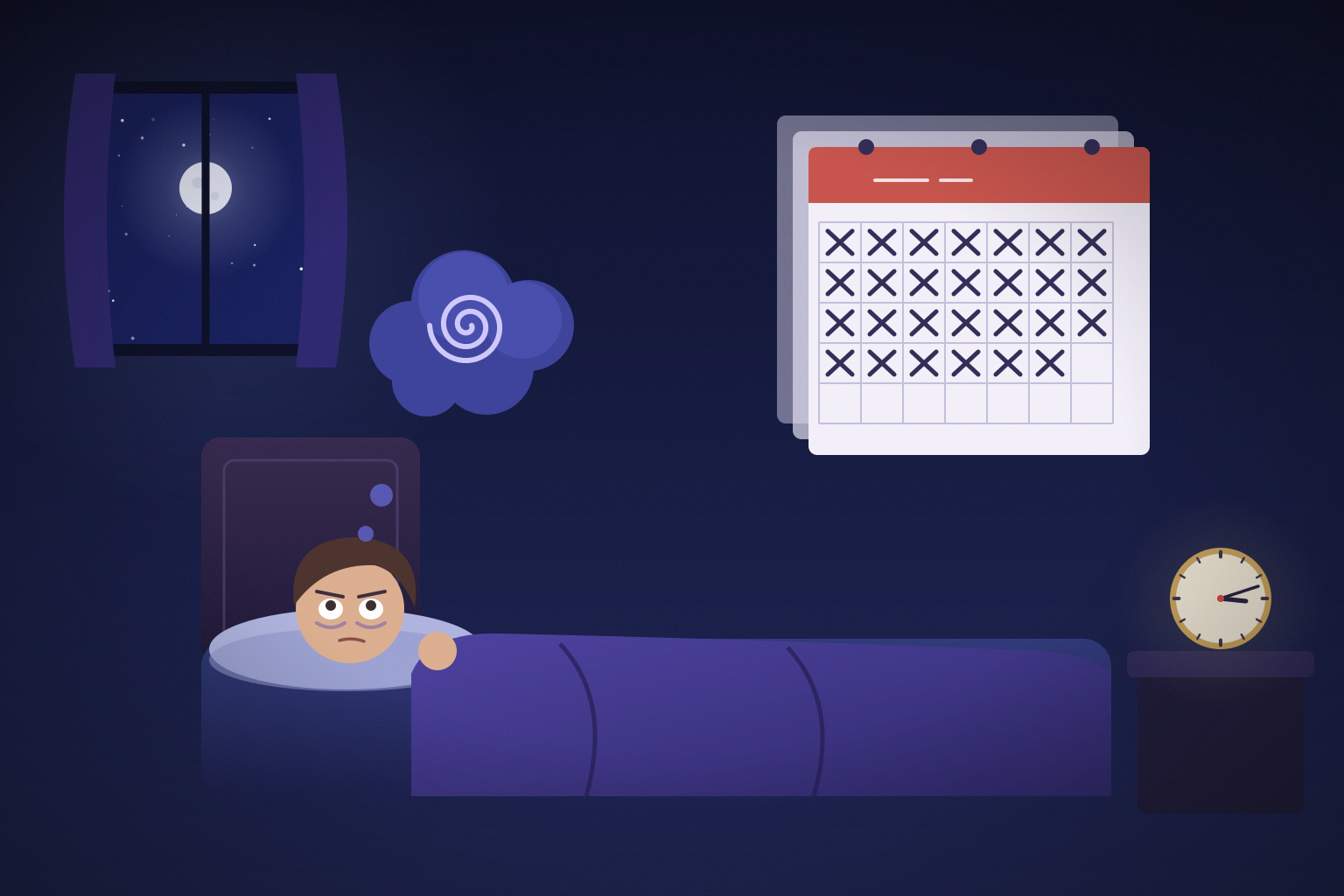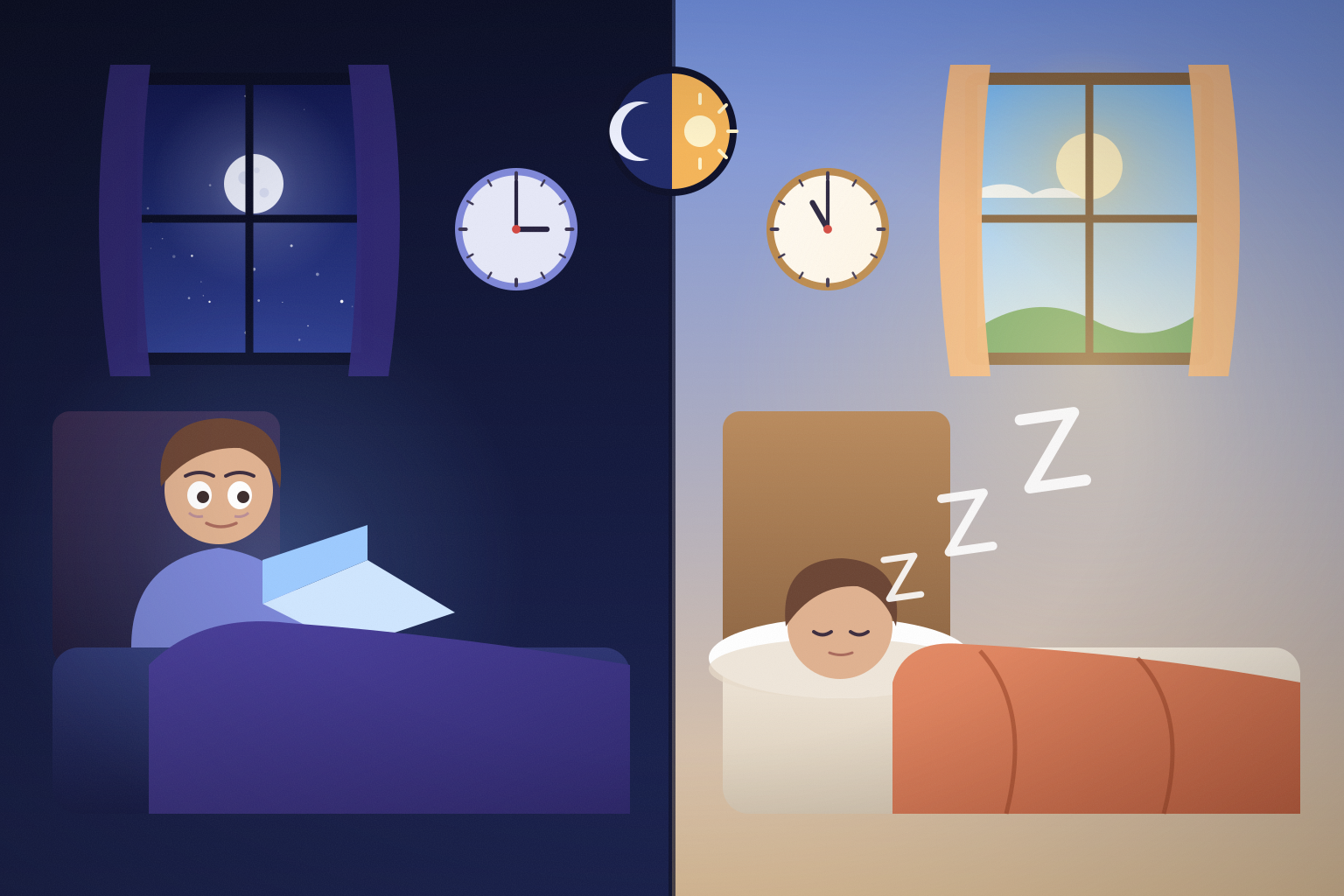
You're exhausted at 10 PM, you go to bed, and you lie awake until 3 or 4 AM. When you finally fall asleep, you sleep well. But the alarm goes off at 7 and you're wrecked for the entire day. On weekends, left alone, you sleep from 4 AM to noon and feel fine. You've tried earlier bedtimes, melatonin, and every sleep-hygiene tip you could find, and none of it holds.
Or perhaps it's the opposite: you're falling asleep at 7:30 PM, awake at 3 AM, and unable to stay up for anything in the evening.
These are not failures of discipline. They're circadian rhythm sleep-wake disorders, conditions in which the body's internal clock runs out of step with the schedule you need to keep. They're easy to misdiagnose as ordinary insomnia, and they respond to a very different kind of treatment.
How the Body Clock Works
Almost every process in your body runs on a roughly 24-hour cycle, and a master clock in the brain keeps those cycles in time. On average, that internal clock runs slightly longer than 24 hours, so it has to be reset every day. Light is the strongest reset signal. Morning light nudges the clock earlier, and evening light nudges it later.
Two things follow from this. First, your clock tells your brain when to feel sleepy and when to feel alert, independent of how long you've been awake. Second, when the clock's timing doesn't match your required schedule, you can't simply choose to sleep at the right time. Our guide to the four stages of sleep and how much sleep you need by age cover the rest of the picture.
The defining feature of a circadian disorder is that sleep itself is normal when it's allowed to happen at the body's preferred time. The quality and amount are fine. The timing is wrong.
The Main Types
Delayed Sleep-Wake Phase Disorder (DSPD)
This is the "night owl" pattern taken to the point where it causes problems. Sleep and wake times sit well later than conventional hours, generally by two hours or more, so falling asleep before the early hours of the morning is nearly impossible and waking for a standard morning is extremely hard.
Key features:
- Cannot fall asleep until very late, even when exhausted
- Sleeps normally, and deeply, once asleep, if allowed to wake late
- Severe difficulty waking for morning obligations
- Chronic sleep loss on school and work days, and long catch-up sleep on days off
- Alertness peaks late in the evening or at night
Who gets it: it's most common in adolescents and young adults. Puberty shifts the body clock later, which is a normal biological change that becomes a disorder in people whose shift is extreme or persistent. Estimates of how common it is vary widely with how it's defined, from well under 2 percent of the general population to several percent of adolescents in some studies.
The usual misdiagnosis: because the main complaint is "I can't fall asleep," it's frequently labeled sleep-onset insomnia. It's also mistaken for depression, ADHD, or simple avoidance of school and work. The clue is that sleep is fine when timing is unrestricted.
Advanced Sleep-Wake Phase Disorder (ASPD)
This is the mirror image. Sleep and wake times sit well earlier than conventional hours, generally by two hours or more. People feel overwhelmingly sleepy in the early evening and wake in the early hours of the morning.
Key features:
- Strong sleepiness in the early evening, often making evening social and work activities difficult
- Waking very early, sometimes before dawn, and being unable to go back to sleep
- Normal sleep quality and amount when sleeping on the preferred early schedule
Who gets it: it's more common in older adults, and some families carry inherited variants in clock genes that produce a strongly advanced rhythm.
The usual misdiagnosis: the early waking looks like insomnia or depression. Waking too early is a recognized feature of depression, so it matters that a clinician looks at the whole pattern rather than just the wake time. Our guides on waking at 3 AM and insomnia versus sleep apnea cover other causes of night and early-morning waking.
Non-24-Hour Sleep-Wake Rhythm Disorder
In Non-24, the body clock isn't reset to the 24-hour day at all. It free-runs on its own slightly-longer-than-24-hour cycle, so sleep and wake times drift later by a bit each day, month after month.
Key features:
- A cycle that moves progressively later, so that bedtime and waking slide around the clock over weeks
- Periods when the clock lines up with the day, followed by periods of severe insomnia at night and sleepiness during the day, as it drifts out of alignment
- A pattern that repeats every several weeks to months
Who gets it: it's common among people who are totally blind, whose eyes can't send the light signal that resets the clock. It's rare in sighted people, where it sometimes appears in those who also have delayed phase disorder or certain neurological or psychiatric conditions.
Treatment note: in 2014 the FDA approved tasimelteon, a drug that acts on melatonin receptors, as the first treatment for Non-24. It was originally developed and approved for use in totally blind people, and the current labeling refers to Non-24 in adults. This is a decision for a sleep specialist, and it isn't a treatment for delayed phase disorder.
Irregular Sleep-Wake Rhythm Disorder
Here there is no consistent main sleep period at all. Sleep is broken into several short bouts spread across the 24 hours. It's seen mainly in people with neurodegenerative conditions such as dementia, and in some children with neurodevelopmental conditions. Management focuses on structure: regular daytime light, activity, and mealtimes, with specialist input.
Shift Work and Jet Lag
Two more circadian disorders are driven by outside circumstances: shift work disorder, in which a work schedule collides with the body clock, and jet lag. Our guide on shift work sleep disorder covers the first in detail.
How These Differ From Insomnia
| Feature | Insomnia | Circadian rhythm disorder |
|---|---|---|
| Core problem | Difficulty sleeping despite the opportunity | Sleep is timed wrongly relative to the schedule |
| Sleep when allowed on preferred schedule | Still poor | Normal in quality and length |
| Weekends and vacations | Often no better | Often much better, if sleep can follow the body's timing |
| Typical pattern | Variable, with racing thoughts and anxiety about sleep | Consistent, predictable shift of the whole sleep period |
| Main treatment | CBT-I | Timing-based treatments |
The distinction matters because the treatments differ. CBT-I is the right treatment for chronic insomnia, but it doesn't correct a body clock that is hours off, and sedating medications taken to force an early bedtime rarely solve a timing problem.
How These Disorders Are Diagnosed
Diagnosis depends mostly on documenting the pattern rather than on a single test.
A detailed history, including your natural sleep and wake times on free days, when the problem began, and how it affects school or work.
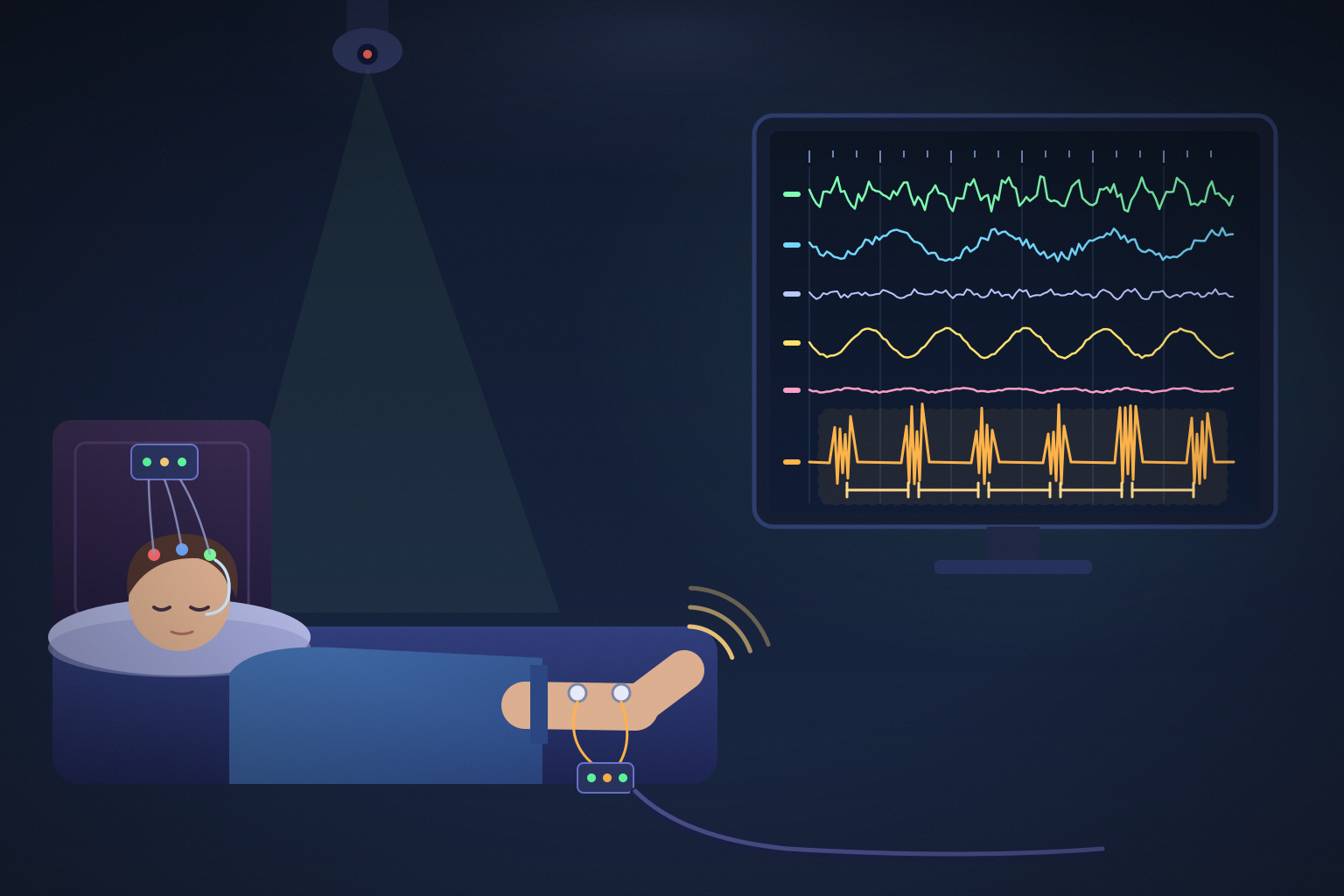
A sleep diary, kept for at least one to two weeks, including days off.
Actigraphy, a wrist-worn motion sensor that tracks rest and activity across days and shows the timing pattern, typically for a week or more.
Ruling out other conditions. Sleep apnea, insomnia, restless legs syndrome, depression, and medication effects can all mimic or accompany a circadian disorder. If another sleep disorder is suspected, an overnight study may be needed. Our guide on home tests versus in-lab studies explains how that decision is made.
Because the diagnosis rests on diaries and actigraphy, much of the evaluation can be done remotely. Our guide on telemedicine for sleep disorders covers what can and can't be done online.
Treatment: The Principles
Treatment of circadian disorders is built on timing, which is exactly why it benefits from specialist guidance. Light and melatonin can shift the clock in either direction depending on when they're used, so the wrong timing can make things worse. The principles below are the outline of what a specialist works with, not a do-it-yourself schedule.
Timed light. Bright light shifts the clock, and the direction depends on timing. Light in the morning moves the clock earlier, which helps a delayed pattern. Light in the evening moves it later, which can help an advanced pattern. Just as important, avoiding bright light at the wrong time protects the gains.
Timed melatonin. Melatonin given at the right time relative to the body clock can shift its timing, and mistimed use can be ineffective or push the clock the wrong way. The right timing is individual, which is a good reason to involve a clinician rather than relying on a bottle label.
A fixed wake time. A consistent wake time, kept even on days off, is the anchor most programs build around.
Gradual shifting. Moving sleep timing in small steps, under guidance, tends to work better than abrupt changes.
Environmental changes. Dimming lights and screens in the hours before the desired bedtime helps people with a delayed rhythm, and getting daylight early in the day reinforces it.
Schedule accommodations. For students, later school start times are a recognized remedy, and the American Academy of Pediatrics has long recommended them. Adults may be able to negotiate work-hour flexibility.
Treat contributing conditions such as sleep apnea, depression, and anxiety.
Our guide to evidence-based sleep hygiene covers the supporting habits, and our guide on sleep debt explains why weekend catch-up sleep isn't a fix.
When to See a Specialist
Consider an evaluation if:
- Your sleep timing has been consistently out of line with your needed schedule for more than a few months
- You've tried regular schedules and sleep hygiene without lasting change
- It's affecting school, work, mood, or relationships
- You're totally blind, or your sleep keeps drifting later day after day
- Your timing runs in your family
- You've been treated for insomnia or depression without improvement
Look for a board-certified sleep physician or a behavioral sleep medicine specialist. Our guides on choosing a sleep clinic and board-certified sleep physicians explain what to look for. Our symptom checklist includes a circadian section you can use to organize what you're experiencing.
The Bottom Line
Circadian rhythm disorders are timing disorders. In delayed phase, the clock runs late; in advanced phase, early; in Non-24, it drifts around the clock; and in irregular rhythm, it breaks into pieces. In each, sleep is normal when it matches the body's own schedule, which separates these conditions from insomnia.
They're real, they're treatable, and they respond to carefully timed light, melatonin, and consistent routines rather than to willpower. Getting the diagnosis right is the first step.
Is your body clock out of step with your life? Use our sleep clinic directory to find an accredited sleep center near you for a proper evaluation.
Written by
Daniel Marin
Sharing insights on sleep health and wellness to help you achieve better rest and improved quality of life.